


Hear What The Scientists Say
Description
This section is from the book "Food And Health: An Elementary Textbook Of Home Making", by Helen Kinne, Anna M. Cooley. Also available from Amazon: Food And Health: An Elementary Textbook Of Home Making.
Hear What The Scientists Say
What does bread contain? Bread made from white flour contains all the stuffs necessary in food.
If you should make a list of what the bread contains and compare this with a list that shows the different foodstuffs2 found in milk, you would find them to be almost the same, but not occurring in the same amounts. The bread contains less mineral matter than milk, and therefore is not quite a perfect food. It has but little water, and a large quantity of something that is not found in the milk; that is, starch. Curiously enough starch and sugar are very much alike; and Mother Nature, who is a wonderful chemist, can change one into the other. Indeed, you may have learned from lessons in physiology or hygiene that when we eat starch it is changed to sugar by the digestive juices before it is absorbed and carried about by the blood. The protein is found in the gluten, which you can easily obtain by tying some flour in a cloth, and washing out the starch.
1 See Foods and Household Management. Kinne-Cooley, Chap. XII.
2 See page 294.

Fig. 25. - A dissected grain of wheat.
Why are so many foodstuffs found in wheat? Is it not interesting that in the grain of wheat the same kinds of materials are stored to feed the baby plant that nature supplies in milk for the young animal, the little plant drinking water from the soil? There is so much of this food in the grain, that it is worth while for man to use it himself as food.
Why is bread a cheap food? The scientists tell us, too, that for ten cents' worth of bread we can have more body-building material and energy than from ten cents' worth of any other kind of food, even of cheese, beef, eggs, milk, potatoes.1 When Miss Travers asked the question at the beginning of this paragraph, Pleasant Valley pupils answered it, after a few minutes' discussion. See if you can answer at least in part. You can buy a heavier weight either of milk at 9 cents per quart or of potatoes at 60 cents a bushel; but the milk gives less energy, and the potatoes less building material, than the bread.
Should we ever buy baker's bread? One of the mothers present asked Miss Travers if it is economical to buy bread. Her answer was : "It depends upon what you are trying to save. In the summer it saves heat in the kitchen, and your time and strength. The bread costs a little more per loaf than when it is made at home."
1 U. S. Department of Agriculture. Farmers' Bulletin 487.
Some one also asked if it were "just as good" as homemade, and Miss Travers replied: "That depends upon the baker, and the bakery laws of the state. It should be good, because the baker has an oven that is better than that in the home stove, but he does not always use good material, and work in a clean place. We must all work together to see that bakery laws are made and enforced, for it is said that about fifty per cent of the bread used in this country comes from the bakery. But there is nothing in the world better than the best home bread. And do you not think every girl should learn to make it?" Everybody said, "Yes," to this question; and the pupils went home, anxious to have a proper bread contest as soon as possible. One pleasant fact about such a contest is that it is possible for all to win, since you compete with a standard for bread, and not with each other.
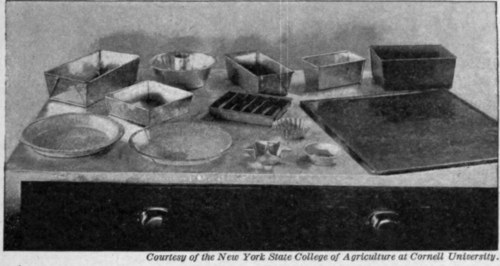
Fig. 26. - Pans for baking bread, cake, and pastry, of tin, iron, and enameled ware.
Exercises And Problems
1. Make a list of the foodstuffs contained in bread; that is, starch, sugar, etc.
2. Explain why bread costs less than milk.
3. Separate the gluten from the rest of the flour, as explained in the text, knead and stretch it.
4. Can you tell what winter wheat is? spring wheat? the difference between them?
Continue to:


My Books

