


Lesson 6. Making Bread How Shall We Make Bread For The Contest?
Description
This section is from the book "Food And Health: An Elementary Textbook Of Home Making", by Helen Kinne, Anna M. Cooley. Also available from Amazon: Food And Health: An Elementary Textbook Of Home Making.
Lesson 6. Making Bread How Shall We Make Bread For The Contest?
What kind of flour shall we buy? In order to make the bread contest exact and fair to all, the loaves should be made from the same kind of flour. Different brands of flour make different kinds of bread, the quality of the flour depending upon the variety of wheat and upon the method of manufacture. Modern flour mills produce an excellent flour.1
A good bread flour is creamy in color, feels grainy to the touch, and contains a large amount of gluten. Spring wheat grown in the northwestern part of United States has more gluten and less starch than winter wheat living in the ground through the winter farther south, and makes a good flour for yeast bread. Some people who are judges of flour, like a mixture of spring and winter wheat flour for bread.
1 Foods and Household Management. Kinne-Cooley, Chapter XII.
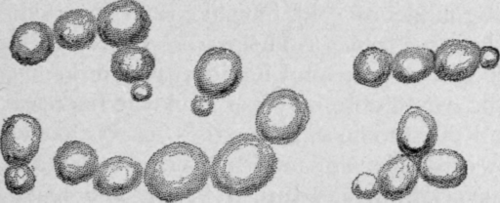
Why is yeast put into bread? Something is needed to make the bread light and porous; yeast is used for this purpose. This is a fact already known to you. People have used yeast for many years in making bread, but it was not until the microscope gave us eyes to see small things, that we could learn what yeast really is and how it works. If you should look at yeast through a powerful microscope, you would see something like this picture (Fig. 27). Even then you would need to be told that this tiny object has life, and that it is a tiny one-celled plant. As new cells develop in the bread, one budding out from another, a gas is formed. This gas, as it expands, makes the bread "rise," as we say. The gas is of the same kind that we breathe out from our lungs; its name is carbon dioxide. Alcohol is also formed. Both the gas and the alcohol pass off in the baking.
Buchanan's Household Bacteriology.
Fig. 27. - One form of yeast seen through a powerful microscope.
What does the yeast need to form new cells? If you stop a moment to recall what all plant life needs for growth, you can decide what these tiny cells want, too, - food, warmth, moisture. The yeast cells find food in the flour and moisture in the liquid mixed with the flour. We must give them warmth.
Now you understand why, in winter time, the bread dough is put in a warm place. The yeast cell is not killed by moderate cold, but, like the trees, it does not bud when it is cold. And the reason why soft, or compressed, yeast cake, and liquid yeast are kept cool, is that the yeast cells may not bud and increase, until we want them to do so. The tiny yeast is like what we usually call a plant in another way. During a drought when everything has turned brown and looks dead, you have seen grass grow green in a few hours after the welcome rain falls again. Thus, will the yeast cell remain dry for a length of time, to bud and increase when moisture is supplied. Does not this explain the dry yeast cake, in which thousands of the tiny cells are mixed with meal, dried and kept ready for use?
Where does yeast come from? The story of the yeast is a very pretty one, and might be used as the subject of a composition in school. If all the liquid yeast and beer, which always contains yeast, should be thrown away, and all the compressed and dried yeast cakes burned, would the yeast cells be lost to us, and could we have no more yeast bread? No, indeed ! We could begin all over again, and set a trap to catch the "wild" yeast cells that are present in the air, clinging to fruit and other things, and growing wherever they have a chance. What would the trap be like? Your mother may have caught the cells already; for when canned fruit or preserves "work," the busy little yeast cell is there, finding just what it needs to make it comfortable, - and it thrives on sugar in small quantities. Have you ever heard of "salt rising" bread, made without adding yeast? Here again the wild yeast was in the flour probably, ready to develop in the dough. It is more convenient, though, to cultivate the cells and to keep them ready to use whenever we wish.
Perhaps your mother keeps liquid yeast on hand. Dry yeast cakes and compressed yeast are useful and convenient, however, and save the trouble of making the liquid yeast.
What else do we put in bread? We use a liquid, - either water or milk, or some of both, - and salt. We sometimes add a little sugar, and some form of fat, - butter or "butterine" or lard, - which makes the bread and crust less tough. Some people dislike the taste of lard in bread. Those who like a moist bread, add a mealy mashed potato.
Dried currants, or raisins, and nut meats make a pleasant variety in bread, especially when it is made of graham flour. Part of the bread dough can have extra fat and sugar put into it, with a little spice and dried fruit, to be baked in biscuit or rolls.
Continue to:


My Books

