


Chapter 5. The Breathing Work Exercises. Part 3
Description
This section is from the book "Reichian Therapy. The Technique, for Home Use", by Jack Willis. Also available as a hardcopy from Amazon.com.
Chapter 5. The Breathing Work Exercises. Part 3
Push Breathing
Best exercise for: GETTING THE CHEST DOWN
This exercise is very tiring, no more than five minutes per work session
normal inhale (belly, chest)
at the start of the exhale (at the same time as the 'ah'
sound) roll the pelvis up
roll with the quadriceps
don't raise the back from the bed
don't spread the legs
keep the pelvis up for the full exhale
when the full exhale is completed, push out the belly then tense your chest muscles to push out all the air from your chest
Important: keep the pelvis rolled up while the belly is out and you are pushing all the air out.
As the 'belly-out-breathe-chest-only' is the big exercise for getting the chest up, so this is the big exercise for getting the chest down. Everyone should be able to do both of these exercises but the belly-out breathe with the chest is the big exercise for people with a long thin chest in chronic exhale and this exercise is the big one for people with a barrel chest in chronic inhale.
This exercise must be done correctly. There are various important reasons why this exercise must be done with caution. Also this exercise can be physically exhausting so another reason not to overdo it.
At this point in the narrative — and much out of order since I will repeat all this in Part Two of the book — I am going to introduce you to the proper way to roll the pelvis. The only reason I am doing this now is that you might as well learn about this here and perhaps start to get it right. But rolling the pelvis is really its own exercise and here it is only that the rolled pelvis is essential (though the rolling technique is not essential here) to this exercise. What that implies is that at this point in your work focus on this push breathing exercise and simply keep in mind that this is not a bad place to also start to learn the proper way to do the roll the pelvis exercise.
Medical Note
As noted in Chapter one (on page 29), this exercise raises the pressure inside the brain cavity (the inter-cranial pressure). This can result in death for those who have a silent aneurism in their brain. If you have had an amphetamine habit, don't do this exercise. Also there is a genetic condition called a "berry aneurism." It is rare, but it is also silent until it ruptures. There is a medical way to test for the presence of a brain aneurism, but you are very unlikely to get any physician to prescribe it absent any present medical indication of its need.
There is also a medical issue if you have elevated blood pressure. Many pharmacies have a free blood pressure test stand that you can use, or you can purchase an automated blood pressure device at the pharmacy. If you have a doctor, then your blood pressure is in your medical records and you can call your doctor's office to get the values.
If you are on medication that is reducing your blood pressure to a normal value, then this exercise should be OK. If you are in doubt, ask your treating physician. Because he might easily misunderstand what you are doing, this exercise IS NOT the same as a valsalva maneuver.
That said, here is the exercise. After a normal breath, at the beginning of the exhale — at the same time you are making the 'ah' sound — you roll the pelvis up. This reads as something quite easy to do. At the start of the exhale, you roll the pelvis up at the same time you are making the 'ah' sound to start the exhale.
There are a bunch of errors that are made with the roll the pelvis part of this exercise. I'll deal here only with the ones important for this exercise and save the complete discussion for
Chapter 18.
Later in this book I will have a section on the issue of control. People who have the character need to control everything find it difficult to do two things at the same time. That is, they find it difficult to make a sound and roll at the same time. Characterlogically they need to make sure that they make the 'ah' sound correctly before they can turn their attention to rolling the pelvis. If you have this issue because of your need to control, simply be aware of the issue and over time as you do the work in this book including this exercise you can gradually overcome that character limitation and you will be able to roll and vocalize at the same time.
One error in the operation of rolling the pelvis is that instead of the pelvis being rolled up, it is jerked up. The motion should be smooth, not jerky. Again this relates to the character issue of control and again will be corrected over time as you do the work.
Now to the three errors that are significant. In one error the whole lower body is raised so that the lower back lifts off the bed. Figure 29 shows before the roll (left) and after a proper roll (right).
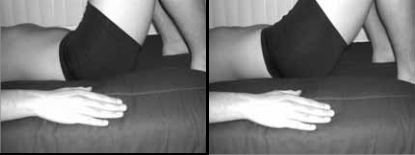
Figure 29
Then Figure 30 shows the back being raised off the bed. In other words, instead of the pelvis being rolled, it is lifted.
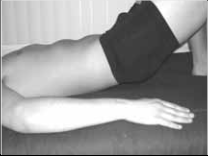
Figure 30
In the second error the legs are separated when the pelvis is rolled. The legs should not spread apart during the roll. This error is shown in Figure 31.
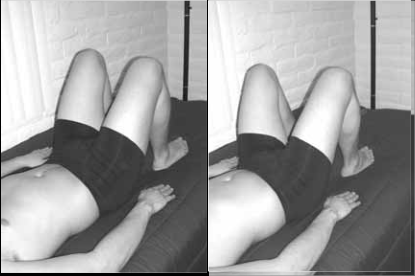
Figure 31
In the third error the pelvis is rolled by tensing the abdominal muscles instead of using the frontal thigh muscles to roll the pelvis. I can't very well illustrate this error with a photograph since the tightening of the abdominal muscles is too slight to show up in a photo. But, again, by placing your hand on the lower abdomen and pressing in slightly during the exercise, you can feel if the muscles tense when you roll the pelvis.
In rolling the pelvis (1) only the pelvis tilts, the lower back does not lift from the bed, (2) the legs do not pull apart and (3) the roll is done at the same time as the exhale begins with the 'ah' sound.
Now the exercise.
At the beginning of the exhale roll the pelvis and keep it up until the exhale is completed. Exhale normally (belly, chest). At the END of the exhale stick out (balloon out) the belly completely and then squeeze out all the air from the chest. I do mean all the air. Keep pushing the air out until it is simply not possible that there is any left. Then lower (not drop) the pelvis and begin the normal inhale.
At the beginning of the exhale roll the pelvis and keep it up until the exhale is completed.
In doing the push there are two common errors you want to try to avoid. The first error is that the belly is ballooned out almost immediately instead of only at the very end of the normal exhale. In learning this exercise, just practice the issue that the exhale is normal (belly then chest) until the normal end of the exhale and it is only at the end that the belly is expanded or ballooned out and the rest of the air pushed out.
The other error is that as the chest is tensed in the attempt to push out all the air, the upper abdomen is also tensed. You can feel if you do that by using your hand resting on the abdomen (Figure 28 on page 93). You should not feel any movement and you should not feel any tensing of the muscle. If you do have this habit, it is hard to break and will simply take a lot of practice.
One thing NOT to do in this exercise is to let the session continue on too long. Since you are learning to use the muscles between the ribs and that alone is tiring, the more you do this exercise the more you will tire and have a tendency to return to tensing the abdominal muscle. So keep the exercise going only as long as you can do the push exhale without tensing the abdomen. Then come back to it on the next learning session.
The first time you may do only a few breaths before you tire so much that you start to tense the abdomen. OK, then stop until the next session. Life is a process, not a test of stupidity (that is, a test of endurance).
That's all there is to it. Sound simple? Wait till you try to do it. It is hard and tiring. If you have a held high chest, you need this exercise to get it down. Even if you have a properly mobile chest this exercise will be useful to increase the mobility in your chest.
1. Start with a normal inhale
2. At the start of the exhale,
a. make the normal 'ah' sound and
b. roll the pelvis
3. keep the pelvis up for the whole exhale
4. AT THE END of the exhale, stick out the belly and
5. push all the air out of your chest
Continue to:


My Books

