


Blow-Off Valves
Description
This section is from the "Blast Furnace Construction In America" book, by J. E. Johnson, Jr.. Also see Amazon: Blast Furnace Construction In America.
Blow-Off Valves
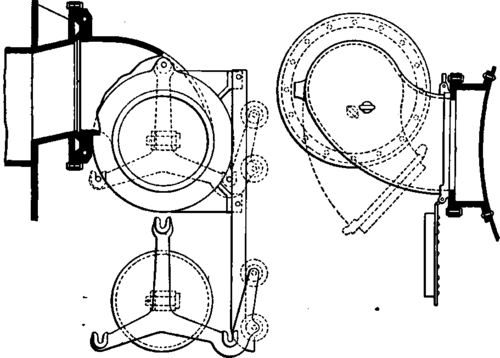
In addition to the valves above described, there is also an air blow-off valve provided, the function of which is to blow off air left in the stove when it is taken off the furnace, since, of course, the stove must retain the furnace pressure after its outlet valve is closed. This blow-off valve is placed close to the bottom and is sometimes arranged to open quickly with a lever instead of with a screw, so that as violent a current of air as possible will blow out through it and thereby carry as much dirt as it can from the passages around the base of the stove.
The construction of this valve as used in the McClure stove is shown by Fig. 160 (page 222). It will be seen that the elbow in which the valve is mounted is arranged to swing as a whole so that this opening serves as a cleaning door as well as a blow-off.
Stove Castings
In former times the reinforcing rings around doors, valves, burner openings, etc., were made of cast iron, but the liability of cast iron to crack when subjected to expansion and contraction stresses, and the enormous difficulty of getting at the rivets holding these to place after the stoves are bricked up has brought about the adoption of steel castings for these fittings in all good modern practice. These are somewhat more expensive in first cost but the failure of a single cast-iron fitting after the stove was in operation would involve a loss several times greater than the whole difference in cost between cast-iron and steel fittings.
Figs. 158, 159. Stenbakken chimney valve.
Packing
It is almost unnecessary to remark that as the steel shell of the stove is exposed to the air and protected by heavy brickwork, it remains comparatively cool while the bricks are heated far beyond the red heat. Therefore, the brickwork expands several times more than the shell.
It is also characteristic of brickwork that while it expands when subjected to heat it tends not to contract to the same amount, and therefore is subject to a small but permanent growth. For this reason the shell of a stove must be considerably larger than the outside diameter of the brickwork, and in order to exert a certain amount of pressure against the bricks and keep them to place this space must be filled with some yielding material. Some constructors prefer to use for this purpose pumice-cinder, others clay, and others again a mixture of these materials.
A similar provision must be made for the vertical expansion of the brickwork and the brick dome of the stove must be left many inches below the shell when the stove is lined. There is not the same necessity for packing material in this space as gravity tends to hold the dome to place, and this space may, therefore, be left open without detriment. During recent years much attention has been paid to radiation losses and means for preventing them. Infusorial silica has been suggested as an insulator and should be an ideal one both on account of its tremendous insulating power and its ability to reduce its bulk under pressure.

Fig. 160. Blow-off valve.
Continue to:


My Books

