


31. Hoisting Towers
Description
This section is from the "Safety In Building Construction" book, by The Travelers Insurance Company Hartford, Connecticut. Also see Amazon: Safety In Building Construction.
31. Hoisting Towers
Under some conditions it is not practicable to install material hoists inside the building, and at some convenient point adjacent to the building a separate, tower-like structure is erected, in which a platform hoist is installed. In many cases where the operations are of considerable size, these towers are erected in duplicate, as shown in Fig. 36. Towers of this kind must be constructed so that they will have the necessary strength and stiffness to sustain all the various stresses to which they may be subjected. Such towers should be built of sound material, and should be designed and erected with careful regard to the maximum loads they may have to carry. They should be strongly cross-braced and strutted, and should have exceedingly firm and solid foundations. Great care should also be taken to see that they are made secure against overturning in any direction. With this in view, they should be safely guyed, or strongly anchored to the building itself, or fixed solidly in some other effective way. When used in connection with a high building, they should not be run up to the ultimate height at the outset, because if this is done the problem of keeping them safely in position is often serious, until the framework of the building has risen to a considerable elevation. In such cases it is better to limit the hoist-towers, at first, to an altitude that will suffice for immediate needs, and to extend them upward when the work has proceeded far enough to make it feasible to provide a safe support by bracing their lower parts to the framework of the building. Care should be taken to have all towers of this kind truly straight and vertical, so that the uprights that sustain the loads will not be exposed to bending stresses, and so that the guys or other supports that are provided will not be subjected to stresses of unnecessary severity. In Fig. 36, which shows a pair of material hoists of the kind here under consideration, it will be particularly noticed that the two towers are fastened together in several places, both by horizontal stringers and by diagonal braces. They are also secured to the building at three different heights, by beams that pass in through the window openings in such a manner that they will not interfere with the progress of the work.
Hoistways of this kind are often sheathed with boards, and where this is done it is best to cover them on the inside, because a smoother surface is thereby presented to the moving material, and loads are less likely to catch against projections in the hoistways. Long pieces of material, when placed endwise on the cage or platform of a hoist, sometimes give serious trouble in this way; and boxes and other objects that are placed too near the edge of the platform often become displaced so that they catch on the framework of the hoistway. The method of sheathing here recommended is seldom followed in practice, the sheathing being usually put on the outside of the framework. There is apparently no good reason for doing this, however, except that the hoistway looks a little better from the outside, and that it is somewhat easier to handle the sheathing in putting it on. Aside from the small amount of extra work that may be required in the construction, the only objection that can be offered against placing the sheathing on the inside, as we recommend, is that by so doing it becomes necessary to have the hoistway two or three inches larger, each way.
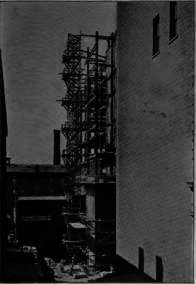
Fig. 35. An- External Material Hoist.

Fig. 36. A Pair Of Well-constructed Material Hoists.
Hoisting towers often have platforms at different levels upon which men must stand or work. All platforms of this kind should be ample in size, and they should be closely planked over, and provided with guard-rails, foot-boards, and netting. Safe means of access to these platforms should also be provided. Stairways are greatly to be preferred for this purpose, although runways or ladders may also be satisfactory if they are properly constructed, guarded, and secured. (See also paragraph 61).
32. Passenger Hoists
In all buildings in which permanent passenger elevators are to be installed, special hoists should be provided as soon as possible, for the use of the workmen in the building. This will tend to prevent the workmen from riding on material hoists, and will also save considerable time that would otherwise be spent by the men in climbing ladders and stairs to reach their work. The number of stories to which the construction may advantageously be carried before passenger hoists are installed will depend largely upon the height that the finished building is to have. There should be no difficulty in deciding this point in any given case.
A regular operator should be provided for each passenger hoist, and an adequate and effective signaling system should be installed. The maximum number of persons that may safely ride on a hoist should be determined in each case and specified upon a sign posted conspicuously in the cage; and no greater number than this specified limit should be permitted to step into the cage, under any circumstances. (See Fig.37).
Dangerous crowding and jostling about the entrance to the hoist at quitting time may be prevented by making the entrance to the cage so narrow that only one man can be admitted at a time, and by requiring the men to form in a single line and wait their turn. This scheme has been carried out successfully in more than one instance.
Except on the sides used for entrance, the cages of all passenger hoists should be completely inclosed to a height of at least six feet, and preferably up to the level of the crossheads; and they should also be covered over on top. The hoistways should also be inclosed, and gates should be installed at the entrances on each floor.
Every hoist should also have an effective safety device that will prevent the cage from falling in case the cable or any other essential part of the mechanism should break.

Fig. 37. Showing how to Prevent Dangerous Crowding at an Elevator Entrance.

Fig. 38. Lined Up to Enter the Elevator.
[This method proved effective in handling the workmen safely and quickly at rush hours. See also Fig. 37).

Fig. 39. As Approved Method for Protecting a Passenger Hoist Shaftway.
Continue to:


My Books

