


Water Closets In General. Continued
Description
This section is from the book "House Drainage And Sanitary Plumbing", by William Paul Gerhard. Also available from Amazon: House Drainage and Sanitary Plumbing.
Water Closets In General. Continued
The mode of flushing a water closet from the main supply pipe of the house is decidedly objectionable, especially with closets located in upper stories of city houses. If water is drawn from a faucet in the basement the pressure is often reduced so much as to create a slight vacuum in the upper part of the pipe. If the valve of a water closet happens to be opened at such times, air, if not foul matter, rushes into the pipe from the bowl. Thus the purity of the drinking water is endangered, while the closet remains without a flush. This risk can be partially avoided by the use of a check valve on the supply pipe to the closet valve. Such check valves, however, are not reliable and often fail to shut properly.
Water closets should be flushed from cisterns, never directly from the main supply pipe. But cisterns intended for storage of water to be drawn for drinking and cooking purposes should not be used for flushing water closets. In all cases the use of a special cistern for each closet or for a group of closets is recommended. Such water closet cisterns are manufactured in great variety by almost all water closet makers.
They are supplied with water either from the rising main or the large tank in the attic, by ball-cocks, made sufficiently strong to withstand the maximum press-ure of water. In their simplest form cisterns have only one compartment, with a pipe attached to their bottom, leading to the closet, and with a valve closing this outlet of cistern, operated by a chain and lever. An overflow pipe is provided to prevent accidents through leakage of the ball-cock. Such tanks are only adapted for hopper closets, and should not be used where water is scarce, as with them a large waste is likely to occur.
Closets, holding water in the bowl (pan, valve, plunger and washout closets) require an "after flush" to refill the bowl, and the cisterns should be provided for such purpose, with a service box, holding a certain quantity of water. The outlet from the cistern to the service-box must be closed by a large sized valve in order to secure a quick filling of the service-box.
Cisterns, arranged with a view to prevent the waste of water, are desirable wherever the water supply is apt to become scanty during the hottest and coldest months of the year. They have, in this case, three compartments, a large tank, supplied by a ball-cock, a measuring cistern, holding the quantity of water fixed for each flush, and a service-box for the after flush.
Water waste preventers for hoppers, however, require only two compartments, the receiving tank and the measuring cistern.
Water closet cisterns are operated either by the common pull-up arrangement, a handle being connected to one end of a lever, the fulcrum of which is firmly secured to the floor, while the other end of the lever is connected by a brass safety chain to the lever operating the cistern valve. Such an arrangement is common for pan, valve and plunger closets. Or else the lever and valve is operated directly by a chain, with tassel or ebony handle, which arrangement seems best adapted to hoppers and washout closets (and slop sinks).
An automatic "seat arrangement," in other words, the operating of the cistern by a depression of the seat through the weight of the person, seems most suitable for public places, schools, factories, etc, where people using the closet are apt to forget to attend to the flushing. With the seat arrangement cisterns with double compartments and double valves must be used. A service-box is attached to the cistern for closets requiring an after flush. The depression of the water closet seat opens the valve from cistern to measuring box, which quickly fills up; relieving the seat of its weight causes the valve to close, and the outlet of measuring box to be opened, allowing the contents of the latter to rush into the water closet bowl. As the valve closing the outlet of the measuring box is of large size (generally 4 inches) the water rushes into the service box quicker than it passes out through the 1 1/4 or 1 1/2 inch supply pipe, thus securing to the bowl the after wash.
The annoyance frequently caused by the leakage of such cistern valves has led to the invention of other forms of water closet cisterns. Many of these are made to empty by siphons, such as Bean's flushing cistern, Purnell's patent siphon water waste preventer, Emanuel's double siphon water waste preventer, Braith-waite's siphon cistern, Brazier's cistern and others.
Bean's flushing cistern, lately introduced into this country, is very simple and efficient in its action. It contains an annular siphon, very much like Rogers Field's siphon. The inner limb (usually of cast iron) is firmly fastened in the center of the cistern, passing through its bottom, where it is connected with the supply pipe to the closet bowl. The outer limb, made of copper, with a dome head, allows of a vertical movement around the inner limb, this movement being effected by a lever, working in a slot, one end of which is attached to the outer limb of siphon, while the other carries at its end a counterweight. A chain is attached to that extreme end of the lever holding the siphon, and the cistern is operated by a handle attached to the chain. By suddenly pulling downward the copper limb of siphon, water is forced over the top of inner limb and the siphon started at once. The outer limb is held down by the suction until all water is discharged, when the counterweight brings the siphon into its original position. The tank is supplied with water by a ball-cock, rising with the water; the inner limb serves as overflow pipe and renders a special pipe for that purpose unnecessary.
Bean's tank provided with an 1 1/4 to 1 1/2 inch pipe to the closet bowl is well adapted to flush earthenware flushing rim hoppers and slop sinks.
The double-siphon water waste preventer of Emanuel, London, is a cistern having two compartments, and a siphon of bent pipe, the shorter end of which opens near the bottom of the first compartment, while its large limb is carried to the closet bowl. The other compartment contains a smaller siphon pipe, the shorter limb of which opens into it. while the long limb is connected to the longer limb of the large siphon. Both siphons are started by forcing down a disc in the first named compartment connected to the lever, operated by chain and handle. This action forces water into the larger siphon, which quickly discharges the water contained in one compartment while the second siphon delivers as an "after flash " the water of the other compartment.
Purnell's water waste preventer is a plain cistern, provided with a common siphon pipe, the longer limb of which passes through the bottom of cistern and leads to the water closet bowl. Near the bottom of cistern a branch pipe leads into the longer limb, reaching to within a few inches from the level of water in the cistern, where it is closed by a valve. This valve is attached to one end of a lever, the other end of which is operated by a chain with handle attached. To flush the closet, the chain is pulled, opening the valve, and thus water flows through the connection pipe into the longer limb of siphon, causing a partial vacuum, which starts its action. The siphon continues to discharge until the contents of the cistern are withdrawn, when it completely breaks. This eastern and Beau's do not give (in their usual shape) an after flush, and are consequently only suitable for hopper closets, slop sinks or urinals.
Bean's tank, however. can be modified to give this after wash, where desired.
Among automatic arrangements for flushing water closets I mention flush tanks, working on the principle of the siphon, or tanks working by gravity. They are useful in railroad depots, schools, large factories, places of amusement, and in exposed localities, where standing water would be apt to freeze. Such tanks collect a continuous driblet from the supply cock until rilled, their capacity being proportioned to the number of closets, and then discharge the full contents at once into the bowl (see chapter on flushing appliances).
The question of ventilation of water closets will be referred to later in speaking of the general arrangement of water closet apartments.
A properly trapped water closet, provided with a good flush from a special cistern, with a flashing-rim bowl of improved shape, located in a well ventilated apartment, judiciously used and well taken care of, should be inoffensive to sight or smell.
Bearing in mind the general principles just stated, we will now examine the various types of water closets. There are six distinct classes viz.: pan closets, value closets, plunger closets, hopper closets, washout closets and trough closets {latrines).
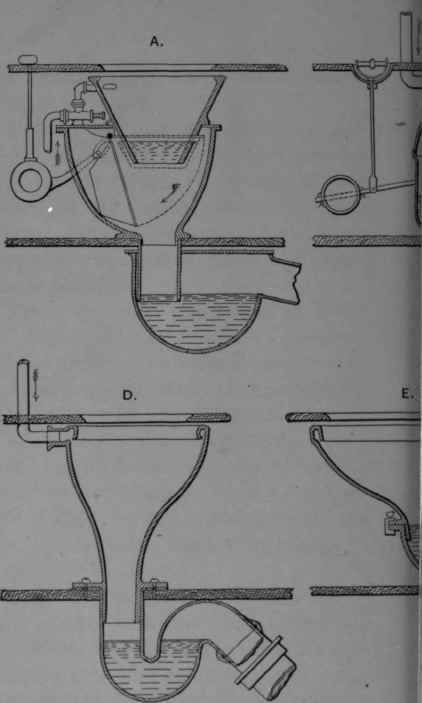
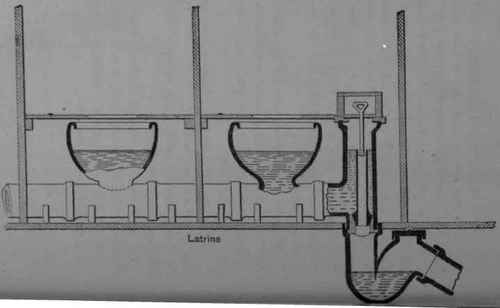
These types are illustrated in Fig. 4 and Fig. 5. The closets shown, however, are not intended to illustrate any manufacturer's special make; they merely represent the various types of closets.
A shows the pan closet, flashed by a valve, supplied directly from the rising main, its bowl being closed by a pan, held in place by the counterweight, the closet outlet being trapped by a large D-trap under the floor.
B is an illustration of a valve closet, with cistern flush, the bowl having improved flashing rim and a special trapped overflow pipe, and being closed by a flap valve held in place by the counterweight; the container is provided with an escape pipe for foul gases, and the S-trap under the floor has a vent pipe attached to pre-thnt the loss of its water by siphonage.
Tvpes C
A Pan closet. B Valve closet. C Pit D Lo

C is a plunger closet with improved flushing rim bowl, supplied with water from a cistern, the outlet of the closet being on one side and closed by a plunger working in a chamber and to be operated by knob and pull. The trap is above the floor and provided with a hub to attach a vent pipe.
While these three closets are operated by more or less complicated machinery, the three following types are free from any movable parts.
D is a long flushing rim hopper having an S-trap under the floor.
E is a short flushing rim hopper with S-trap above the floor.
F is a washout closet, holding water in the basin, which also serves as a trap.
Fig. 5 shows the general characteristics of a trough closet (latrine).
Fig.8
Continue to:


My Books

