


Estimating Labor
Description
This section is from the book "Plumbing Estimates And Contracts", by J. J. Cosgrove. Also available from Amazon: Plumbing estimates and contracts.
Estimating Labor
In the estimating of plumbing work the one uncertain item of expense is the labor. This is due to two causes. In the first place, all workmen are not equally good designers, and those who do not plan the work far enough ahead are liable to so complicate the installation as to necessitate from 10 to 20 per cent. extra labor and material. This difference between the efficiency of men can be equalized, however, by carefully preparing working drawings for work where there are no detail drawings furnished with the plans. By this practice all workmen in the shop are put upon the same footing, and better, as well as more economical, results will be obtained. But even when working on exactly the same kind of work, some workmen accomplish more than others and do it with such ease that it shows they belong in a higher class. Indeed the difference in quantity of work is not confined to individuals, but is true of shops. Some contractors employ only the best of workmen, to whom they often pay more than the prevailing rate of wages, while others are contented with whatever men they can get, so long as they will work for, or below, the prevailing scale of wages. It follows, therefore, that there is an average day's work of all the workmen engaged in the business, and that there is an average day's work for the workmen in each shop. To the careful estimator, the average day's work for the craft is of little use. He wants to know the capacity and limitations of the workmen in his own shop, as that is what he must be guided by. In every shop there are swift workmen and slow workmen, and in basing his estimate he must not accept as a standard of quantity what can be performed by the fastest workers in his employ. If he does the item of labor will show a deficit when the contract is completed, for all of his workmen will not live up to his calculations. On the other hand, the output of the slowest workmen must not be taken as a standard. If it is, too much labor will be allowed for, and the bid might be too high to secure the contract. The only safe way is to figure out what the average output of the men might be and use that as a basis for calculating the labor.
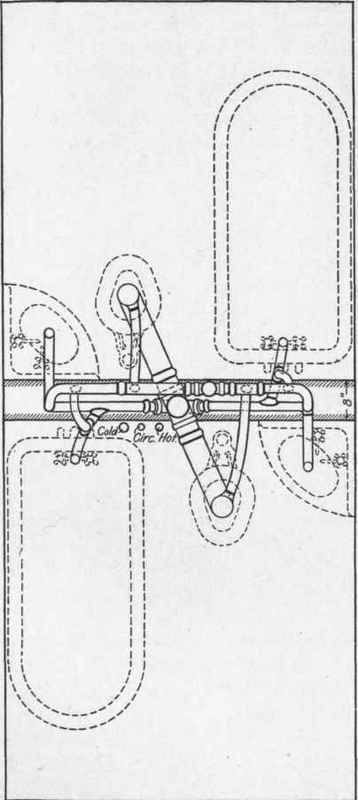
Fig. 32.
When a contractor first starts in business, and before he has secured work and organized a working force, he must have some basis on which to calculate the cost of labor. For the benefit of such individuals, as well as for whatever other good it may do, the approximate amount of work of various kinds which can be performed by the average workman, together with ways of checking the estimate, will be given.
In running cast-iron soil pipe in the ground, where the trenches are dry, no measurements to be taken, pipe to be cut or fittings to be inserted, an average workman should be able to calk 24 joints of 6-inch pipe, which would be equal to 120 lineal feet. If running 5-inch pipe he should be able to calk 140 lineal feet, and if small pipe, 160 lineal feet. Where, however, measurements must be taken, the building prepared to receive the pipe which must be cut and calked, 12 joints of 6 inch, 15 joints of 5 inch, 18 joints of 4 inch, 20 joints of 3 inch or 22 joints of 2 inch would be about an average day's work. That allowance should be sufficient, even when the pipes are to be run under ceilings, or placed in any other part of a building where the work would be considered difficult of access. In tall buildings, where companion stacks of soil and vent pipe are extended from the cellar to the roof, the plumber and his helper should be able to carry a 5-inch soil stack and 3-inch vent stack two stories in height each day.
It might be well to state that in the foregoing allowances it was assumed that the journeyman had for an assistant an apprentice or helper.
The amount of wrought pipe that can be handled should be judged in each case from the layout of the work, and the amount of cutting and fitting required. It is obvious that the quantity of work in the line which represents a day's labor cannot be stated in feet, because in some parts of the installation 40 or 50 pieces of pipe might have to be cut and fitted to use up only about 30 feet of pipe, while in other cases hundreds of feet of pipe might be installed without cutting half a dozen threads. When the pipe is fairly easy to install all in full length and with but few fittings, such as pump pipes and overflow pipes, 100 feet of 2 1/2 and 3-inch pipe would be a fair day's work, and 80 feet of 4 and 5-inch pipe, or 60 feet of 6 to 8-inch pipe would likewise be considered a good day's work.
In work such as the usual labor of installing wrought-pipe drainage systems, where the large sizes of pipe are cut by a machine, the measuring and installing of 12 pieces of 4-inch, 4 1/2-inch, 5-inch or 6-inch pipe would be a fair day's work. Fourteen pieces of 3-inch or 3 1/2-inch; 18 pieces of 2-inch, measured, cut, threaded and installed, or 24 pieces of 1 1/4 or 1 1/2-inch, measured, cut, threaded and installed, would constitute a fair day's work.
In the running of water-supply and drip pipes 32 pieces of 3/4-inch or 1-inch pipe, measured, cut, threaded and installed, would be a fair day's work, while one-half of that amount, or 16 pieces, would represent a fair day's work installing the same size of polished brass or nickel-plated brass pipes. For 3/8-inch or 1/2-inch pipe 48 pieces would not be a large day's work for wrought iron, while one-half that amount of brass or nickel-plated brass pipes could be installed.
When estimating the labor roughing-in lead work, 8 wiped joints are generally considered a day's work. By referring to Fig. 25, which shows the roughing-in for a bath room, it will be observed that there are 8 wiped joints on the lead pipes, and that amount of work would be considered an average day's work As a matter of fact, a good workman would rough-in the lead work of two such rooms in one day.
Referring to the same figure, it will be further noted that the vent connections for all the fixtures are installed and all that will be necessary to connect the basin to the drainage system will be 2 wiped joints, while the bath tub will require but one. It may be assumed, therefore, that the three fixtures in the bath room can be set and connected up complete with water supply in one day, It is assumed that the rising lines of water supply are already installed and outlets left in each room.
If, instead of roughing-in the lead work as shown in the illustration, the stacks were run and short pieces of lead pipe extended through the plaster so the lead roughing would have to be done at the time the fixtures were set, the three fixtures could not be set in one day and more time would have to be allowed for roughing-in and finishing the bath room.
Continue to:


My Books

