


Use Of Special Fittings
Description
This section is from the book "Plumbing Estimates And Contracts", by J. J. Cosgrove. Also available from Amazon: Plumbing estimates and contracts.
Use Of Special Fittings
In this sense the word "special" is used not to designate fittings which are made to order, but such stock fittings as are seldom used in practice. An examination of the fittings listed in plumbing catalogues will show that there are many kinds of fittings made which the average plumber never sees in his experience as a journeyman. The estimator, however, should familiarize himself with the various fittings, so as to have stored in his memory the various specials he can call upon to help lay out the work economically. A few examples of special fittings and their uses will help to make the meaning clear. The ordinary TY fitting, such as is used for water-closet outlets at the various floors of a building, are about 12 inches long from the center of outlet to end of fittings, and soil pipe is 5 feet long from the inside of hub to the end of pipe. If, therefore, a building to be roughed-in has 10-foot ceilings and 12-inch joists, as shown in Fig. 8, two lengths of pipe and the necessary fittings will just reach from floor to floor, so as to bring the outlets at their respective heights. If, however, the ceilings were over 10 feet in height, two lengths of pipe and an ordinary TY fitting would not be long enough, and under such conditions a short piece of pipe is usually cut from a double-hub length to piece out the pipe and bring the outlets to their proper levels. The careful estimator, however, who is posted as to special fittings, knows a trick worth two of that. Instead of cutting a length of pipe for the soil and vent stacks at the various floors, he uses long TY branches for the soil and waste pipes, and long T branches, to bring the waste and vent outlets to their proper heights. By this means he saves the extra lead, oakum and labor required to cut and insert a short piece of pipe, eliminates two joints at each floor, thus reducing the possible cost of repairing leaky joints when the test is applied, and the extra length of fitting costs no more than an equal length of soil pipe. In the case of a 5-inch soil stack and accompanying 3-inch vent stack the lead required would be 8 pounds, which at 4 cents per pound would cost 32 cents. Add to this the cost of oakum and gasoline, together with the labor of cutting pipe and making the joints, which would average over an hour, at, say, 65 cents per hour for plumber and helper, and one dollar per floor can be figured as saved on each double line of stacks. In many tall buildings there are a number of stacks, and if, for example, a building having eight such floors be assumed, and twelve double lines of pipe extending from the cellar to roof, there would be a saving of 8 x 12=$96 approximately in just this one item of cost.
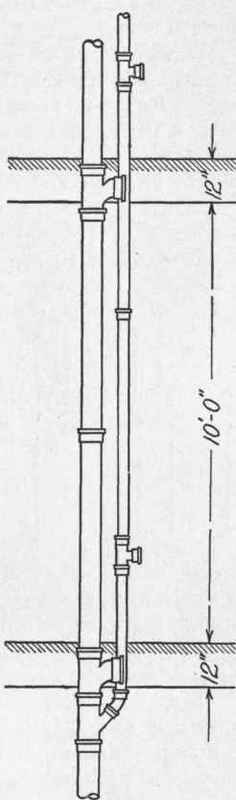
Fig. 8.
It was stated, when explaining how to take off quantities from plans, that fittings in the groundwork should be measured as soil pipe. That is true, for, besides the reasons stated, the work cannot be laid out on plan so as to show exactly the way the lengths will be disposed, and some allowance must be made for changes. If the work could be laid out accurately, the same as for rising lines, the exact amount of pipe required would be ascertained and estimated upon.
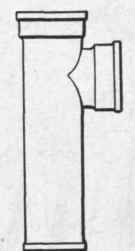
Fig. 9.
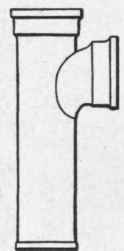
Fig. 10
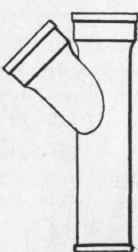
Fig. 11
That is what the careful estimator would do with rising lines when he can figure the exact amount of pipe required to reach from fitting to fitting on the several floors.
Long T branches are shown in Fig. 9, and the sizes they may be had in are given in Table XVII. Long TY branches are shown in Fig. 10, and the sizes they may be had in are indicated in Table XVII, while Y branches of long pattern are shown in Fig. 11 and the sizes they are made in are given in the same table.
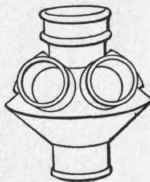
Long 4-inch 1/8 bends, Fig. 12, also 1/6 bends are made, but only in lengths of 18 inches. Long quarter bends but not long-turn quarter bends are shown in Fig. 13, and long quarter bends with foot-rest are shown in Fig. 14. The size and length that they may be had in can be found in Table XVIII. A double Y fitting with side outlet can often be advantageously used on vertical stacks of soil pipe. Such a fitting is shown in Fig. 15. The sizes in which it may be had are given in Table XIX. Double angle Ys, Fig. 16, are likewise very convenient in some work and should be borne carefully in mind. They may be had in the sizes stated in Table XX.
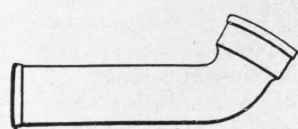
Fig. 12
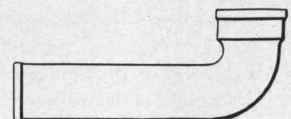
Fig. 13
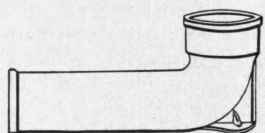
Fig. 14.
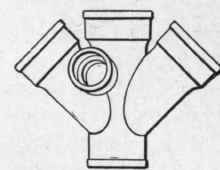
Fig. 15
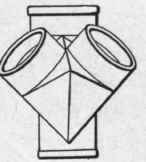
Fig. 16
Table XVII. Lengths And Outlets Of Long Y, Ty And T Fittings
4 | X | 4, | 24 | inches | long |
4 | X | 4, | 30 | ,, | ,, |
4 | X | 4, | 36 | ,, | ,, |
5 | X | 4, | 24 | ,, | ,, |
5 | X | 4 | 30 | ,, | ,, |
5 | X | 4, | 36 | inches | long |
6 | X | 4, | 24 | ,, | ,, |
6 | X | 4, | 30 | ,, | ,, |
6 | X | 4, | 36 | ,, | ,, |
Table XVIII. Size And Lengths Of Long Quarter Bends
2 | inch, | 14 | inches | long |
3 | ,, | 15 | ,, | ,, |
4 | ,, | 18 | ,, | ,, |
5 | inch | 18 | inches | long |
6 | ,, | 18 | ,, | ,, |
8 | ,, | 18 | ,, | ,, |
Table XIX. Size Of Double Y Fittings With Side Outlet
4 | X | 4 | with | 2-inch | Outlet |
4 | X | 3 | ,, | 2 ,, | ,, |
4 | X | 2 | ,, | 2 ,, | ,, |
5 | X | 5 | ,, | 2 ,, | ,, |
5 | X | 4 | ,, | 2 ,, | ,, |
5 | X | 3 | ,, | 2 ,, | ,, |
5 | X | 2 | with | 2-inch | Outlet |
6 | X | 6 | ,, | 2 " | ,, |
6 | X | 5 | ,, | 2 " | ,, |
6 | X | 4 | ,, | 2 " | ,, |
6 | X | 3 | ,, | 2 " | ,, |
6 | X | 2 | ,, | 2 " | ,, |
Table XX. Sizes Of Double Angle Y's
4x4 inch 5x4 inch 6x6 inch
Continue to:


My Books

