


Originality In Estimating. Use Of Stock Fittings
Description
This section is from the book "Plumbing Estimates And Contracts", by J. J. Cosgrove. Also available from Amazon: Plumbing estimates and contracts.
Originality In Estimating. Use Of Stock Fittings

It may be laid down as a general rule, to which there are only a few exceptions, that the entire work in a plumbing installation should be made up of standard stock pipe and fittings. This is particularly true in localities far removed from supply houses, for the carrying of special fitting necessitates the tying up of considerable working capital, without the excuse of it being necessary. For instance, single and double hub pipe, Y fittings, 1/8 bends, TY fittings and long-sweep 1/4 bends are all that are necessary to be carried in stock. If special fittings are necessary for any operation they can be ordered with other materials for that work. With the fittings enumerated, an average workman should be able to rough-in any building; and using 45°-angle Y fitting does not lead to the con-fusion nor require the numerous fittings that go with Y branches of other degrees of angle. The foregoing remarks are applicable only to cast-iron pipe and fittings. When wrought-pipe systems are to be installed, a greater variety of bends are required than for cast-iron soil pipe.
It should be borne in mind that fittings should conform to the work, the work not have to be designed and laid out so as to use special fittings. If a fitting is not adaptable and capable of being used in almost any line of pipe, or in any position, it is not a suitable fitting to carry in stock, although it might possess great value as a special.
The simplicity, economy and convenience of using only 45°-angle Y fittings and 1/8 bends may be seen by referring to Fig. 6. When a 45°-angle Y fitting is used the branch itself will project a straight connection indefinitely at that degree of inclination from the main pipe. If, however, it is desired to continue the branch line parallel with the main pipe it can be done by using a 1/8 bend and turning it in the direction shown at (a). If, on the other hand, the branch is to be continued at right angles to the main pipe, this can be accomplished by means of a 1/8 bend, by turning it in the direction shown by the fitting (6). If now, instead of a 45°-Y fitting a half-Y or 60° branch, (a), Fig. 7, be used, in order to project the branch at an angle of 45° from the main pipe, a 1/32 and a 1/64 bend would have to be used together to make up the sum of the 15 degrees the branch is away from a 45-degree angle. The two bends enumerated, a 1/32 and a 1/64 bend, together make up the sum of ll 1/4 + 5 5/8 = 16 7/8 degrees which is 1 7/8 degrees more than is wanted but is the best that can be done with the fittings obtainable. To turn the branch at right angles from the main a 1/12 bend, (6), would be required, and to turn the branch parallel with the main a 1/6 bend, (c), would be required. It will thus be seen that it is necessary to carry in stock four different degrees of bends, when half-Y fittings are made use of, and, as full Y branches and 1/8 bends would naturally be carried in stock, this necessitates an expenditure of working capital for seven different kinds of fittings, where two would not only be sufficient but better.
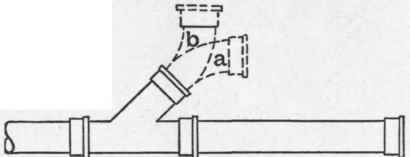
Fig. 6.

Fig. 7.
It will pay the contractor to provide plenty of double-hub pipe on every operation, as it will save the waste entailed by cutting single-hub lengths of pipe. Even in cities where double hubs and single hubs are permitted, the lead, oakum and labor, required to calk a hub onto a piece of pipe will increase the cost to far more than that of double-hub pipe. True economy, then, lies not in carrying single and double hubs in stock, but in ordering a liberal amount of double-hub pipe.
Continue to:


My Books

