


Baths - Continued. Part 2
Description
This section is from the book "Plumbing Practice", by J. Wright Clarke. Also available from Amazon: Modern plumbing practice.
Baths - Continued. Part 2
Another case came under the writer's notice where dirty water was drawn out of a bath at the tap over a sink on the floor below. In this case the cold-water cistern was small and had an intermittent supply. When preparing the bath, the cistern was emptied and the cock to the bath left open. During the time the bath was being used water was drawn at the sink, but as the cistern was empty it came from the bath. If cocks similar to those shown as Figures 241 and 242 in last chapter had been used this could not have happened.
Bath-rooms should always be well ventilated, and in such a way that there can be no unpleasant draught. Decency forbids open windows being used, even when the climate is such as to admit of this (unless precautions are taken to insure privacy). An unventilated bath-room always has an unpleasant odour in it, arising from a variety of causes. If a sponge is used by the bather the cellules will get full of soapy matter, and a few hours after using this will smell very offensive. These remarks apply to body-brushes and rubbers. The bath itself may be left in a dirty condition by allowing an accumulation of soapy curds to adhere to the sides. The bath may, perhaps, have been allowed to overflow, so that a pool of dirty water lay in the safe until it became offensive, or the cocks may have been in a leaky condition, and where the bath is inclosed with woodwork this is unnoticed. In addition to these remarks there is a probability of smells arising from a defective arrangement of the waste pipe and trapping.
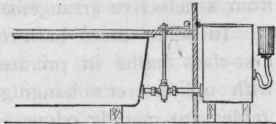
Figure 256.
In some cases bath-rooms are hung with paper. In some first-class baths in private houses the walls have been covered with upholsterer's hangings. In these cases there is always an unpleasant mouldy odour arising from moisture being retained in the wall-coverings. When the walls are painted, or covered with glazed tiles, steam will condense and run down. All this points to the necessity of ventilation. In some instances air-bricks are fixed in the walls near the ceiling for this purpose. In others a perforated centre-piece has been fixed in the ceiling, and a tube leading to the outer air to carry away any vapour. One eminent firm fixes a hollow and perforated cornice all round the bath-room, with tubes through the house-walls and with the ends open to the air. Whatever system of ventilation is adopted, care should always be taken to guard against any unpleasant draughts. A fire is generally looked upon as an additional comfort in a bathroom, but a hot-water coil is much preferable. With a very little extra trouble a hot-water coil can generally be made to work off the hot supply to the bath. If made of 1 1/2-inch copper tubes, say about 4 feet 6 inches long and to stand about 3 feet 6 inches high, with about six or seven longitudinal pipes, it will be found a convenient size for airing or warming bath towels. If this coil is nickel-plated it presents a smart appearance. This way of warming a bath-room has the advantage that no attention is required in the same manner as when a fire is used, and as the action is continuous the painted or tiled walls do not get cold enough for steam to condense upon, or if paper or hangings (which should on no account be recommended) should be used to cover the walls, and become damp, the heat would soon dry them again, and prevent mouldy or other smells being generated. Towels, etc, could be hung up to dry, instead of being left in a wet state. Thorough ventilation is absolutely necessary to carry off all damp vapours, which would otherwise condense again on objects or walls in the bath-room. This would take place in most cases during the night-time, when the boiler-fire would be out and the water cooled down, so as not to impart heat sufficient to keep the moisture suspended in the atmosphere in a state of vapour. The floors of bath-rooms should be waterproof, and more especially when on an upper story, so as to avoid any possible injury to rooms below. The floors should also be impervious to moisture, or, failing this, a tray should be provided for the bather to stand in. Carpets should not be allowed in a bath-room. A large flat piece of cork may be used for the bather to stand upon, as it does not feel so unpleasantly cold to the feet as oil-cloth and some other kinds of floor-covering. The only furniture required in a bath-room is a dressing-table and a cane-seated chair, and on no account should chests of drawers, wardrobes, clothes, or linen-chests be permitted to be in such a place where they become damp or musty-smelling. All baths should be fixed so that the bather may face the light.
From a sanitary point of view, baths should be open all around, and no inclosures used which would, perhaps, hide any defects or leakages. It has sometimes been found that fungoid matter has grown on the woodwork around a bath. At a noble earl's residence the writer found the cocks of a bath leaking very badly, and mushrooms growing out of the wooden inclosure. These mushrooms had stems about 10 to 12 inches long, and the tops were about the size of a shilling. They were all quite white and free from colour, and as they all appeared to be leaning in the same direction, search was made for the cause. A crack was found in the woodwork, through which a very fine ray of light could pass, and it was toward this ray of light that the fungoids were leaning, although about 3 feet away.
In addition to the baths that have been described there are shower-baths. Figure 257 represents a very simple one that can be screwed on to the wall. A weighted lever is keyed on to the spindle of a valve at the extremity of the bracket, and on the nozzle of the valve is screwed a copper or other sheet-metal rose or spreader. This can be used for cold water only. It has the advantage that the water runs during the bather's pleasure; immediately the handle is released, the water ceases running.
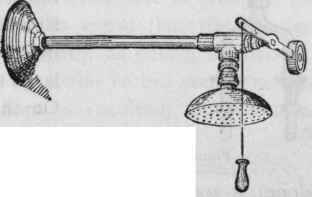
Figure 257.
Continue to:


My Books

