


Baths - Continued. Part 3
Description
This section is from the book "Plumbing Practice", by J. Wright Clarke. Also available from Amazon: Modern plumbing practice.
Baths - Continued. Part 3
Figure 258 is another kind of shower-bath, which can be suspended from the ceiling. This can be supplied with a small service pipe, with a ball-valve and ball to keep it full, ready for use. A, A, is a metal ring encircling the bath for attaching a curtain for preventing the water splashing too much. Hot water can be laid on to this bath, but it is dangerous to do so, as the bather has no means of knowing the heat of the water without the aid of a pair of steps and a thermometer, and so runs the risk of scalding himself.
Figure 259 represents a shower arranged by the writer. This consisted of a plain shower-bracket fixed at the necessary height, with hot and cold water attached, the cocks being at a convenient position for the bather to adjust at his pleasure. The two pipes were joined together at C, and at B was fixed a Negretti & Zambra's thermometer, on a level with the bather's eye, so that he could see the temperature of the water, and by simply turning one or other of the cocks, make it hotter or cooler, as required. These baths all require a curtain to prevent the water rebounding off the bather's head and shoulders beyond what he may be standing in - usually a plunge-bath, or else a large tray especially made for the purpose. On the score of economy, a plain canvas or linen curtain is generally used, but unless this is taken down and dried (rarely done), it soon begins to smell unpleasant. Plain vulcanized india-rubber curtains have been objected to because of their unpleasant smell, but after a time this, to a great extent, will pass away, and as they retain no water they are not so unpleasant as the others. In some houses a wooden inclosure has been made for shower-baths; in others, zinc or other sheet-metal, enamelled inside, has been used. This last few years a new kind of bath has been much used. This, commonly called a needle-bath, is shown in elevation, Figure 260. The union, A, is for connecting the service pipe to the shower-bath, and that at B for the needle or spray-bath. In some baths, another union, C, is attached to what is commonly called the "wave." This is a narrow slit inside the bath, from which the water can play on the hips of the bather. In some baths a jet is fixed immediately beneath the shower, or a rose is attached to the jet. This is sometimes called a "sitz-bath." These conveniences are only useful for medical purposes, and should not be attached unless really necessary, for the reason that a complication of cocks or valves is required, and these very often get out of repair. Dirty water will get into the rose or sinking of the sitz when the plunge-bath is used. When selecting or making a spray-bath, note should be taken that the tubes outside the hood-part, and the holes inside, are not too large, as, if so, the water will escape so freely out of the bottom holes, or a large quantity will be required to fill the tubes, that the top holes are almost useless. If the hood-part is attached to a plunge-bath of the ordinary shape, it is found that the needle-sprays will splash over the side of the bath, as shown by arrows, Figure 261. This does not happen when the bather stands in the centre of the hood. When a hot bath is required, the water is generally turned on before entering the bath, so as to ascertain the heat, and avoid the risk of scalding. Baths made to the shape shown at Figure 262 do not splash over the sides so much as the one last described. All makers have their own system of supplying this kind of bath with water.
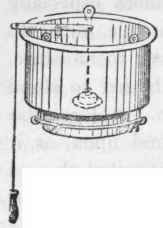
Figure 258.
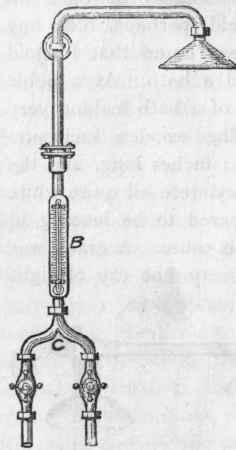
Figure 259.
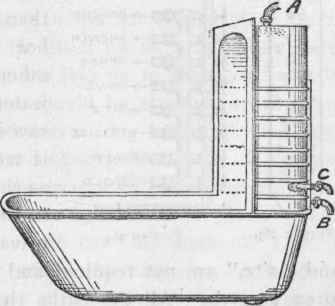
Figure 260.
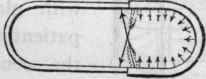
Figure 261.
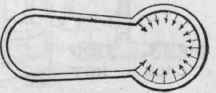
Figure 262.
Figure 263 illustrates the engraved face-plate of one of the commonest tiers of nobs to the cocks or valves.
Figure 264 shows another kind in side elevation. This is more simple than the other, as there is only one hot and one cold-water valve, the others being used to distribute the water to the desired places. This also saves a complication of piping, which is required when cocks are arranged as shown by the face-plates and knobs in Figure 263. For ordinary baths for private house the "douche," "wave," and "sitz," are not required and should not be fixed, for reasons already given. All the baths the writer has seen have the disadvantage that should the bather wish to turn on more hot or cold water, he cannot do so without stepping outside the hood. It would be better if the heads of the cocks or valves were fixed inside, so as to be under the bather's control.
Figure 265 represents a spray-bath as used in some hospitals. Instead of a metal hood with perforations, as shown at Figure 260, per forated copper tubes are used, and inclosed in a framework with glass sides, so that a patient standing or seated in the centre can be watched from the outside. A separate cock is attached to each ring, and a thermometer fixed so that the attendant can regulate the heat of the water to any desired degree, and can also turn it on at any desired point, so as to play on any part of the patient that may be desired. Most medical men have their own ideas with regard to this kind of bath, but it is very little trouble for any ordinary skilled workman to carry them out so as to suit special cases.
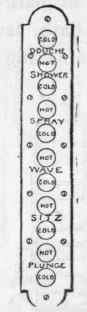
Figure 263.
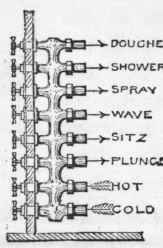
Figure 264.
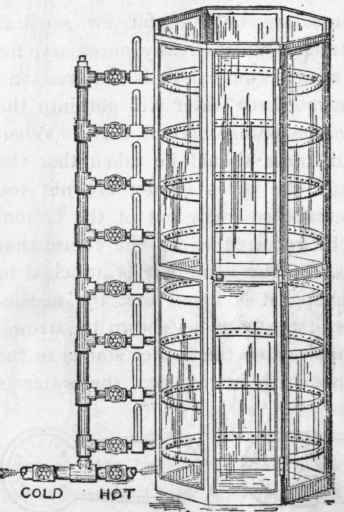
Figure 265.
Continue to:


My Books

