


Baths - Continued. Part 4
Description
This section is from the book "Plumbing Practice", by J. Wright Clarke. Also available from Amazon: Modern plumbing practice.
Baths - Continued. Part 4
In first-class houses a "bidet-pan" is sometimes fitted up in the dressing-room. These can be fitted up as a miniature bath, and have hot, cold, and waste pipes laid on to them. As a rule, the waste pipe from these fittings should be attached to the trap of the bath-waste, and so as to avoid a long length of untrapped waste pipe the pan should be fixed close to the bath. If trapped separately the water will sometimes evaporate out of the trap, and this occurs when this fitting has not been used for some weeks. When fixed near the bath a cover can be made so that it represents a seat. In a house where the bath-room is used by both sexes it is highly improper to fix these pans, and, although fixed by him, the writer never recommends them.
Figure 266 is sometimes useful either for invalids' use or as a child's bath. It is called a "sitz-bath," and can have hot and cold water attached in the same manner as an ordinary bath; also with back-shower, bottom-shower, and wave at the back. All baths can be enamelled inside and outside, so that no inclosure is necessary. The writer has seen a 5-foot 6-inch plunge-bath nickel-plated inside. It looked very nice, and would not appear so dilapidated as the ordinary enamelled ones do after they have been in use for some time, but the cost of doing them in this way prevents a general adoption of the system. _____ made to a large size they are very difficult to get true, as they twist and warp very much in the burning; but latterly, makers appear to be improving in this matter and send them out much truer. Another advantage of these cabinet-tops is a raised margin all around the edges, which prevents water from running off on to the floor, or, perhaps, the user's dress and boots. The sinkings for soap and nail-brushes are a convenience, and are much better than the ordinary portable dishes, but the covers very often are found to be in the way and generally get broken or lost. Sometimes a waste pipe is made in the porcelain from the sinkings into the bowl, but a channel, made as shown at A, A, Figure 270, is better, as there cannot be any accumulation of stale soap to give off any effluvia. After usage of a wash-hand basin it always occurs that soap-curds and other matter float on the surface of the water, and as the basin is emptied of its contents these curds adhere to the sides of the basin. If a whirling motion is given to the water as it subsides, the basin takes longer to empty and the floating matter is still left sticking to the sides. Figure 274 is a view of a bowl with perforations near the top edge with the necessary provisions so that the supply to the basin passes through the holes. Figure 275 is another basin with a flushing-rim. Both these last basins can be rinsed after using by turning on the water for a few seconds. Figure 276 is another patent basin with a brass rose, so arranged that the incoming water is spread around the inside of the bowl so as to rinse it. Figures 274, 275, and 276, are supplied by means of valves fixed beneath, with knobs projecting through the top, the pipes being connected to the basin by means of the arms, A, A. Figure 277 is a sketch of a wash-hand basin fitted in such a way that the inlets for clean water are connected to the waste-apparatus. At one time these kinds of fittings were thought to be very good, but they are now being condemned by most sanitarians, although a great many are still used. The objection to them is, the incoming water will often bring back any small pieces of matter or soapy curds that may be hanging about the neck, B. The same kind of supply-valves can be used, and the outlets connected to the arms, A, A, of the bowls, as shown at Figures 274, 275, and 276. For supplying wash-hand basins nearly all the manufacturers have their own system and their own valves. When the valves are fixed beneath the top, the knobs for opening them are generally fixed as shown at Figure 277. It is better, although more costly, to fix them as shown in fragmentary section, Figure 278. In this case the knob is pulled forward and a slight turn given to it, when the valve will remain open; or the space, C, can be made larger, and screw-down cocks used. The marble shelf, D, can be made to lift off for access to the cocks for repairing. When the knobs are fixed on the top, as shown at Figure 277, the metal-work soon gets tarnished, even if nickel-plated. The guides also sometimes work loose, so that any water splashed on the top will run through. The back nuts are very difficult to screw up, the plumber having to lie on his back and punch them around with his hammer and chisel, unless he has time to get a specially-made spanner to turn them with.
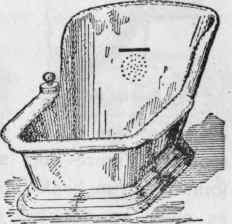
Figure 266.
Continue to:


My Books

