


Chapter XXVI. Baths - Continued
Description
This section is from the book "Plumbing Practice", by J. Wright Clarke. Also available from Amazon: Modern plumbing practice.
Chapter XXVI. Baths - Continued
Figure 248 represents in section a waste-valve patented by a leading firm of sanitary engineers. With this valve and a 2-inch waste pipe an ordinary-sized bath can be emptied in two and one-half to three minutes.
Common brass plugs and washers are not much liked for emptying baths, as they generally are made too small; the grating at A, Figure 249, gets choked with small pieces of soap, etc, and the links of the chain get filled with matter and always look dirty. The plug, by being allowed to fall about, chips off pieces of enamel. This latter can be prevented by making the plug of vulcanized indiarubber, with a small brass plate on each side for fastening the ring to, as shown by Figure 250.
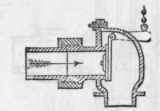
Figure 248.
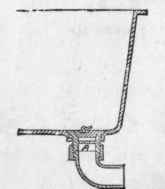
Figure 249.
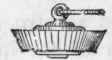
Figure 250.
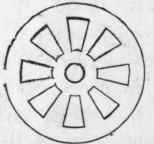
Figure 251a.
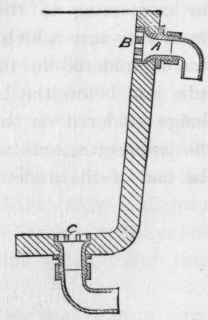
Figure 251.
Figure 251 is a fractional section of a porcelain bath showing the overflow and waste connections. A, A, are brass couplings, with bent unions for joining to waste-valve and overflow pipe. B, C, are porcelain gratings to prevent anything washing into the pipes to choke them up. B should be cemented in to prevent it falling and breaking, but C should lay loosely in the sinking so that it can be lifted out for access to the waste pipe for cleaning it when necessary. Figure 251a is a plan of the porcelain grating.
Some Water Companies insist that all bath supply-valves shall discharge above the water-line of the bath, so that it can be seen if the water is running, and thus avoid waste. They also stipulate that the overflow shall not be connected to the waste pipe, but shall discharge out-of-doors in some conspicuous position. When this is done a flap should be fixed on the outlet-end to prevent cold air blowing through. This flap should be light so that it will open with the least pressure behind it. Flaps are generally made of sheet-copper, as shown at Figure 252. Any plumber can make them, and instead of cutting out the centrepiece when making the joint, as generally done, it should be bent as shown at A, when it will prevent the flap opening so far as to fall back and remain open, which now so often occurs when wind is blowing against it. The necessity of a leaden tray or safe on the floor under a bath has already been pointed out. This safe should be larger than the bath or it will not catch any overflow. The wooden floor should be laid so that any water will run down toward the outlet or overflow pipe from the safe. When the bath is fixed care should be taken to fix it level. If this is not done a space will be found at he lowest end between the rim of the bath and the wooden top. Strips of sheet-lead under the feet are the best for blocking up a bath; when wood is used it sometimes gets rotten from the surrounding moisture.
The ordinary way of arranging a bath-waste is shown by sketch section, Figure 253. In this case a large-sized trap is fixed, and the overflow and waste pipes discharge into it as shown. Very often the waste from an adjoining sink or wash-hand basin is also made to discharge into the same trap. This is not by any means a good plan. On looking at a case of this kind it will be found that the discharges will, so to speak, boil over the trap and lie in the bottom of the safe, frequently giving off unpleasant odours. It will be noticed that this trap also receives all that may leak into the safe. So that this boiling over of the trap may not distribute the water over a large area, a sinking may be made in the floor. But this cannot always be done, and sometimes the bath is fixed at a higher level so as to gain the same object. This is an improvement, but it is much better to fix the waste pipe tight over the trap so as to entirely avoid the back-wash, as shown at Figure 254. In this case a small trap (say the same size as the waste pipe) can be used. An indiarubber ring under the flange will prevent any escape of water into the safe. Where the waste apparatus is arranged in this way a separate overflow pipe must be fixed from the safe through the wall, and a copper hinged flap fixed on the end, as explained for bath-overflow. The overflow pipe from the bath can be made to discharge over that from the safe, as shown in Figure 254.
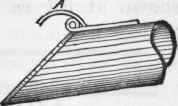
Figure 252.
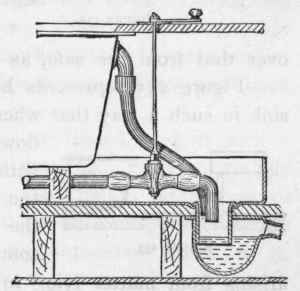
Figure 253.
Figure 255 represents how a bath was connected to a slop-sink in such a way that when a pail of water or slops was thrown down the sink it ran back into the bath with force enough to lift the plug out of the waste pipe. On opening the lid of the bath, which had not been used for some weeks, the stench was abominable, arising from matter lying in the bottom, and which had washed up and been left behind, as the water or liquid portion had slowly subsided or passed down the waste pipe.
Figure 256 is a sketch showing a hot-water cistern fixed in a cupboard at the head of a bath. This was at the house of the proprietor of one of the leading London sporting journals, whose wife and servants could not tell how it was that the hot water so often looked cloudy and soapy, and the water in the best bath always looked as if it had been used, although only just drawn. The bath - Figure 256 - was on the nursery floor, and the hot-water cistern being so close - "why, it will only cost a few shillings, guv'nor, to lay on hot water to that bath," was the remark of the expert who conceived and carried out the brilliant idea. Only a few words of explanation are necessary. Bath and hot-water cistern being on the same level the cock was often left open, being unnoticed, as the hot water ceased running when the levels between that in the cistern and bath were equal. During the time the children were bathing, any hot water drawn at a lower level would be syphoned out of this bath; the ball-cock in the feed-cistern, being only 3/8-inch, not supplying the cistern as fast as it was drawn out, with the results given.
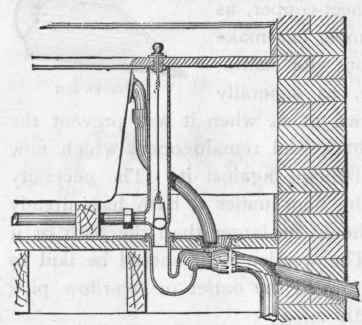
Figure 254.
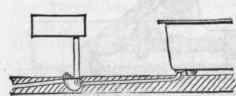
Figure 255.
Continue to:


My Books

