


Chapter XXV. Baths
Description
This section is from the book "Plumbing Practice", by J. Wright Clarke. Also available from Amazon: Modern plumbing practice.
Chapter XXV. Baths
It is not often that a plumber has to make a bath. In some old country mansions a wooden tub or casing lined with sheet-lead is found, and generally as shown at Figure 239, the bottom and sides being put in in one piece, and the ends soldered in afterward. Baths sold by makers may be enumerated as follows: Sheet-copper, zinc, tinned and galvanized iron, concrete, porcelain, stoneware, cast-iron, marble or slate slabs bolted together, and marble cut out of the solid block. These last are not often seen; they also have the objection that the bath requires to be prepared some time before using, when a warm bath is required, so that heat may be imparted to the material, which would otherwise feel cold to the bather. The stoneware and concrete baths are generally used in hospitals, public baths, and other institutions of a similar kind. The metal baths, and also those made of slate slabs, are usually enamelled inside, either in a plain tint or grained in imitation of marble. When baths are intended to be fixed without an enclosure, a rounded rim is made on the top edge, and they are also enamelled on the outside, and sometimes have ornamental feet to stand upon. For best work the copper baths are preferred, as they last a long time, and when they get discoloured or scratched can be re-enamelled so as to look equal to new. All kinds of sheet-metal baths, when made of light substance, should be well "cradled" - that is, have a skeleton wooden casing fitted to them to prevent the bottom and sides from bulging outward by the pressure of the water and weight of the bather. For cheap work the cast-iron baths are very good, and if the enamel is such that it expands and contracts in the same proportion as the iron they last some considerable time. Complaints have sometimes been made that common iron baths are too narrow in the bottom, so that a stout bather will get wedged in.
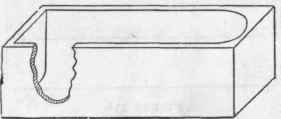
Figure 239.
A bath is not only a comfort and convenience, but the waste water is a valuable auxiliary for flushing the drains. This is too often lost sight of, and the mistake made of fixing a small waste pipe and discharge-cock, so that the bath is slowly emptied of its contents. The result is, the water dribbles through the drains instead of being sent through with a good scouring force to clear away any matter that may have lodged in them.
Figure 240 is a sketch of a bath as commonly fixed, with 3/4 or 1-inch waste and hot and cold-water cocks attached. The levers are omitted for clearness. On looking at this it will be seen that the inlet for water is through the waste pipe. This is a very bad plan, as when the bath is emptied the soap-curds which float on the surface of the water, being the last to leave the bath, frequently remain in the waste pipe and get washed back again with the incoming water, making that look dirty and anything but inviting to the bather. In some cases the supply to the bath is by means of standard cocks with nozzles projecting over the bath, as shown in sectional elevation, Figure 241. This is better than the plan last described, and does away with the evil pointed out When these cocks are used they should be fixed at the foot of the bath; if fixed at the head there is danger of the bather knocking his head against them; if fixed at the side the elbows might suffer, and they are also difficult to get at for connecting the unions when fixed near a wall or partition. Sometimes, when a bath supplied in this manner is being charged with hot water, the room is filled with volumes of steam, and if the walls are cold this condenses and runs down. Another way of supplying a bath is shown at Figure 242. This is almost similar to the last one described, the only difference being that the valves are combined and discharge through the same nozzle, a porcelain cover with a soap-dish, A, being fitted over the valves, this being more cleanly-looking than the cocks, which soon tarnish unless protected by nickel or silver plating. Figure 243 is an illustration of a bath showing the supply and waste apparatus fixed inside the bath at the foot. These baths are also made with the valves at the side near the foot, and are either right or left-handed. Figure 244 is an illustration of a copper bath with side-inlets for the supply of hot and cold water. If these are kept low down the ends of the pipes are soon covered with water, and this prevents the free escape of steam into the room. The waste pipe, A, is shown connected near the middle, as done in the usual way, but it is an improvement to fix it as near the end of the bath as possible. This saves a piece of pipe, and as the waste pipe is always more or less foul on the inside, the shorter the pipe the better. Sometimes, on the score of economy, the pipes are left short at the points B, B, and the plumber, when making a soldered joint to them, has allowed the hot solder to touch the sides, and so discoloured the inside enamelling that the bath has had to be sent away to be re-enamelled. Some baths have only one inlet pipe. This is wrong, as, if the hot and cold-water cisterns were at different levels the pressure from the hot-water cistern at the top of the house would prevent the cold water, supplied from the cistern on the same floor as the bath, from entering. Baths of the description under discussion should always have unions attached to the pipes at C, C, Figure 244, so that they can readily be uncoupled should it be necessary to take them out for repairs or renewal of any of the parts.
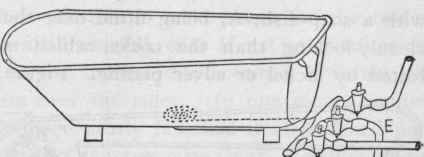
Figure 240.
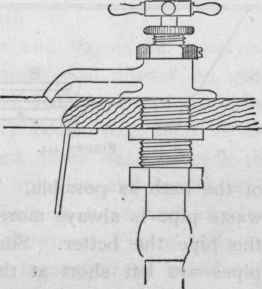
Figure 241.
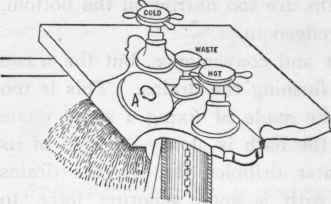
Figure 242.
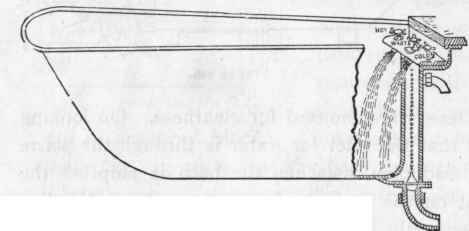
Figure 243.
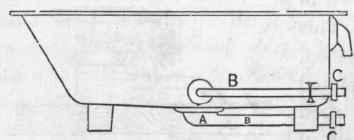
Figure 244.
All baths should have overflow pipes. Indeed, the overflows should be as large as it is possible to make them, for the reason that should the bath be filled too full, even if not to overflowing, when the bather gets in the sudden displacement of water will frequently cause it to run over the sides. In one case a gentleman who liked his bath to be nearly full, had it altered and perforations made all round near the top edge, with a hollow space outside to catch the water, as shown at Figure 245. The holes were 3/8-inch in diameter, and yet this was not found to take the displaced water away quickly enough. This was an extreme case, but shows the necessity of large overflows to baths, and also, when they are fixed upstairs, the importance of having safes or other means for catching any overflow of water that may take place, and so avoid doing injury to any rooms beneath.
To describe all the various cocks and valves for supplying baths with water would weary the reader and answer no good purpose. Suffice it to say that nearly all bath makers have either a patent or an adaptation of ordinary cocks, etc, such as are used for other purposes, and are turned, when fixed beneath the inclosure, by means of socket-keys or spindles and levers, or, if lever-valves are used, a connecting chain is fixed and attached to a knob through the bath-top, as shown at Figure 246; the spindle, G, sometimes being triangular in section, or round with a protecting strip on one side so arranged that when the knob is pulled up as far as it will go and a slight turn given to it, it will remain, thus holding the valve open.
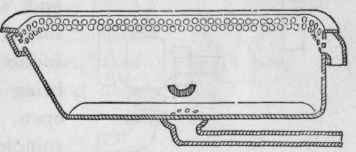
Figure 245.
For discharging the water out of a bath, very often a common stop-cock, as shown at E, Figure 240, is used. In some cases the size is only 3/4-inch, and with the ordinary square way. In others a 2-inch round or clear-way-cock has been fixed, but this is not to be recommended by any means, as it is so difficult to turn them, especially after they have not been used for some time. Figure 246, if made to a good size, is a very good waste-valve, F being connected to the bath waste pipe, but the lever should be as short as possible or it will not open very wide. The same kind of valve has been used without the lever and weight, the spindle being continued as shown by dotted lines; the friction in the stuffing-box of the valve being generally sufficient to keep it open. It is found in practice that the spindle is very liable to get slightly bent or the valve moved sideways, in which cases it is difficult to open or shut this valve. For this reason they are now rarely used.
A very simple waste-valve is shown in section, Figure 243, which is an indiarubber ball, with a weight above it, resting upon a turned brass seating bedded near the bottom of a cast-iron tube. This tube is connected with a branch pipe from the bath, and has a union for connecting to the waste pipe. In some cases a smaller tube is used instead of the ball, the bottom end being made to fit into the brass seating, and thus acting as a plug to-retain the water in the bath. The annular space between the inner and outer tubes fills with water to the same level as that in the bath. When the bath is filled to a certain height the water begins to overflow down the inner tube, which is made to stand so that the top is level with the highest point at which it is intended the bath shall fill.
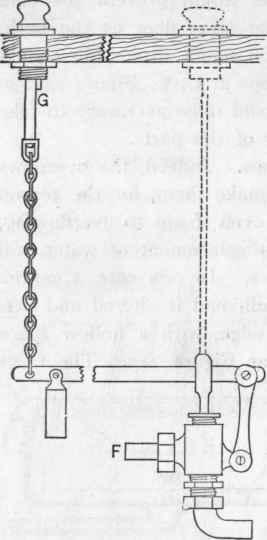
Figure 246.
When this kind of waste apparatus is used the overflow-connection is generally omitted from the bath. Plumbers sometimes make a bath-waste apparatus with lead pipes, as shown in section, Figure 247. The outer tube is a piece of 4-inch lead soil pipe with the bottom end reduced to 2 inches, and a hole made in the side at the level of the branch pipe, H, from the bath. The inner tube is 2 1/2-inch lead pipe, with a corresponding hole opened in the side, and so fitted that it projects through the one in the outer tube. The top of this inner pipe is cut down so as to act as the overflow pipe, the outer tube having its top level with the rim of the bath. A brass union, H, is soldered in, as shown, for connecting to the bath. K is a small brass ring into which is ground a valve, and this is soldered to the bottom of the inner tube just below the branch, H. L is a lead flange soldered on to support the weight of the apparatus, and also for cementing over the end of the under waste.
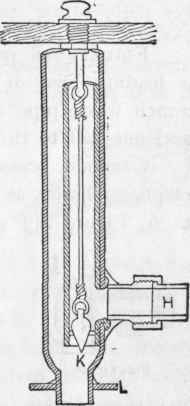
Figure 247.
Continue to:


My Books

