


Chapter XXIV. Slop-Sinks
Description
This section is from the book "Plumbing Practice", by J. Wright Clarke. Also available from Amazon: Modern plumbing practice.
Chapter XXIV. Slop-Sinks
Slops from nurseries, and also invalids, should never be thrown into the ordinary sink. It is a daily occurrence to see the housemaid empty a pail of slops down a sink, and then immediately draw water for toilet purposes into a glass bottle from a cock, the nozzle of which may be splashed with slops. This suggestion is not nice for water-drinkers or those in the habit of drinking water out of the toilet bottle. In all well-arranged houses a special provision is made for receiving chamber-slops. Some kinds of slops must go into the water-closet, but these are the exception rather than the rule.
There is no more frequent cause of stoppage in soil pipes and drains than allowing slops to be thrown down water-closets. Nail, tooth, and scrubbing brushes, housemaids' flannels, lumps of soap, the sweepings of the bedrooms, small ornaments, and a host of other matters are frequently recovered from those places. A properly-constructed slop-sink would catch and retain all these matters, and at the same time allow others to pass away. It is unreasonable to expect a person to hold up the handle of a w.c.
apparatus with one hand and pitch a pail of slops into it with the other, and yet if this is not done the basin will often over flow on to the floor or into the safe beneath. In some cases a plain basin, as Figure 226, has been fixed for the purpose, but while this is better than the pan or valve water-closet, still there is no provision for intercepting improper articles passing through at the risk of causing a stoppage in the pipes. Figure 227 is a sectional elevation of the same kind of slop-sink, with a galvanized-iron wire basket fixed over the top for catching solid articles that would otherwise pass away. Some years ago this was a speciality of one firm of sanitary engineers, but they have now discarded it on the ground that the meshes of the wire basket got clogged with matter, and in time this smells very offensive. Another firm. of sanitary engineers have a slate sink perforated in the bottom near one end, and an earthenware basin fixed beneath for receiving slops. Figure 228 is a sketch showing this. In this case no provision is made for intercepting brushes, etc. Figure 229 is an elevation of a basin with a piece broken out to show the grating in the bottom. All these slop-sinks are made of earthenware. It not unfrequently happens that the basins get broken by throwing improper things into them; indeed, from the usage they sometimes get, one would think that they had been intended for rubbish-shoots. Figure 230 is a patent one that seems to meet all requirements. It is made of cast-iron and is porcelain-enamelled inside. The back and ends are higher than the front so that nothing can splash over them, and, although rounded in the bottom, the top is square so as to be readily adapted to an enclosure, and, if fixed in an angle, no corner is left to be filled in with woodwork or other material, which would be necessary if it had been round. It is also made large enough to hold rather more than a pail of slops, so that if a housemaid's flannel should cover the perforated grating before the person using this place saw it in time to stop, the sink would not overflow. The faint lines show the position of the strainer to the bottom, but I believe this is now discarded and a metal star-grating bolted to the bottom with a T-bolt and screw so as to be easily removed if required. A slop-sink should not be fixed more than 18 inches high in the front. The higher the pail has to be lifted the less control the person has over it, and the more likelihood of the surroundings being splashed with offensive matter. Receptacles for slops should always be fixed in a well-lighted and well-ventilated position. If in a dark place the slops might be thrown on the floor by mistake.
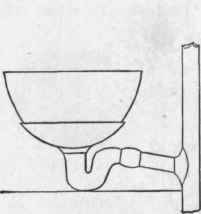
Figure 226.

Figure 227.
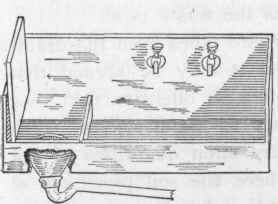
Figure 228.
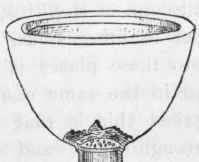
Figure 229.
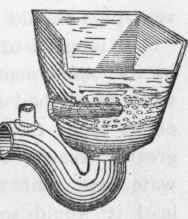
Figure 230.
A rule has been laid down that all sinks should be trapped, and this one is no exception to the rule. The waste pipe should not be less than 2 inches in diameter; a size larger, say 3 inches, in very large establishments or hotels would be better, and the vent pipe should be of the same size as the waste pipe.
It is usual to disconnect slop-sink waste pipes from the drains in the same manner as other sinks, but it may be argued that what is pitched into these places is often so offensive that they ought to be treated in the same manner as water-closets The greatest reason against this is that very often quantities of hot water are sent through them, and where the soil pipes are of lead it would soon cause them to break. Leaden waste pipes that are used to conduct hot waste water very often break from the same cause, and, speaking from experience, the more firmly and rigidly a pipe of this kind is fixed the more likely it is to break by the alternate expansions and contractions. One firm I have worked for use lead waste pipes 2 inches in diameter, and the substance of the lead from 2 to •22 inches thick. The reader may judge of the strength of this pipe by the statement that it requires a pressure of 498 pounds on the square inch to burst it, and yet the writer has had to make good broken places in a bath-waste of this description before it had been used for twelve months. An expansion joint, as shown in section, Figure 231, is better than a soldered joint for hot-water waste pipes. A hard-wood mandrel is first made, as shown at Figure 232. This should be well greased and driven in the end of the lead pipe, causing that to swell out to form the socket. If the end of the pipe is first warmed, it will be found the 'substance of the lead is not reduced in thickness, and if the part A of the mandrel is made to just fit the pipe it will prevent the pipe buckling sideways or the socket being made more on one side of the pipe than the other. A bead can be worked on the end of the socket, and a pair of very thick lead lugs soldered on the back for fixing to the wall. B is a vulcanized indiarubber ring, sprung on the tip end of the entering pipe. The size of the socket should be such that this ring on the end of the other pipe will fit moderately tight, so that when one pipe is pushed into the other the ring will roll between them and finally remain where shown. The socket should be about 5 inches deep inside, and the entering pipe should only be allowed to enter about 4 inches, so as to avoid its resting on the bottom of the socket, in which case the objects aimed at would be defeated. 2-inch pipes are generally made in 12-feet lengths; if these are cut in halves and each piece treated as shown, the sockets will be about 5 feet 6 inches apart, and that is quite far enough, as the only fixings are at the sockets.
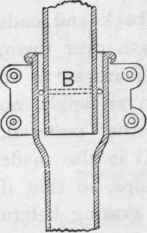
Figure 231.
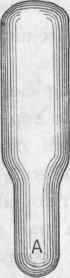
Figure 232.
Continue to:


My Books

