


Chapter XXXVII. Water-Closets - Continued
Description
This section is from the book "Plumbing Practice", by J. Wright Clarke. Also available from Amazon: Modern plumbing practice.
Chapter XXXVII. Water-Closets - Continued
Some years ago an eminent master plumber designed and patented a plunger closet, as shown by Figure 402.
The basin and trap were made in one piece of white earthenware, and water was retained in the basin by means of a hollow plunger, fitted in a side chamber over the outlet where it is connected with the trap. If the basin filled too full the water overflowed down the hollow plunger. Closets of more recent make have a solid plunger and a separate overflow-arm. Since the patent ran out several other firms make slightly-varied copies of this closet. Although several people prefer this kind of closet, the writer still thinks that they are not nearly so good as the valve closet shown at Figure 400 for the reason that those he has seen were always very dirty and offensive-smelling in the chamber in which the plunger and overflow are situated. Neither is the joint of the outgo of the trap to be trusted, for reasons given further back when speaking of trapless valve closets.
Those closets that retain a body of water in the basin are considered the best because the faecal matters are at once immersed and thus prevent any bad odours escaping from them. In addition, immediately the handle of the apparatus is raised, the contents of the basin are floated away by the accompanying body of water. Neither does the basin get stained in the same way as some of the other descriptions of water-closets which do not retain a body of water in the basin.
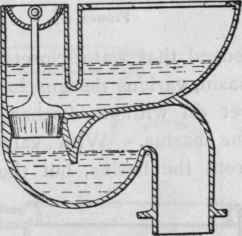
Figure 402.
Some people believe that the "pan closet," Figure 403, is a very good one because it retains water at the bottom of the basin.
But it is now abandoned by all good plumbers as being, compared with other kinds, the most offensive in its action, and which no amount of ventilating or flushing will prevent giving off foul vapours each time the handle is raised. These vapours emanate from the inside of the large chamber, X - the whole of the inner surface of which sooner or later gets coated with filth.
It being generally acknowledged that water-closets should retain water at the bottom of the basin, various designs have been invented to gain that object and yet do without discharging-valves for emptying the contents of the basins. With valve closets the contents fall or gravitate from the basins, but those referred to, and shown at Figure 404, require some power to dislodge the contents and carry them away. This power is supplied from the flushing-water, which has to come into the basin with such force as not only to cleanse the basin but dislodge the contents collected in the hollow at W. This kind of water-closet is made, almost without exception, by every English maker of water-closets, and at the present time it is the most popular closet of the day, being sold and fixed by thousands. This is rather strange, as amongst the hundreds that the writer has seen in use, he has seen scarcely any that were clean in their action, or could be kept clean without the daily use of a brush. The water in the hollow is not deep enough so that faeces can be immersed, and the stains left after being used are in some cases as bad as if the basin had been quite dry before using.
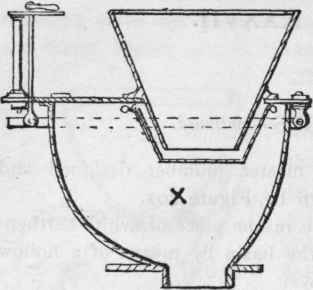
Figure 403.
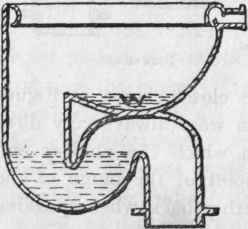
Figure 404.
Another-shaped basin, shown at Figure 405, is much cleaner than that shown at Figure 404. With this basin the deposit drops into water which is about 4 1/2 inches deep, and there is considerably less amount of basin-surface to be kept clean. These basins have flushing-rims, and, in addition, a jet is placed near the rim so that the incoming water will play on the floating matter in the basin and drive it through the trap and down to the drain.
Figure 406 is a basin and trap made in one piece of earthenware, and in its action is similar to Figure 405, excepting that it has no water-jet to assist the flushing-rim in washing away the contents of the basin. These closets are very much liked, and great numbers are found to be fixed. In the writer's opinion it is not so good as Figure 405, in that it has considerably less surface of water at V, and the larger the water-surface the lesser liability there is for the basin sides to get fouled.
The last three kinds of water-closets that have been described are sometimes made to an ornamental pattern or otherwise decorated. They are then fixed without any enclosure, but with a rim-seat, as shown at Figure 407. A great many sanitary engineers have a dislike for urinals, as it is so very difficult to keep them clean, and fix the water-closets, as shown, so that they may be used for either purpose. If there is no enclosure to water-closets, the whole of the space around them is lighted and ventilated, and there is less liability for any slops or filth to accumulate in the manner so often found with enclosed water-closets. One eminent firm makes valve water-closets to fix without any enclosure.
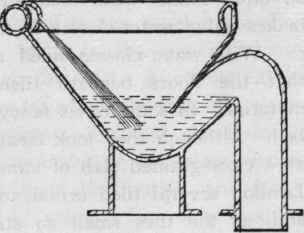
Figure 405.
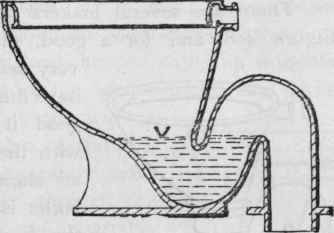
Figure 406.
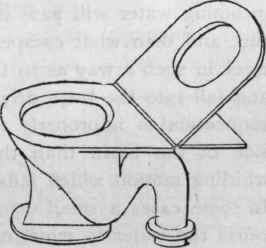
Figure 407.
With water-closets fixed as above described, it is important that the floors beneath them should be made of impervious material. In some cases fancy tiles have been laid on a concrete bed. Although they look clean and smart they are not so good as a close-grained slab of stone. In a large public institution in London several tiled urinal and water-closet floors were taken up, and, as the tiles smelt so strongly of urine, it was decided to relay the floors, where necessary, with slate slabs, in as large pieces as possible, so as to avoid having more joints than could be avoided. At a large theatre in London the floors were relaid with black asphalte for the same reason.
Continue to:


My Books

