


Chapter XXX. Urinals
Description
This section is from the book "Plumbing Practice", by J. Wright Clarke. Also available from Amazon: Modern plumbing practice.
Chapter XXX. Urinals
The subject of urinals is one of the utmost importance, and I may premise any further statements by saying that I have never seen one that might be said to be entirely satisfactory, and we have yet to learn the secret of making them sanitary. Take public urinals first. In the older districts of London, and in a great many by-streets, a small recess is made in a wall, generally by the side of a public-house or tavern. Sometimes a screen of slate or cast-iron is put up, or a door is fixed for the sake of decency. Inside no special provision is made for keeping the place clean or for catching the urine, which is ejected against the walls or on the floor, and then has to flow towards a grating, or sometimes only a hole, and so into the drain. Sometimes the walls are rendered, or covered, with mortar or cement, so badly done as to be no protection against their becoming saturated with urine. The floor is sometimes paved with bricks, in other cases with stones. The joints are not always made good, so that liquid matter lies in pools all over the place. In some cases no light or ventilation is provided, and not even a water-supply for washing down the floor. On entering one of these places the person's eyes begin to run with tears, and the pain of the nostrils is similar to that just before a fit of sneezing, so strong are the ammoniacal vapours. Although these places are for the use of the public, a great many of them are private property. When they become so bad as to be a public nuisance, they sometimes get washed down and a coat of lime-white may be laid on the walls. A few days afterwards these white walls are invariably found to be covered with disgusting literature and quack doctors' hand-bills. The sooner the sanitary authorities seek out these places and have them removed the better it will be for those unfortunate people who reside near them, and others who, from sheer necessity, must make use of them In a few cases a stone trough is fixed, but, for want of attention, they soon become coated with yellow matter.
Public urinals should not be made against dwelling-houses; an air-space should always be between them, and if they can be fixed several yards away it is better. In towns, several of these places should be provided to prevent any outrage against decency by the thoughtless, or those driven by necessity.
In busy thoroughfares and streets an independent iron building is sometimes put up. Figure 311 is a sketch showing a very common description. They have from two to perhaps ten or twelve stalls, the whole of the construction being cast-iron. The stalls are continued down to the floor, a channel runs along the floor at the back side, and the foot-stone or slab is laid to fall towards it. In some cases an attendant visits these places once or twice a week and washes them down with water and broom, or a cock and water pipe are fixed in a convenient position for the attendant to screw on a hose for washing down with. Figures 312 and 313 are plans of two other structures. These have cast-iron floors laid with a fall towards the gratings or traps A. In some districts brick buildings are erected similar in plan to Figure 311, and the walls lined with slate slabs. Sometimes very thick glass is used instead of the slate slabs, but, from a sanitary point of view, there is very little difference between any of those described. They all smell so offensive that users never stay in them longer than they possibly can help. In some instances a perforated pipe, sometimes called a " sparge pipe," is fixed over the part used, and water laid on to run continuously down the back sides of the stalls; or, where it has been found necessary to economize with water, a small tank has been fixed with the necessary apparatus to automatically discharge the contents at regular intervals of time. In these cases the back slab is sometimes quite dry in the intervals between the discharges, so that the salts of urine soon deposit and become so hard that they cannot be scrubbed, but have to be scraped off. Some people are under the impression that cold water causes the fur to accumulate more quickly, but this is not the fact. Anyone noticing these places will find that the back slab over which the water streams always looks cleaner than the divisions or sides, which get splashed, but rarely get any water at all.
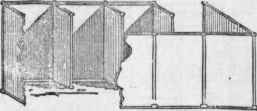
Figure 311.
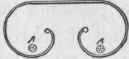
Figure 312.
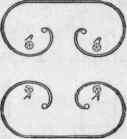
Figure 313.
Figure 314 is a sectional elevation of one stall of a urinal for which several authorities have a preference. Several of this kind will be found in railway stations, both in town and country, and to have to use them is simply abominable. The slate apron B is generally covered on both sides with urine as well as the sides of the stalls, the back only being washed by the sparge pipe C. Bad as this evil is, in some cases it is made worse by having the slate apron piece fixed so high that people of short stature eject on the outside, at D. The first great evil in all the conveniences described is allowing the urine to spread over a too large surface by having more exposed than is really necessary. For instance, if the divisions were cut off at about the height of a person's knees, little or no matter would be splashed on them, and if there were no aprons there would be about 14 square feet less of surface in each stall to get fouled, thus leaving only about 6 feet at the back to be kept clean.
In some public places has been introduced a new kind of urinal. Figure 315 is a sectional elevation of one stall. This is a great improvement on the old-fashioned open stalls, but it is far from being a thorough success. One great advantage is, the urine passes directly into a trough, E, of water, and at short intervals of time the flushing-tank, F, automatically discharges itself into one end of the trough with sufficient force to displace the contents and leave a body of clean water behind. A branch water pipe is so arranged as to wash out the foot-channel, G, at the same time. Those the writer has seen are very much furred with urinary deposit, in spite of the violent scour of clean water sent through it. The trough is fouled down the front side, at H. The writer has watched visitors, and noticed that some of them stand too far away, as if afraid of soiling their dress, and boys can scarcely reach high enough. In addition, the front edge of the trough appears to be too wide, and, being rounded, any drippings on it sometimes runs outward.
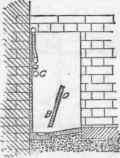
Figure 314.
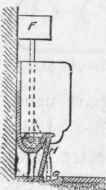
Figure 315.
Continue to:


My Books

