


Wash-Hand Basins. Part 5
Description
This section is from the book "Plumbing Practice", by J. Wright Clarke. Also available from Amazon: Modern plumbing practice.
Wash-Hand Basins. Part 5
"Tip-up" basins are sometimes fixed in ranges, and have a large trough placed beneath so as to receive the contents of the basins. This is far from being a good plan, as the dirty water is splashed over a large area which soon becomes offensive.
In hospitals, and public schools attended by the poorer class of children, it is very probable that certain diseases may be conveyed from one body to another by means of wash-hand basins, and the question arises, would it not be better to dispense with them altogether in those places. I think it was in Paris that I saw something similar to Figure 308, which is a section. Instead of basins, a long V-shaped slate trough, with a channel down the centre, was fixed, and taps at intervals, with a stream of water running all the time a person was washing. By this arrangement the risk of communicating a specific disease is minimised, but the channel should be large enough for the water to pass away without coming up into the trough, and the opening at G should be so narrow that pieces of soap, etc, could not be washed away.
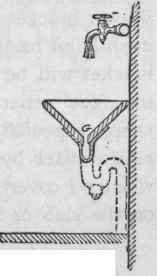
Figure 308.
The tap should be high enough so that the head can be held beneath, but not so high as to cause the water to splash about too much. For children's use the trough should not be more than 2 feet high, but for adults it should be 6 inches higher. With regard to the materials of these troughs, porcelain would be the best, if it were possible to make them large enough, but failing that, slate is the best material, especially if a kind is selected which is not absorbent. The slate could be enamelled, but after a time the enamel peels off, or gets so chipped as to look unsightly. In some cases long open troughs filled with water have been fixed for the use of the class of people who may be termed casual paupers, or tramps. In these cases it is highly probable that one person, suffering from any skin or other communicable disease, may so contaminate the water that other users may be infected with the same complaint. From this point of view the trough, although simple, and, comparatively speaking, inexpensive, is highly dangerous for using under the above conditions.
A small shower apparatus fixed to a lavatory is a comfortable luxury. This can be made and fixed in a way similar to one illustrated in the chapter on baths, but the crane should be jointed so that it can be turned aside out of the way when not wanted to be used. A looking-glass fixed behind a lavatory is a great improvement, both with regard to appearance and convenience. It also prevents the wall at the back from becoming splashed and thus rendered unsightly. When a back glass is used the above; shower-bracket cannot be fixed on the back wall. When the-wash-hand basin has a cover, or is otherwise enclosed, the shower-bracket will be found objectionable. The drippings of water from the rose generally continues for some considerable time after using, especially if the perforations are very small, when they retain water by capillary attraction. This is of little consequence when no cover is fixed over the basin, as any drippings would fall on the slab or into the bowl. In some cases hot and cold-water cocks have been connected with a coupling-union, and a piece of flexible indiarubber hose attached. On the loose end of the hose a small rose is fixed, as shown in Figure 309, for spreading the stream of water. The hose should be wired inside to prevent kinking, which would stop the waterway and prevent the free flow of the water, and if it is covered outside with a silk or worsted plaiting it adds to the appearance. It is unnecessary for the hose to be larger than 1/2-inch in the bore. The rose should be of ebonite because of its lightness. If a metal one is used and allowed to fall it would, perhaps, break the basin. The rose should not be more than about 2 or 2 1/2 inches across the perforations, H, Figure 309, and the holes should be as small as possible so that very fine sprays of water escape. The perforated face, H, should not be much rounded - in fact it should be nearly flat so as to avoid the water spreading over too large a surface. If the rose is small, the pressure of water not too great, and the hose nice and flexible, the user can hold it in any position he pleases, either over his head, or under, or at the sides of his face. The part I, Figure 309, is better if made rough, so that the hand can hold it more firmly and the user have better control over it. When hot water is used the person should try the heat, by allowing it to run for a few seconds on his hand, before applying it to his head or face; or a thermometer, as described when writing on shower-baths, could be attached.
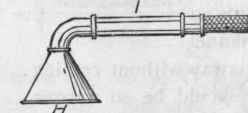
Figure 309.
Figure 310 is a very convenient shower and spray apparatus patented by a leading firm of sanitary engineers. It is supplied with hot and cold water. The crane has ground-in joints so arranged that it can be swung sideways when not wanted. The rose can be turned upside down, as shown by dotted lines, and sideways, or any other desired position. When this fitting is nickel-plated and kept nice and clean it presents a smart appearance. The joints should be made of the very best metals, as constant use will soon cause them to leak, although they do not have to withstand any great water-pressure.
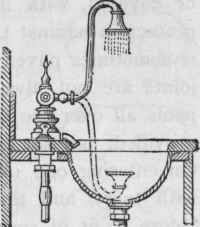
Figure 310.
Continue to:


My Books

