


Urinals. Part 2
Description
This section is from the book "Plumbing Practice", by J. Wright Clarke. Also available from Amazon: Modern plumbing practice.
Urinals. Part 2
Figure 316 is a plan of a public place. Although the smells are offensive, they are not nearly so bad as some of the others described. In this case the slate divisions are placed at an acute angle to each other, and a large cast-iron bowl with three lips is placed in the centre. The stalls are cut off at the level of the top edge of the bowl, and, as they do not project far, users are obliged to stand so close to the basin that the lip catches most of the drippings. A constant supply of water is laid on to the bowl, so that it is always full and the contents in continual motion.
Figure 317 is a section through the basin showing the overflow pipe, which can be lifted out when necessary to empty the contents for cleaning. The bowls are generally made of cast-iron, but a few have lately been fixed made of vitrified stoneware.
Figure 318 is a sketch plan of another arrangement of the same kind of urinal. The framework of the enclosure is of iron, with slate panels. A skeleton or lattice-iron roof is fixed over all, and the bottom of the centre post forms the waste or overflow pipe. On the top end of the post is a gas-lamp, with red-coloured glass, on which the word "Gentlemen" is embossed. On the floor, at K, in Figure 317, an open grating is let in to catch drippings. This is the most objectionable part of the whole arrangement, as the space beneath is generally charged with offensive smelling matter, such as urine, street-driftings, cigar-ends, and a host of other things.* This grating has an advantage: by catching any wet that may fall, the user's boots do not become so saturated as to be offensive and objectionable to others besides himself, and neither does he leave wet foot-marks behind him. It would be an advantage if a provision was made so that a small stream of water would be distributed under the grating, so that the space beneath would be washed clean.

Figure 316.

Figure 317.
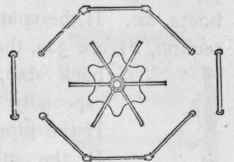
Figure 318.
* Since writing the above, several improvements have been made in this arrangement. - J. W. C.
Figure 319 is a sketch section, showing a trough-urinal fixed in a London street, and which appears to act very well and give off very little smell. The trough is porcelain-enamelled iron. A constant supply of water is laid on to it and passes through perforations in the bottom, as shown at L, and the overflow is through perforations near the top edge, at M. As urine is considerably heavier than water it sinks to the bottom, hence the above system of flushing has reason on its side.
When plain stall-urinals are ordered to be fixed, there are a few improvements that can be made on the way in which they are usually fitted up. For instance, when flushed with a sparge pipe, a great deal of water splashes outward and on to visitors' boots, etc. If the sparge pipe is perforated, as shown in fragmental section, Figure 320, the water-jets will sometimes rebound from the back slab, as shown by the arrow, to A, and more especially when the face of the back slab is rough. If the pipe is perforated, as shown by dotted lines, at B, the splashing is not quite so bad. The jets of water being thrown upward, in falling meet and break the force of the water issuing out of the holes in the pipe. If the perforations are made in this way an evenly-distributed sheet of water runs down the back slab, but in the ordinary way of arranging the holes the water will run down in streams. A ledge is generally improperly left, as at C, from which the water will sometimes rebound, as shown by the arrows. Sparge pipes should be made of copper. When iron is used the metal rusts, some of the holes get filled up, and others grow larger and very much out of shape, so that the water is not evenly distributed. All sparge pipes should have a small hole in the bottom near one end, so that when out of use the whole of the water may drain out. In winter this water will get frozen, and perhaps burst the pipe. When an apparatus is fixed so that the flushing is intermittent, it generally happens that when the force is spent the last portion of the water will run out of the holes and to the under side of the pipe, as shown at D, Figure 320, and fall on to the floor, or into the channel, and splash very much. In some cases a metal sheathing has been fixed over the pipe, as shown at E, Fisfure 321, to prevent this. A great deal of the splashing of water may be avoided if the back slab is fixed with a slope, as shown at F, Figure 321.

Figure 319.
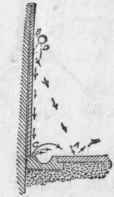
Figure 320.
In some of the principal railway stations and a few public places in London white earthenware basins have been fixed, as shown at Figure 322. This is a step in the right direction, as urine is not splashed over such a large surface as in the other kinds described. Most of these basins have flushing-rims, so that the incoming water washes over the whole of the inner surface.
Figures 323, 324, and 325 are sectional plans of three of the commonest kinds of basins.
Figures 324 and 325 are considered the best shape for catching drippings. The waste-holes in Figure 325 are the best arranged, as they are partly in the back as well as the bottom. Sometimes a cigar-end or piece of cigarette is thrown into the basin, which, on unfolding, will cover the bottom waste-holes and prevent the water from running away. It is very rarely that the back waste-holes get stopped in this way.
Continue to:


My Books

