


Urinals. Part 3
Description
This section is from the book "Plumbing Practice", by J. Wright Clarke. Also available from Amazon: Modern plumbing practice.
Urinals. Part 3
All the basins described have straight-down waste pipes. Some others are also made with back outlet waste-arms to connect to the waste pipe behind the back marble or slate slab, instead of as Figure 322, where the waste pipes are shown on the front of the slab, and discharging into an open channel. Urinal-basins, when connected to the waste pipe instead of into the open channel, should be trapped. This is generally done by means of a lead trap soldered in the waste pipe - in some instances one trap to the range, and others a trap to each basin, this latter being the right thing to do.

Figure 321.

Figure 322.
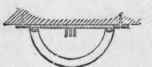
Figure 323.

Figure 324.
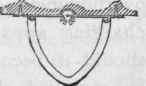
Figure 325.
Figure 326 is a vertical section of a basin and trap in one piece of earthenware, so constructed that water is retained in the bowl. The lip, G, hangs so that whatever runs down will drop on to the floor instead of running under the basin and down the back slab. This evil is generally unnoticed, although a frequent source of smells near these places. There are other basins, with earthenware traps to them, not constructed to retain any body of water. Some sanitary plumbers will fix a range of ordinary urinal basins, and a valve and overflow pipe, so that water is retained at the same level in all the basins. Figure 327 shows how this is done, the basins and slabs being omitted for clearness. H H are as fixed for back outlet, and I I are for straight-outlet basins. When fixed in this way a constant dribble of water should be running, so as to keep the contents of the bowls, etc, in motion, and also to prevent an accumulation of urine in the basins. It is a further advantage to fix an automatic flushing-tank, so as to periodically send a good scouring flush through the pipes, etc. If this is done, precautions should be taken to have the overflow large enough to prevent the basin overflowing. A moveable panel should be fixed in front of the discharging apparatus, so that it can be readily got at for cleaning should it become furred and choked up. The basins can easily be removed should the branches or the horizontal waste pipe require cleaning.
When several basins are flushed with one apparatus, great care is required in so arranging the service pipes that each basin will get its fair quantity of water. Figure 328 shows a good way of doing this. K is the flushing-tank fed by a small tap, L.

Figure 326.

Figure 327.
A dribble or continuous flush can be arranged by fixing the pipe and stop-cock, M.
In some cases, where the supply of water is limited, what is commonly called a "treadle-action" apparatus is fixed to each basin. There are several kinds of these treadle actions. They mostly consist of a small hinged platform, either above or level with the flooring. Some are inlaid with fancy tiles, and others have iron gratings. The treadles are so arranged that a person stepping on them causes a valve fixed beneath to open, or act upon a lever connected by means of wires to a valve in a specially-arranged cistern. In some cases the valves are arranged so as not to open until the person steps away. These valves are specially made to run one gallon of water and then close themselves, but do not allow any water to pass during the time the platform is depressed.
These treadle-action apparatus are a common cause of complaint by reason of the smells that escape from them. They are mostly found to contain a quantity of stale urine, and when the floor is swept, or washed, other matters get in to add to the evil. When fixed in a wooden floor, or on brickwork, or stone, into which the offensive matter soaks, no amount of cleaning will get rid of the smells. One very good description of treadle apparatus in the market has an enamelled-iron tray in which the valve is fixed, and a small perforated pipe is so arranged that jets of water escape at each opening of the valve and thoroughly wash out this tray at the same time as the basin. But even this is a nuisance if improperly fixed.
Figure 329 represents in section one the writer had to alter-some time ago. The cause arose from the blunder the plumber made when fixing it of branching the waste pipe from the tray into the trap in such way that water, etc, laid in it, and sometimes rushed up into the tray in such a volume that it did not get thoroughly washed out again.
The reader is again referred to Figure 322. The stalls or divisions should be clear of the floor so that it can be swept clean, and have no corners for dirt to accumulate in. The stalls are generally about 2 feet apart. This gives a fair amount of room, and at the same time prevents users from standing on one side of the basin so as to use it improperly. The divisions generally project about 2 feet from the back. This is a great mistake, and it causes users to stand too far from the basin, and this occurs more particularly in railway stations, where travellers perhaps have rugs and travelling-wraps on their arms. The stalls should only project about 12 inches clear of the back, so that visitors can stand close to the receivers.

Figure 328.

Figure 325.
The iron gratings placed over a hollow space in the floor should in all cases be removed, as they only become receptacles for filth. If these places (urinals) are properly fitted up, very little will fall on the floor, and hence it is unnecessary to provide for something that ought not to happen, and which eventually becomes a source of evil. Veined marble is a good material to use for urinal-stalls, and costs very little more than enamelled slate. Light coloured enamelled slate looks very nice when quite new, but it is objectionable for reasons that have already been given in another place. In some cases the slate has been enamelled black, in others to imitate granite and marbles; but there are so many mischievous people, amateur artists, about who, when they cannot use a pencil, do not hesitate to take the point of a pocket-knife to gain their object. The front lip of the basin should not be more than 2 feet above the floor, and should be 1 inch lower rather than higher. In one public institution in London the urinals are arranged as shown by Figure 330, which is a plan. No basins are used; a constant stream of water is kept running down the A-shaped backs, and also down the sunken part in the floor. This floor-flushing is shown by Figure 331, which is section across Figure 330, at A 6. N is a perforated pipe hidden beneath the foot-stone. These places are in the charge of attendants, whose duty it is to keep them clean, but in spite of all the care taken there is always an unpleasant odour near them.
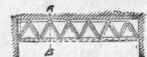
Figure 330.

Figure 331.
Continue to:


My Books

