


Water-Closets - Continued. Continued
Description
This section is from the book "Plumbing Practice", by J. Wright Clarke. Also available from Amazon: Modern plumbing practice.
Water-Closets - Continued. Continued
There are several makers of closets of the kind shown by Figure 408, and for a good, plain, and cheap basin, they are very serviceable when well flushed, and have flushing-rims. Although they are all good it is advisable to choose those with the outlet of the basin well back, as shown by the sketch. When the outlet is in the centre, faeces will fall on the back side of the basin, but with those suggested as the best it falls directly into the water in the trap.
The plumber should always be careful how he attaches the flushing pipe to the arm, U, so that the incoming water will pass in equal quantities each way round the rim, and then what escapes near the front part of the basin will meet in such a way as to turn over with a kind of cascade action, and fall into the trap, driving the contents before it. When the connection is improperly made more water will pass round one side of the basin than the other, and thus form a vortex or whirling motion which fails to clear the contents out of the trap. In some cases a small defect in the construction of the basin will cause the water to whirl round, when it does not exercise such a cleansing force as when it streams downwards from the hollow rim of the basin, converging at the outlet. A good way to test how a water-closet basin will flush is to crumple up a piece of soft water-closet paper between the palms of the hands and throw it into the trap and then flush the basin in the usual way. This is a very severe, though simple, test, as the paper is very buoyant and difficult to send through the trap. At public exhibitions of sanitary goods, the attendants, when showing off water-closet basins, will place pieces of paper all round the inside of them. On flushing the basins these pieces of paper are carried down by the water, and, getting over the outlet, are forced through the trap by sheer weight of water. In use a basin is very rarely filled with paper in the manner described, so to get to know how one is cleared by flushing, the applied test should be as nearly as possible what would occur in ordinary usage. It appears strange at first sight, but it is more' difficult to get rid of one piece of crumpled-up paper than six or eight pieces opened out flat in either wash-out or wash-down water-closet basins.
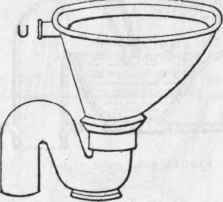
Figure 408.
Figure 409 is the common long hopper with the side-inlet flushing-arm. As the incoming water whirls round the basins they are never so clean as those with a flushing-rim. Three or four flushes of water of about two gallons each will very rarely drive one piece of crumpled-up paper through the trap, and in use these closets are invariably found to have fasces and paper laying in the trap.
In public schools and institutions, where there is a large number of inmates, it is difficult to provide water-closets suitable for their purpose, and, at the same time, to be free from offensive smells. If basins are used they are constantly being broken, or the traps choked up by boys' caps, jackets, and other articles of dress. Or books and pieces of stick are poked down. In these cases trough water-closets have to be fixed as shown at Figure 410.
There are several objections to these water-closets, one of the principal being that the sides get splashed at the back with faeces and at the front with urine, and no provision is made for flushing the sides. It is difficult to scrub them with a broom, as the seats have to be fastened down to prevent children opening them and falling in. One seat-holder can splash his neighbour, and a mischievous boy has been seen to splash another boy by means of a stick. Further, a pyramid of matter will accumulate under each seat and remain there until an attendant raises the discharging-plug and empties the contents of the trough down the drains. It is also necessary to scrub the seats with water and broom two or three times a day as they get fouled by people standing on them. Figure 411 is a section across a trough water-closet, showing what has been found in several cases. Nearly all the urine is discharged over the top edge of the trough, as shown by the arrow, and falls on the floor.
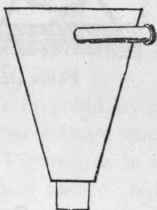
Figure 409.
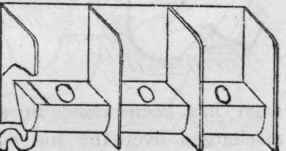
Figure 410.
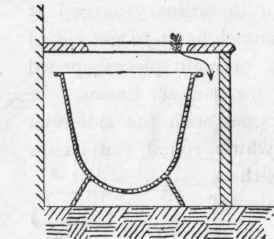
Figure 411.
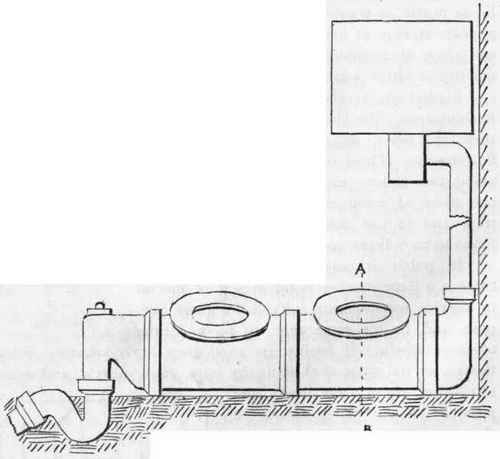
Figure 412.
Ranges of closets of a better description have been designed and fixed these last few years. Instead of U-shaped slate or iron troughs those of a cylindrical shape are much used. They are also made of vitrified stoneware, and are so constructed as to retain a body of water in them. The flushing is arranged to take place at regular intervals of time by means of an automatic discharging cistern which is a great improvement on the older system of having it done by an attendant. Although there are several patented kinds in use, an illustration of one only, which the writer considers the best, is shown at Figure 412. Some the writer has recently fixed, for the use of the outdoor poor at some Union offices, had no enclosures of any kind, and the seats were simply rings of wood bolted on to flanges made on the fitting. They were fixed sloping towards the front so that they could not be stood upon, and the space from the crown of the cylindrical part to the back wall was filled up with portland cement concrete, the surface being.worked up to a smooth face so as not to harbour vermin, etc. Figure 413 is a section on A B, showing what is meant.
The writer was shown, at a large public institution near London, some water-closets invented by a civil engineer several years ago, and it seems rather strange that they are not more generally used than they are. Figure 414 is a sketch drawn from memory. Only two basins are shown, but each range had about eight or ten. Each basin dips about 1/2-inch into the water in the trough, and is flushed by means of a valve worked by the opening of the door to each stall. At stated intervals of time a valve is opened so as to send a stream of water through the trough and thoroughly flush it out. Ventilating pipes are attached as shown, so that a current of air passes through the trough.
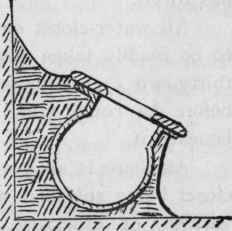
Figure 413.
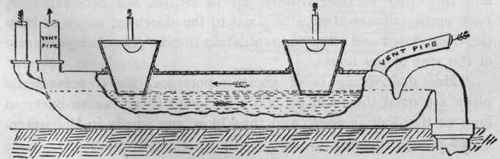
Figure 414.
All the water-closets that have been described may be accepted as typical of those in general use, the principles being the same but varied in detail. For this reason it is not necessary to pursue the subject of water-closets any further, excepting to say that the best kinds of apparatus are useless unless a good water-supply is attached so as to float the matter away. Human ingenuity has not yet invented an apparatus that will eject what is deposited in it into the public sewer or wherever the matter has to go.
All water-closet enclosures, when used, should be made so as to be readily taken down or opened. The writer had to take out thirty-two (32) screws one day when making an examination before he could take down a water-closet seat to see what was beneath it.
As there is always a liability of the woodwork round a water-closet being splashed with slops, etc, it is a good plan to paint, varnish, or otherwise render the woodwork impervious. This applies more especially to the perforated part over the basin, the under side of which is invariably found to be saturated with urine and to smell very offensive.
As stated in an earlier chapter, water-closets should never be fixed in or near sleeping apartments, and the room in which a water-closet is situated should always have a provision made for constantly changing the air. Two pipes, one to let fresh air in and the other for the vitiated air to escape, are necessary. A back spring should always be fixed to the doorway, so as to keep the door closed and allow for ventilation to take place independently of the rest of the house.
This door-spring is of great importance, for if several air pipes are fixed they will generally be found to act as air-inlets so long as the door is open, and thus blow any smells in the water-closet into the house.
Continue to:


My Books

