


Chapter XIV. Sewerage And Sewers
Description
This section is from the book "Plumbing Practice", by J. Wright Clarke. Also available from Amazon: Modern plumbing practice.
Chapter XIV. Sewerage And Sewers
Public sewers very rarely have any provision for ventilation excepting those in the streets, commonly called lamp-holes, and the gulley-gratings by the sides of the streets.
In some districts may be seen here and there a small iron pipe, of about 4 inches in diameter, fixed up the side of a building. These pipes are supposed to be quite sufficient to ventilate a sewer of, perhaps, several feet sectional area. The lamp-holes spoken of above, very rarely exceed 1/3-foot of space for air to pass through, and even that small amount of opening is generally contracted, and in a great many cases choked with street refuse.
The side gulleys are not intended as sewer-ventilators, but anyone, when passing these places, would not require to be told what duties they are performing; in fact, complaints are heard daily about the nauseous smells which escape from them. These places are constructed as in Figure 120, with a tide-flap fixed at A, but in some districts the silt-box is being taken out, and a gulley-trap, constructed to catch driftings and street washings, is fixed in lieu of same, as shown in Figure 121, on looking at which it will be noticed that as long as the water does not evaporate sufficiently to break the seal, no smells can pass through.
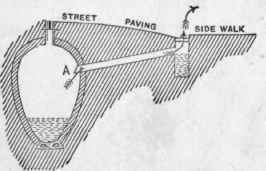
Figure I20.

Figure 121.
Figure 122 is an enlarged view of this gulley-trap. Figure 123 has a valve-trap in combination with the water-trap. When this is done, a moment's thought will prove that public authorities are themselves aggravating an evil, without providing another source for pent-up air to escape, or stagnant air to be put in circulation. Boxes of charcoal have been tried in ventilators to deodorize the sewer air, but are now discarded as being perfectly useless, for the reason that it is impossible to keep the charcoal dry, it being of no value when in a damp or wet condition; and if packed so closely as to prevent sewer air from escaping without coming under its purifying influence, the free circulation of the air is impeded, or perhaps entirely obstructed.
It has been suggested that the street lamp-posts should be adapted so as to act as sewer-ventilators. In some places a stoneware-pipe air-drain has been laid from the sewer and built up in the party-walls of houses, to the no small annoyance of the inmates, who could not tell where the smells came from until the walls were cut away and betrayed the source.
Patents have been taken out for passing sewer air through wire gauze heated with gas jets so as to render it harmless, but, if this is done, it should discharge at some considerable height. As to its being harmless, is open to considerable doubt. It has been proposed to have connections from sewers to any high factory chimney-shaft that may be near, and no doubt this would be a good plan, but these shafts are so far apart that they would be of about as much use as trying to empty the sea with a pail.
This ventilation of public sewers is rather beyond plumbers' work, but at the same time it has a great deal to do with the success of the sanitary arrangements of houses, and in more ways than one. For instance, in London the rainfall is discharged into the same sewer as the sewage proper. The result is, after a heavy fall of rain the sewers are so fully charged as to reduce the air-space, and if no vent is provided for this compressed air, it will force its way back up the tributary drains, which convey sewage from the houses, and possibly gain access to the habitation to the injury of the inmates by breaking through the water-seal of the traps; for it must be remembered there are thousands of houses that have no ventilation pipes to the soil pipes or drains, or any other protection beyond a trap under the water-closet or other fitting, although, in some instances, the pipes which conduct rain-water from the roofs have been connected directly to the drain and so act as vents. In some cases where the sewers are not efficiently ventilated, when the water subsides after a storm, the seal of any of the traps in the house can be broken by the water being syphoned or forced out, by the air rushing through to fill what would otherwise be a partial vacuum in the sewers.
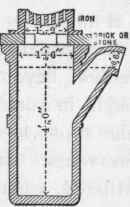
Figure 122.
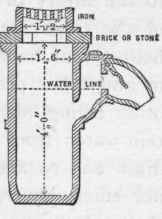
Figure 123.
Again, in a badly-ventilated sewer the gases become more concentrated, and putrefaction of the contents takes place more rapidly, and even if these gases do not actually force themselves through the water in the traps (which some people maintain they do) still the water becomes so impregnated as to be converted into sewage, and so give off foul emanations inside the house.
These sewage gases, or sewer air as some prefer to call it, seem to play a very peculiar part. Hundreds of people die from the effects of breathing them - so the doctors tell us; but as a fact, the writer has questioned scores of sewer-men, some of whom had worked in sewers for more than twenty years, and not one had ever had any illness or suffered from their effects in any way. On asking a leading question as to what complaint these men suffer from most, the answer is almost invariably " rheumatism." The writer has been down into a great many sewers, but never felt any ill effects, although two or three times he has had slight diarrhoea and a sickly feeling when working near an open drain, or when removing dirty old fittings, etc. Dr. Richardson, in a lecture at the Parkes Museum of Hygiene, made the remark on this question that " he supposed they (the sewer-men) got so used to it that they were not influenced by these emanations, and cited a case where he went near some men who were removing refuse from which sulphuretted hydrogen was escaping, and which made him vomit and gave him diarrhoea. These men only laughed, and said it was rather warm, and went on with their work as if it was nothing unusual to them." As doctors make the statement that these odours from sewers do make people ill, and in a great number of cases cause death, it behoves plumbers to take every precaution that human ingenuity can invent for keeping them out of dwellings or places where they may be inhaled. Dr. Shirley Murphy told the writer some time ago that the improvements made in sanitation during the last few years had been the cause of adding quite two years to the average period of life.
Continue to:


My Books

