


Sewerage And Sewers. Continued
Description
This section is from the book "Plumbing Practice", by J. Wright Clarke. Also available from Amazon: Modern plumbing practice.
Sewerage And Sewers. Continued
Dr. Lyon Playfair made the remark in the House of Commons on the 4th of March, that "in one generation the span of human life had increased by two years." This was on the question of improved dwellings for the poor and the influence it had upon health.
At a meeting of the Executive Committee of the Parkes Museum, in 1880, Sir William Jenner made the statement that "the sewers of this metropolis are always filled with the poison of typhoid fever, with diphtheria, and a series of other terrible maladies."
Coming from so high an authority we cannot do otherwise than accept this as a truism, and do all that can be done to obviate the effects.
The first question to consider is - Where is the starting point for the sanitary plumber? The answer is - If these evils are in the sewers, keep them there in preference to allowing them to pass into the house drains. If they can be got rid of by destruction, or be dispersed in a proper and harmless manner, by all means do so, but keep them away from the dwelling. The proper place to start from is as hear the general sewer as possible. There are several contrivances for this purpose, and one of the most in use is what is commonly called the "tide-flap," which is fixed on the extremity of the house drain inside the sewer. This consists of a galvanized-iron plate, suspended on a hinge, or in some cases on two pairs of iron chain links over the end of the pipe, so that it fits as closely as possible. This contrivance is not to be trusted in any way; a match, piece of orange peel, piece of paper, and the thousand and one things that float down the drains, get between the flap and its seating, and so render it useless for keeping back smells, and it is a well-known fact that rats can open them and so pass into the house drains.
There are a great many different kinds of these flaps - Figures 124, 125, and 126 - and no doubt some are better than others, but, for the reasons given, it is almost impossible to get any piece of mechanism that will keep back smells and at the same time allow the sewage to flow freely away.
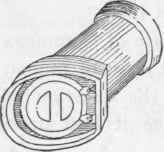
Figure 124.
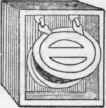
Figure 125.
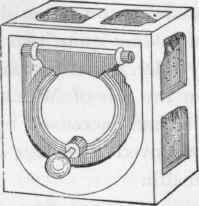
Figure 126.
There are other contrivances specially constructed to prevent the back flow which occurs when the drains discharge from a house at a low level into the sea, a tidal river, or sewer which is liable to flooding. Figure 127 is a sectional elevation of a ball tide-valve, which explains itself, and although there are other kinds in the market, they are mostly the same in principle. For drains discharging into ordinary sewers these tide-valves are of no use for keeping sewer-air from entering the house drains, but are only intended for keeping sewage back. This is a good description for its purpose, as it will be seen that sewage cannot very well get on the top of the ball so as to clog it and prevent it from fitting over the end of the incoming pipe when any back pressure of sewage takes place.
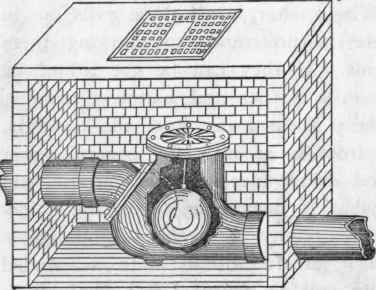
Figure 127.
It has been argued that all house drains should enter the sewer at a level just above the surface of the water, at its ordinary level, in the sewer, so that when an extraordinary quantity of water is discharged into them, the ends of the drains are covered. This will prevent any compressed air in the sewers forcing its way back into the houses. But this is not a good plan by any means, as in rainy weather the ends of the pipes would always be covered, and so render the drain, if it is trapped, "air-bound," and thus prevent the free flow of sewage from the house, with the result that discharges from upper parts of a building would escape through the lower fittings, even if the water in the sewer was low enough to allow them to run away if the connection had been made at a higher level. Again, if the connection is made at a low level, rats could much more easily gain access to the house drains, and although most people object to these animals in a house, still it must be admitted that they sometimes act as scavengers, and no doubt get rid of a great deal of garbage in the sewers which would otherwise putrefy and give off foul emanations. Where there are signs of rats in a house, defects in the drains are generally found. It may be noted that when the drains are of iron or vitrified stoneware, it is very rarely that these pests are discovered, although in hotels and such-like public buildings, one or two will often get under the floors and propagate very rapidly, but with pains they can generally be starved out or poisoned. This way of getting rid of them is objectionable, as the dead bodies lay about and putrefy, and, if in a damp situation, the smells arising from them are noticed for several weeks afterward.
Watts & Co., of Bristol, make a very good machine called an "Asphyxiator," which is of great use to plumbers, both for testing overground-pipes for defects, and also for exterminating vermin, as well as for distributing an aerial disinfectant. This machine will be referred to again at a future time, as I find it of great help when making examinations for smells.
Continue to:


My Books

