


Chapter XV. House Drains
Description
This section is from the book "Plumbing Practice", by J. Wright Clarke. Also available from Amazon: Modern plumbing practice.
Chapter XV. House Drains
In towns house drains made of brick are now becoming things of the past, but in some parts of the country, builders stick to them and believe in no other description. Bad as this description of drain is found to be, there are others worse. In a country parsonage, beneath the wine and beer cellars, were found drains large enough for a man to crawl through, the sides and arch built of random rubble - that is, of irregular-shaped stones. The stones in the bottom had been worked to a face - rough, it is true - so much so that solid sewage lay all over the bottom. Liquids glided over the top of the solids in a zigzag course made by themselves, and part escaped into the surrounding earth.
Most of the drain pipes used in London and other large towns are what are commonly called glazed socket pipes. They are made from 2 inches external diameter up to 2 feet, and are 2 to 3 feet long in all sizes. There are several kinds of these pipes, but for the present only two will be mentioned, namely, the lead-glazed pipes, which are made of inferior clay and which will not stand the necessary heat for burning them properly, and the salt-glazed, which must be made of a clay or composition of clay and other ingredients which will stand a very high temperature, so that the sodium of common salt, used for the purpose of glazing, will combine with the silicate of the clay and the other necessary constituents, to convert the surface of the article into a coating of glass which will withstand the action of sewage gases. Lead-glazed pipes are reported as not being capable of resisting this action. With the laying of the branch drain from the house to the sewer, the sanitarian's trouble commences.
Figure 128 represents in section how a disreputable tradesman was found to be laying a new drain from a house. To save a smal fee he was making his own connection, and, in addition, scamping his work by burrowing under the roadway, instead of opening out in a proper manner. It appeared as if he had taken out an old brick drain, and in knocking out the connection with the sewer by means of a crowbar had made a larger hole than was necessary, and then had simply pushed his new pipe to within about 6 inches of the sewer. This was done in such a way that a great deal of liquids would not reach the sewer at all. He had then pushed a lot of broken bricks around the opening left, some of which had fallen through so that solid sewage would cling around these pieces. The " shore-man " (sewer-man) said this was very commonly done.
Another experience was where a new drain had been laid in a house, and, although all fees had been paid, the connection with the sewer had not been made good in a proper manner The sewer-man's excuse was that he expected to have two or three more to do in a few days, and was going to do them all at the same time. But before this was done a violent storm took place, and the sewer was so full that water ran out, which, following the excavation made to lay in the pipes, found its way into the basement of the house to a depth of about 14 inches, and which had to be carried out in pails. These drains had been laid for about eight or nine days, had been plugged at the outlet, charged with water and proved to be perfectly water-tight, and this was proof that the sewage was not escaping out of the pipes when the storm took place, but found its way beneath, or by the side of them, and so followed the trench, the earth in which had not sufficient cohesion to resist the hydraulic pressure brought to bear. This is one reason why all pipes laid under the above circumstances should be enveloped in concrete.
The best system to commence with is to dig the trench as neatly as possible, taking care not to loosen the sides more than can be helped, to dig the bottom even, and also to remove all loose earth from the bottom. After carefully levelling from end to end of the trench to see what amount of fall can be had, drive in wooden stakes at intervals of about 8 or 10 feet, and projecting above the bottom 4 to 6 inches, as intended for the thickness of concrete, with which cover the bottom of the trench to the height of the stakes; make the concrete slightly hollow for the pipes to lay in, and have spaces at each socket, so that the man can get his hand and tool beneath to trowel up the face of the cement-joint. This way of preparing for laying the pipes is very important, and for want of it serious results frequently occur. One of these is, that very often a settlement takes place in the earth beneath the pipes. If this is soft earth or a loose sandy soil, sooner or later it is sure to give way, and if there should be water in the soil the circumstances are worse. Or, if one of the joints in the drain should leak, the water trickling through causes the sand or earth to run and leave a hollow.
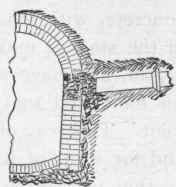
Figure 128.
At a banker's house, at Sunningdale, a drain was stopped. Figure 129 is a sketch of what was found. It appeared that a leaky joint had caused the sandy soil to run, and at last the drain broke in such a manner that all the sewage from the house ran into the hole and made matters worse. This hole was about 6 feet in diameter and 5 feet 6 inches in depth, measured from the top of the loose stuff which fell in when the stone paving was taken up. Such was the nature of the soil that no doubt this hole would have become so large that the whole of the paving in the yard would have eventually fallen in, and it is just possible that the wall of the house would have fallen at some future date. Some think if drains are laid on rocky earth no concrete is wanted. Experience teaches otherwise, because if the bottom of the trench is too hard it will cause the pipes to break by crushing; and in a case of a hard gravelly bottom, drain pipes have been crushed, as shown in section, Figure 130.
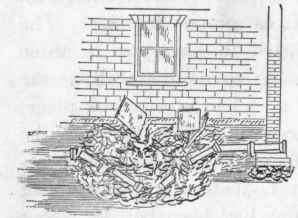
Figure 129.
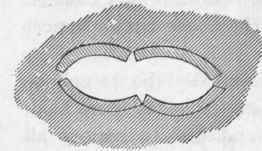
Figure 130.
Continue to:


My Books

