


House Drains. Continued
Description
This section is from the book "Plumbing Practice", by J. Wright Clarke. Also available from Amazon: Modern plumbing practice.
House Drains. Continued
This drain was about 7 feet deep. On looking at the fracture it was seen that the pipes were ordinary vitrified stoneware of very fair quality. We all know the strength of an arch, and the resistance a cylinder will present against a crushing force if it is distributed over the entire surface, but if applied to particular parts the resistance is soon overcome and the whole collapses. This more readily takes place in drains in towns where heavy traffic in the streets causes the earth to vibrate, and shakes the particles into closer contact, so that anything rigid must either sink with it or break. This is more especially the case in new districts, and no doubt there are hundreds of cases of fractured drain pipes from this cause that are not discovered until something leads to a search being made. We have only to take note of how often a water or gas main requires repairs, especially in newly-made roads, to understand the importance of protecting a frail piece of stoneware, which, in most cases, is no stronger than ordinary crockeryware.
After the trench has been prepared with a concrete bottom, the next thing is to select the pipes, taking care to reject all that have cracks in them, looking particularly to the part where the socket or hub is joined to the barrel. A great many will be found to have holes through them. Pass the hand carefully over the inside surface of the pipe to feel if it is rough; don't be in a hurry over this, or a piece may be cut out of the hand. Next see that the spigot and hub are true, so that the joint can be properly fitted. Any pipes that are very much bent should be laid on one side for curved positions. Very few indeed will be found to be straight; those that are not should be laid so that a perfectly graduated line of fall is at the bottom. Most men are anxious that the drain should look nice and straight in the trench, and they put the bagged part of the pipe downward, as shown at Figure 131, which is intended as a side view. A moment's thought will enable the reader to understand that in the case of a rather sluggish fall the hollow parts will retain a portion of sewage., which will then decompose and give off some of the smells most people are anxious to keep out of their houses. If these pipes, were properly laid, with the bent part at the side instead of the bottom, this would be avoided, and, although the course of the sewage would be rather serpentine, the whole of it would drain away provided the current of water was sufficient to carry away the solid matter.

Figure 131.
After selecting the pipes, the next thing is to put them in position, and as many as possible at the same time. The most common way, and which cannot be too strongly condemned, is to put a portion of cement on the bottom of the socket or hub, and then lay in the next pipe. As this pipe is pushed in, it forces 2 part of the cement forward in a body, which stands up in a heap, as shown at A, in Figure 132. This also prevents the end of the pipe from getting home to the bottom of the socket, so that a space is left for filth to accumulate in. Sometimes the above cement excrescence is wiped or scooped out, but very often it is not, with the result that a stoppage invariably takes place sooner or later, and this is independent of the amount of sewage that is retained by these series of weirs. On looking again at Figure 132 it will be noticed that another evil is shown, and that is the joint is not true all round; the spigot is hard on the bottom of the hub, which in itself forms a check to the free flow of sewage. Some men will bed the spigot-end with clay and then face up the joint with cement. This has the advantage that should the clay project inside the pipe it will get washed away by the water that passes over it. The usual way is to now place more cement carefully on the top of the joint where it can be seen, the sides not always being considered of much importance. Perhaps the drain-layer really does take pains that some of the above evils do not take place, and trowels his joint all around, and takes so much time over it that the cement gets nearly set.
The next thing he does is to prepare for and lay in another pipe in the same careful (?) manner, and, in endeavouring to get it tight home, he jars the last pipe that was laid and so breaks the joint; but he could not help it, or was so earnest in making the next joint that he did not notice what mischief he had done.
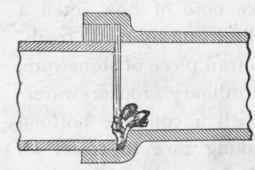
Figure 132.
To avoid all the above evils it is best to prepare the concrete bed as described, and, while it is still in a soft condition, to bed all the pipes on it, and take a crowbar or lever of any kind and force all of them home into the sockets. This applies when there is a long straight length. To insure the joints being fair and true inside it is best to give them one strand of gasket or yarn (tarred is best, as it will not rot away so soon) in each socket, and then, as quickly as possible, make all the joints in succession, with Portland cement and a very small quantity of clean sharp sand, and carefully trowel the surface to a smooth face and not be content to smear over a portion with the hands.
Some men use neat Portland for this, but I have had so much trouble with the sockets or hubs bursting, that unless the cement is old and nearly dead I use a small portion of sand. To show the power of Portland cement, it will be enough to state that in one case the central portion of a pipe drain with cement joints was lifted over 2 inches from the bottom of the trench; the centre part was raised like an arch.
At a Bank the smells from the drains were so bad that, although they had not long been taken up and relaid, it was found necessary to have them again examined, with the result that there was scarcely a sound joint found in the entire length; nearly every socket had burst with the swelling of the Portland cement with which the joints had been made.
A new 6-inch pipe drain had been laid, with good concrete foundation, through a house; after an interval of two days it was tested with water, and about half-a-dozen sockets were found to have split open sufficiently for the water to ooze through. When laying this drain, the bricklayer was asked what fall he was giving the pipes. He answered, " 5/8-inch to each 2-foot length." Thinking he must have made a mistake of about 1/4-inch, I asked how he obtained so much fall. He proved that he was right, but it was in the manner as shown in sketch, Figure 133, which is a longitudinal section. On looking closely into this it will be seen that although each individual pipe had that amount of fall, when levelled from end to end the drain would have little or no fall at all; indeed, it could be laid to fall the wrong way, and still be proved by the spirit-level that each pipe had a fair fall in the proper direction.

Figure 133.
If it is required that the direction of the drain shall be changed, and there is not a properly-constructed bend at hand, the usual way is to cut the end of a straight pipe to a bevel, and get around the corner in that way. The joint cannot be made in a proper manner, as it is impossible to fit an oval end - as shown by dotted lines - into a round socket, as in Figure 134. The result of trying to do this is shown in Figure 135, and it is almost invariably found that there is an opening left, as at A, and a space left inside the socket, at B, for filth to accumulate.
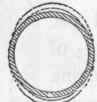
Figure 134.
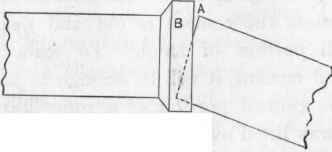
Figure 135.
It cannot be too strongly insisted upon that there shall be no parts where sewage can be caught or retained in any conductor.
Anyone, who has any knowledge at all of drains, would be able to form a very clear opinion as to their condition by simply smelling around the top of the ventilation pipe, and if the drains are trapped or disconnected from the public sewer, and yet he finds an abominable stench issuing from the vent pipe, he would know at once that something was causing these foul emanations, and as it could not be the materials of which the drains were constructed, it must be from something they contain and which should not have been there, and would not if they had been properly constructed and plenty of water discharges sent down them.
Continue to:


My Books

