


Chapter XLI. Cylinders And Hot-Water Circulation
Description
This section is from the book "Plumbing Practice", by J. Wright Clarke. Also available from Amazon: Modern plumbing practice.
Chapter XLI. Cylinders And Hot-Water Circulation
Hot-water cylinders should always be enclosed so as to avoid unnecessary waste of heat by radiation. They may be fixed in an enclosed recess, or covered with a non-conducting material such as "fossil meal," and other similar preparations.
A wooden casing may be fitted round them, with a space left between to be afterwards filled with a suitable material.
Dry hair-felt has been much used for this purpose, but the writer has recently had to take away all the felt that was placed round some hot-water pipes, as moths were found to propagate in that material. In the case referred to the moths propagated to an extent that would appear almost incredible, and then spread into the woollen furniture of a house and had played sad havoc, some being almost entirely ruined and spoilt. In another case fleas were found to an unpleasant extent, and the hair-felt had to be removed because it was found to harbour them.
For ordinary use "slag-wool" has been found very efficient to prevent radiation of heat from cylinders, and is free from the objections referred to above, but it is necessary to have an outside covering. As the cylinder is usually fixed in the kitchen, anything unsightly should be avoided. For first-class work nothing looks smarter than a polished mahogany lagging, with bright polished brass bands or hoops to hold it together, and if the hoops are tightened up with screws the whole enclosure can easily be taken to pieces should it be necessary to do anything to the cylinder or the connections.
I think I have read somewhere that in New York it is the practice to supply the hot-water system direct from the public water-main. This must be a very dangerous practice. Although the writer has no experience of this kind, still he cannot help thinking that there is danger of the boiler bursting, besides the annoyance of being without hot water should the mains break down or be emptied for repairs to them or any branch connections. Or the pressure from the mains would be seriously reduced should all the water be required to supply the engines when a fire broke out in the neighbourhood. In the writer's practice he always advises that the water be laid on from the main to a cistern or cisterns which will hold at least enough for twelve hours' consumption.
We will now return to the question of hot-water circulation.
The pipes between the boiler and cylinder should never be less than 1 1/4 inch in diameter, but 1 1/2 inch is much better. Or, if smaller pipes are used, the connections to the boiler should be of the sizes stated, as it is not at all uncommon to find the ends in the boiler partly filled with fur, and especially where very hard waters are used. The cylinder may be fixed in any convenient position, but it is usual and best to fix it as near the boiler as possible.
Figure 438 represents a very good way for connecting the pipes, and a great many men fix them so.
Figure 439 is another way much practised. In this figure the cold-water service pipe is connected with the return pipe to the boiler, for the reason that it has been thought not advisable for cold water to enter the boiler to replace the hot water that has passed away into the system of pipes. By connecting it with the return pipe a certain quantity of warm water from the cylinder mixes with the cold, thus not submitting the iron boiler to sudden expansions and contractions. In Figure 438 the cold water is shown as passing directly into the boiler. In Figure 438 the manhole is shown as usually fixed, and in Figure 439 it is shown near the bottom of the cylinder, so that any mud or sediment can be more easily removed. In Figure 439 the pipes from the cylinder are shown as running horizontally. It is found in practice that the water will not circulate so freely in horizontal as in vertical pipes. In cases similar to the one quoted it has been found necessary to fix the pipe, N, from the boiler flow to the cylinder flow pipe, so as to accelerate the circulation in the cylinder pipes. It may here be mentioned that no draw-off cocks should be fixed or connected to the boiler or cylinder, but should be branched into the flow pipe from the cylinder. The reason for this is, that should the cold-water supply be exhausted or cut off for any purpose, it would not be possible to empty the boiler, etc, for reasons it is not necessary to repeat. A special cock should be fixed for the plumber to empty the cylinder when necessary for cleaning out or making any repairs. This cock should have a square head, or else be locked up so that servants could not tamper with it or make use of it. This cock is shown at O, Figure 439. In some instances a pipe is connected with this cock so as to discharge the contents of the cylinder into a drain or waste pipe. This is not a good plan, as the cock may be left open so that the water can run to waste and not be noticed. It is much better to fix a bibb-cock as shown, so that the water can be drawn into pails. This gives a little more trouble to the plumber, but as it has to be done only once or twice in a year, the trouble is not worth considering. A stop-cock should always be fixed in the cold-supply pipe as shown at P, Figure 439, so that in case of accident the water can be shut off at once instead of the person in charge having to run to the top of the house, or wherever the cold tank-is fixed, to shut off the supply. No expansion pipe is shown in the figures, as it is usual to fix that from the highest point of the circulating pipes.
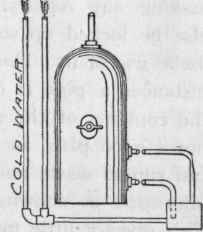
Figure 438.
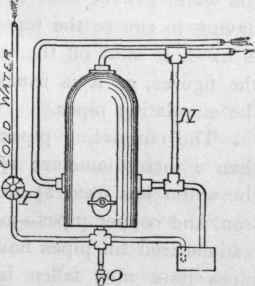
Figure 439.
The circulating pipes from the cylinder should never be less than 1 inch diameter; 1 1/4 inch is better, and for large mansions the writer has used 1 1/2-inch pipes. In addition to iron, galvanized iron, and copper pipes - as described in an earlier paper - lead and lead-encased tin pipes have been used for hot-water pipes. Lead pipes have now fallen into disuse; indeed, the writer has not fixed any lead circulation pipes for this last fourteen years. Hot and cold water passing alternately through lead pipes causes them to expand and contract to such an extent as to cause the pipes to break, and this occurs more when the pipes are too firmly fixed. Branch pipes frequently break near the joint to the main pipes. On looking closely at the ends of the fractured pipes the lead looks as if its particles were disintegrated, and there is no doubt that it is the want of tenacity in the metal that will not bear a tensile strain when shrinking that is the cause of the pipe being pulled asunder. The writer has used lead-encased tin pipe for hot-water work, and will not readily forget his first job. The great difficulty was to make the joints. A plumber's wiped joint was found to melt the inside lining of tin, leaving a thin shell of lead, the tin melting and running into a mass in the bottom of the inside of the joint. Blow pipe and copper-bit joints were tried and found to be failures. Next was tried a lining of pasted brown paper inside the joints and then an ordinary wiped joint made. This answered fairly well, but the paper was found to wash off, and several pieces would congregate in some bend or branch-joint and cause a stoppage. The ends of the pipe were packed with whiting, but that was not a success. Tinned sheet-iron nipples inside the pipe ends before wiping the joint were fairly successful, but it was found that gun-metal coupling-unions were the best means for connecting the pipes.
Continue to:


My Books

