


Chapter XIII. Lining Sinks
Description
This section is from the book "Plumbing Practice", by J. Wright Clarke. Also available from Amazon: Modern plumbing practice.
Chapter XIII. Lining Sinks
Sinks of all kinds are made in such quantities and of such a variety of materials, that one would think the plumber would never be called upon to make one. Some of these sinks are made of galvanized wrought-iron, but these are not much liked, as dirt accumulates around the rivet-heads, and so they are difficult to keep clean. Enamelled-iron ones are very good until the enamel gets chipped, but they are unfit for wash-up purposes, as, being very hard, they are destructive to crockeryware and any other frail articles that may be clean.' ed in them. Vitrified stoneware and pottery ware sinks are easily kept clean, but are very liable to get chipped, or perhaps broken, and are quite as ruinous to glass or chinaware as the other kinds of sinks described. These sinks are also very difficult to get true in shape, as they warp and twist very much in drying and burning. The sinks above described can only be had in what are called stock sizes, and if any other is wanted the buyer has to pay for the moulds and patterns, and also has to wait for several weeks until they are made. The manufacturer generally makes two, although only one may be ordered, as there is always a probability of one of them being unfit for use, and in which case, if that precaution was not taken, an interval of several more weeks would elapse before another one could be made, and attended with the same risks as for the first. Wooden sinks soon wear out, although they are the least destructive as wash-up sinks. Sinks made of slate slabs break by expansion when hot water is used in them. After looking all around, the plumber need not have any fear of these rivals, for it is almost impossible to have anything better than a good lead-lined wooden sink. Any plumber can make them, and to any size and shape; they are not destructive to what may be washed in them, can be made at once, and easily repaired when required, or the lead cut out and new put in when the old is past repair. The old material is a valuable set-off against the cost of the new. The only disadvantage they labour under is that hot water soon causes the lead to rise in buckles and eventually to crack and break, but this can be avoided by taking precautions which will be described. Sinks, as a rule, are lined in the same manner as cisterns, and generally about the same substance of lead is used. This is mistake number one, and is a false economy. If anyone would take the trouble to calculate the quantity of lead required for a sink, they would see at once that a few shillings or a dollar more would be in some cases sufficient to perhaps pay for lead double the substance, so that it would wear longer. As a rule it will be found that the ends and back side of the sink need not be quite so thick as the bottom and front side, but at the same time, as an economy, the four sides and bottom are sometimes made out of one piece of lead, so that the four corners only need be soldered, thus saving that material. This way of lining a sink has been described when speaking of cisterns. Another mistake often made is when the wooden case has its sides and ends at right angles to the bottom. When this is done, the lead lining is so fixed that it cannot expand when filled with hot water, so that the bottom bulges upward, and eventually a ridge is formed. As this ridge stands up a little it gets worn very much, and gradually gets worse and worse until it breaks. When this occurs, it is generally soldered over, leaving an unsightly-looking patch, very few plumbers taking the trouble to pull up the lead and dish out the woodwork beneath, and then dress the lead into it, so that it can be soldered flush with the surrounding parts. Sinks should always be repaired in this manner. It is advisable, before dressing down the lead into the dishing, to place two or three thicknesses of paper, so that when soldering the place the heat may not convert the water in the wood-work into steam, which would keep " blowing" through the solder. The plumber could also make a neater and quicker wipe, as the metal would not chill so quickly by the wet and cold beneath.
If sinks were made with sloping sides, as shown in illustration, Figure 115, the lead would not be held so tightly, and could expand and contract without such a risk of breaking, and would consequently last much longer. Of course it is very wrong to put a cistern where it is liable to be affected by frost; but if cisterns so exposed were made as described for the above sink, the expansion of the ice would not force out the sides and disjoint the dovetailed angles, as is so frequently the case. Another good plan, when lining sinks, is to have a hollowed wooden fillet fixed in each angle, as shown in section, Figure 116. In addition to distributing the effects of expansion, it avoids any sharp angles in which dirt and grease can accumulate beyond the reach of the scrubbing-brush. A great many men are in the habit of not only turning the lead on the top edge, but also down the sides for about 1 or 1 1/2 inch. This is a waste of lead, and it also leaves a dirty black mark on the dress of the person using the sink. It is generally done on the front side, so as to prevent the lead being knocked and buckled over into the sink, as shown in section at Figure 117, by standing pails, etc, upon the edge; but this can be avoided by putting an oak capping-piece and fixing it with brass screws as shown in section, Figure 118. This capping should be " weathered" inward, so that any water falling upon it will run into the sink. Where the sink is fixed in an enclosure, the capping should extend to the front so as to prevent any water falling down between, and also to hide the joint, which generally gets filled up with grease and other dirt. In hotels, clubs, and other large establishments, this capping can be made of galvanized iron, but in private houses the oak looks cleaner and neater.
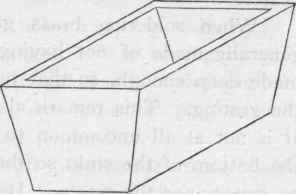
Figure 115.
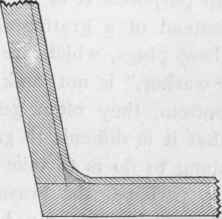
Figure 116.
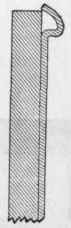
Figure 117.
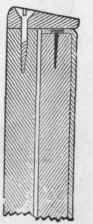
Figure 118.
When soldering brass gratings into sinks, the mistake is generally made of not having the dishing around the waste-hole made deep enough, so that tubs or pails may not bend or injure the grating. This remark also applies to gratings in stone sinks. It is not at all uncommon to see the grating stand higher than the bottom of the sink, so that to get rid of the water it has to be swept into the waste. It may have been all right when first fixed, perhaps, but the bottoms of these sinks generally get torn away by the iron hoops of tubs or pails, or when scouring copper cooking utensils.
When metallic or metal-lined sinks are required for washing-up purposes, it is necessary to have a plug over the waste-pipe instead of a grating, so as to retain the water in the sink. If these plugs, which are ground into what is commonly called the " washer," is not sunk below the level of the surface of the sink bottom, they often get jammed in by pails, tubs, or dishes, so that it is difficult to get them out. When this happens, the usual thing to do is to take hold of the chain and pull until it breaks, or, perhaps, the brass ring by which the chain is connected to the plug. This can be avoided by not only having the washer soldered to the waste low down, as stated, but in addition to have the plug itself hollowed so that the ring can drop down, as shown in section at Figure 119. Another reason why the ground in plugs sometimes gets fixed in the washers, is because the plug when cold is put into its place when the washer is hot, so that it is expanded, and which, on cooling, contracts and grips the plug so tight that in some cases they have had to be unsoldered before they could be got apart. It is always advisable to have wire cross-bars in the washer below the plug, to prevent spoons falling down the pipes and getting lost, or other matters getting into the waste which would choke it up. Some plumbers have gratings instead of the bars, but they generally reduce the water-way, so that the sink takes a long time to empty, or small matters get into the holes and clog them up.
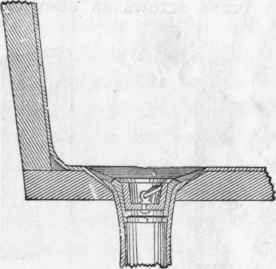
Figure 119.
For sink-tubs for washing vegetables, it is a very good plan to have a tinned-copper perforated strainer fixed in the angle to prevent anything getting into the waste pipe or plug-washer; this also prevents the plug from being jammed in.
It is important that all sinks with plug waste pipes should have an overflow pipe fixed, and this should be large enough to take away the water as fast as it runs in. Neglect of this precaution has sometimes resulted in serious damage to property, especially when the sink has been fixed in an upper storey.
Continue to:


My Books

