


Chapter XXXVIII. Hot-Water Boilers Or Water-Backs
Description
This section is from the book "Plumbing Practice", by J. Wright Clarke. Also available from Amazon: Modern plumbing practice.
Chapter XXXVIII. Hot-Water Boilers Or Water-Backs
It is only in large hotels and public institutions in England that a special provision is made for heating the water which is so necessary for the various purposes required, such as for supplying baths, lavatories, sinks, and for other domestic purposes, and in some instances for radiators and coils for heating the various corridors or rooms.
In ordinary mansions and private dwelling-houses it is usual for the boiler or water-heater to be attached to, and form an integral part of, the kitchen range or cooking-stove.
Figure 415 is a sketch representing a front view of an open range, such as is generally used in the kind of houses above referred to, and which has a large fire surface in front, before which joints of meat, game, etc, can be hung for roasting. In the sketch, A is a side oven sometimes placed as shown, and used for baking pastry, etc, in. Where no provision is made for supplying hot water to other places in the house it is usual to have a large boiler, sometimes made of cast and sometimes of wrought iron, placed at the back of the fire and extending the whole length of it. Where this, which is commonly called a low-pressure boiler, is used, a draw-off tap is usually fixed as shown at D. A small-sized feed-cistern with a ball-valve and the necessary cold-water supply pipe is fixed in a convenient position, and a pipe connection made between the feed-cistern and the boiler. Figure 416 is a sketch showing how this is done. At E is shown a bag in the connecting pipe, made to prevent the water circulating back into the feed-cistern, making the contents of that hot. But for this bag, or trap as it is sometimes called, the water in the feed-cistern would get very hot and give off steam to a very inconvenient extent. This bag, under certain conditions, must be made rather deep. When a large fire is kept up and not much water drawn from the boiler the water will expand in bulk, with the result that although a circulation may not be set up between the boiler and feed-cistern, yet the water will ebb and flow, so to speak, between them, and so raise the temperature of that in the feed-cistern. In some cases the boilers have tops bolted down to them and a hole cast in the top, over which is placed a loose cover. When the water in the boiler is so hot as to give off steam it will escape through the loose cover, the latter making an unpleasant clattering noise the whole of the time the steam is escaping. To prevent this noise it is usual to fix a steam or vent pipe from the boiler, as shown at F, Figure 416. The top end of this pipe is generally carried up the chimney-flue a few feet, some of the escaping steam passing upwards, but a great deal condenses and falls down on to the fire, sometimes bringing soot with it. This is very objectionable, especially where cooking has to be done over the fire. Cases have occurred where the steam pipe, when fixed as described, has had to be altered and continued to a place out-of-doors, or turned into a condensing-chamber.
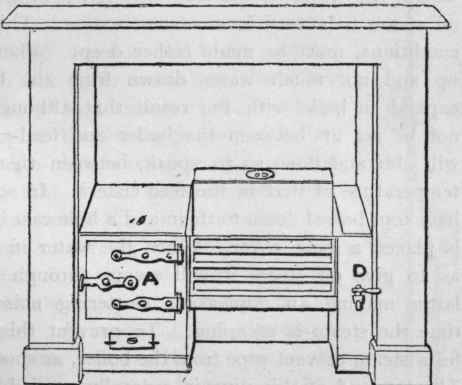
Figure 415.

Figure 416.
Where the boiler under consideration has been of wrought iron, with a manhole bolted or screwed on tight, the steam or vent pipe is indispensable. Water would not run into the boiler if it was air-bound, and when steam was generated it would force the water back into and overflow the feed-cistern. Figure 417 is a sketch showing an arrangement sometimes met with, but not by any means to be recommended. In the sketch, G is a cold-water cistern supplying the boiler, H, and also the cold-water draw-off tap, J. In a case that the writer had to alter, the work was fixed as shown. From appearances it was seen (and was confirmed by report) that originally only one pipe was fixed to supply the boiler and also the cold-water tap over the sink. Whenever the kitchen fire was alight a considerable quantity of warm water had to be run to waste before cold water could be drawn at the tap, J. As it was found that hot water passed from the boiler to the cold-water cistern, which was about 40 feet (forty feet) awa), the writer introduced an ordinary feed-cistern at L, so as to break the continuity of the feed pipe to the boiler. At the same time the expansion pipe, K, had the top end lowered so that if the water in the boiler got very hot and expanded it would overflow and run to waste, instead of forcing its way back into the feed-cistern. The tap, I, was fixed over the scullery-sink, and was the only means of drawing hot water from the boiler. In spite of the alterations made the job was a poor one, and the system is not to be recommended for anyone to adopt.
When repairing or altering work fixed some years ago, one often finds a low-pressure boiler and feed-cistern as shown at Figure 416, and a coil of lead, sometimes iron, pipe inside the boiler, one end of the coil being connected with a pipe leading from a cold-water cistern fixed on an upper floor, and the other end with a pipe leading up to a bath or sink. By this means cold water is simply passed through a reservoir of heated water, and in its passage absorbs and takes away a certain amount of heat. This system is not a good one and is now very rarely practised. One of the greatest objections is the coil has to be removed each time the boiler is cleaned out. Because of this the boiler does not get cleaned so often as it should be, and consequently soon wears out. When the coils are made of iron, oxidation takes place inside and outside at the same time, and they soon corrode.
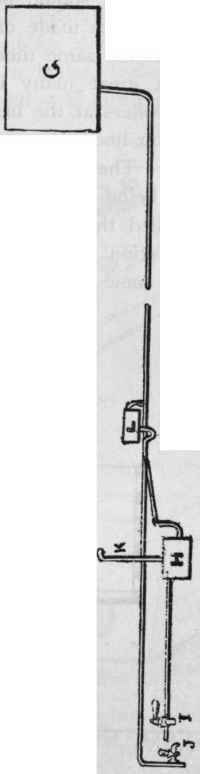
Figure 417.
A great many kitchen ranges of modern construction have two boilers at the back of the open fire, the large one, as shown by firm lines, Figure 416 and a smaller one, as shown by dotted lines. The former is called the low-pressure boiler, the draw-off cock being generally as shown at D, Figure 415. The other one is called the high-pressure boiler, and is connected by means of circulation pipes with a hot-water cistern or cylinder fixed near or at some higher place in the building so that hot water may be drawn at the sinks, baths, etc, on the various floors.
A great many hot-water engineers now omit fixing the two boilers in smaller houses, and arrange for the high-pressure boiler to provide all the hot water that is required. In clubs, hotels, and some of the largest mansions, the low-pressure boiler is fixed and fitted up slightly different, and is used to generate steam to be used for cooking purposes.
In some cases where very large fires are used, say 6 or 7 feet long, so that several joints of meat can be roasted at the same time, the fire lays against the iron boiler, and that is found sufficient to heat the water, but in smaller ranges a flue is constructed to pass beneath and up the back side of the boiler so as to get a larger heating surface. It is always necessary, when flues are fixed, to have dampers so as to regulate the draught.

Figure 418.
In some cases the fire-bars are continued beneath the boiler, as shown in section, Figure 418, at M but the writer has often found it necessary to put a dead-plate over that part immediately under the boiler to prevent cold air instead of heat passing up the flue behind. This cold-air draught is denoted by an arrow.
The shape of the boiler for open ranges is generally as shown at N, Figure 418, that being an end view, but for a close range, or what is commonly called a "kitchener," a boiler, technically named a "boot-boiler," is used. This is shown at Figure 419. A manhole for cleaning out and other purposes is generally placed at P, but the best makers have another manhole at Q. The reader will, no doubt, notice that from the manhole, P, access cannot very well be had to clean the toe of the boiler where most of the fur accumulates, and which it is necessary to remove at intervals of time. The boiler, Figure 419, has fire-bricks placed as shown at r, r, leaving an open space for the heat from the fire to pass up the back flue. A great many boilers are now made and used as shown at Figure 420, a flue being made in the boiler itself. These, sometimes called saddle-boilers, are bedded on a solid base of fire-bricks. A few boilers have a tube through them as shown at Figure 421, the fire passing through the tube and then up an ordinary flue behind the boiler. Where the kitchen fire has been expected to provide or heat sufficient water for a very large house, a double boot-boiler has sometimes been fixed. This is shown at Figure 422. The fire lays between the two feet of the boiler, and an under and back draught is provided for, as shown.

Figure 419.

Figure 420.
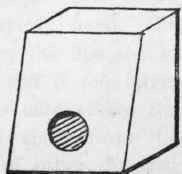
Figure 421.
In some cases water is circulated from a boiler fixed in a "hot plate." This hot plate sometimes has ovens also, and may be described as a horizontal kitchener. The shape of the boiler is usually as shown at Figure 423, the fire being in the centre at X.
There are a great many other-shaped boilers used, but the few illustrated are sufficient for our present purpose. A great many of them are rivetted together, but this last few years the welded boilers have come more into general use.
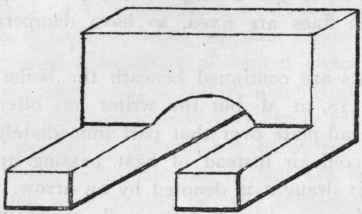
Figure 422.

Figure 423.
Continue to:


My Books

