


Chapter XXXIX. Circulation Boilers
Description
This section is from the book "Plumbing Practice", by J. Wright Clarke. Also available from Amazon: Modern plumbing practice.
Chapter XXXIX. Circulation Boilers
A great many blunders are committed by people who fix hot-water boilers. There are so many intricacies that no one, unless he has had a very varied experience, can always be oertain that his job is going to be a success.
The mistake is frequently made of people attending public exhibitions and such like places, where they see something they take a fancy for and straightway purchase it, or a facsimile of it, have it taken home, and then send for someone to fix it. After it is fixed, grumbling commences, even when the fixing has been properly done. In the case of ranges, one person will grumble that it burns too much coal, no doubt thinking that all cooking, etc, can be done by the range without any coals. Another person will grumble that the ovens will not bake, or the water in the boiler will not get hot. Perhaps the real fault may have been that the range, although a good one, was not suited for the particular class of work required to be done. It is to be recommended that, before buying, an expert should always be consulted as to the suitability of any particular fitting for its purpose. The above evils are aggravated if the range is not properly fixed. To confine our attention to the boiler - it is necessary the flue should not be too small, or it will choke up with soot, and if too large, a great deal of heat will pass away in a useless manner up the chimney. The division between the flues and those from the ovens should be built of fire-bricks, or made of other material that will not crumble away by the action of the fire, or otherwise be broken. If this happens, there can be no control over the heat from the fire, as it will pass away round the ovens when it is most wanted for the boiler, and vice versa. The flues should also be continued to a fair height inside the chimney, and more especially when the building is low, so that the chimney is short, and perhaps so situated that the draught is sluggish, and there is a certain amount of difficulty in getting the smoke to go upwards. On the other hand, in some cases the flues should not be too long, or the fire will burn coals to waste, and more heat be generated than is required.
Where the draught is too strong, and the fire is raised to almost a white heat, the water in the boiler will not get hot so readily as with a fire just above a red degree of heat. The reason for this, no doubt, is that an excessive heat acting on the iron repels the water on the inside of the boiler, leaving a space, and, as the water is heated by conduction, it necessarily follows that it must be in actual contact with the iron, or whatever the boiler is constructed of, to absorb the heat conducted by the iron. Experiments prove that iron heated to redness will repel a globule of water when dropped on it, but a drop of water placed on a piece of iron moderately heated is almost immediately evaporated, as in this case the water is in actual contact with the iron, but in the other case the water is repelled and a space left between, the water dancing about for some considerable time before evaporation is complete. If a piece of red-hot iron is plunged into a vessel of cold clear water, the red colour of the heated iron can be seen for some considerable time, until the temperature of the surface of the iron is so reduced as to allow the water to come into actual contact with it, when it soon cools.
Before the boiler is fixed in its position the plumber should always drill the necessary holes. Some men will chip the holes with a hammer and hand chisel, or use a diamond-pointed chisel, but it is better to drill them, as the holes are made truer, and there is not such a large burr left on the inside edge of them, which requires to be afterwards filed away.
The position of the holes should always be considered. No holes should be made near the bottom of the boiler, as any connection made at that point would, in some cases, become choked with sediment. Another reason is, that if a draw-off pipe is taken from the bottom, the boiler could be drained empty. When empty the fire would act on the iron, oxidizing it to a serious extent, and should water enter the empty boiler when very hot, the sudden conversion of water into steam would cause an explosion, and the destruction of the boiler. Neither is it a good plan to connect the pipes to the boiler on that part exposed to the action of the fire. In some cases the pipes have been fixed through the flues, but this has generally led to their early destruction by external corrosion, besides being an obstruction when the flues require to be cleaned.
One of the most important points to be considered is the way in which circulation pipes are connected with the boiler, and also that the boilers themselves are fixed so as to allow all air to escape when water is entering.
Figures 424 and 425 show boilers fixed unlevel, so that air is pent up at the highest points. Steam will generate in these airspaces, and eventually escape up the flow pipe with such violence as to alarm anyone near and lead them to think the boiler was going to burst. These noises in the boiler and pipes are worse still when the circulation pipes are too small in the bore, or have any contractions so as to impede the free circulation of the water, so as to convey the heated water away from the boiler as freely as possible.
Figures 426 and 427 illustrate bad or improper connections made between the circulation pipes and the boiler. In each case an air space is left between the water and the top of the boiler.
The return pipes in Figures 426 and 427 are denoted by the arrows pointing to the boiler, and may be fixed as shown, but the flow pipes should be connected so that they do not project inside the boiler. Figure 428 is a fragmental section showing how this is usually done by first-class workmen. The hole is tapped with a thread to suit the pipe, and a back-nut screwed on outside, as shown, so as to prevent the pipe being screwed in too far. This connection is a good one when the substance of the iron will allow for the threads being tapped, but when the boilers are made of iron of a light substance, a boss should be rivetted on for screwing the pipe to, as shown in section, Figure 429. Different kinds of waters have different effects on boilers. Hard waters will deposit lime to a very serious extent. The writer has found them with a lining exceeding an inch in thickness, and which could only be removed by chipping with a hammer and chisel Other waters leave a deposit inside the boiler in flakes of a reddish brown colour. This has been found nearly 2 inches thick, built up of thin flakes, and had accumulated in less than two years. Some little time ago the writer cleaned out a kitchen boiler that had no fur whatever on the inside, but he took out nearly a pailful of what can only be compared to gravel, the sizes of the granulated matter varying from a grain of rice to a large-sized horse-bean.
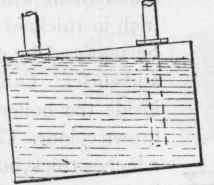
Figure 424.
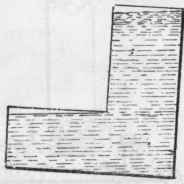
Figure 425.
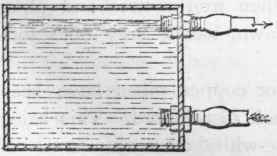
Figure 426.
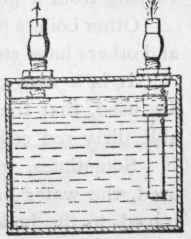
Figure 427.
Other boilers have been found with a kind of slimy coating inside, and others have rusted so that flakes of iron oxide came off the sides. It is a very common complaint, when iron boilers and pipes are used, that the hot water, when drawn, has a very objectionable dirty red colour.
Sometimes, when galvanized-iron or copper pipes have been used, the water has still been very much discoloured. This being traced to the boiler, a coating of lime-white or a thin wash of portland cement being applied to the inside has prevented any further oxidation of the iron boiler and discolouration of the water. When cleaning out boilers, it is generally difficult to get the furred matter out. In the first place the fur is very hard, and adheres very closely to the boiler. In the next place the manhole is generally too far away from where the fur most accumulates; it is also so very small that a man can only get one hand in at a time, and he can very rarely see what he is doing. In some cases special-made chisels, bent for the purpose, have to be used. Most of the boot boilers have only one manhole, and that is situated, as illustrated, at P, Figure 419.
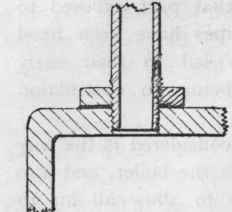
Figure 428.
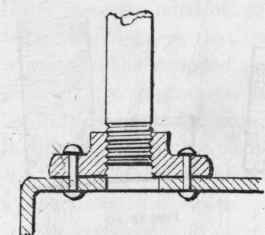
Figure 429.
These manholes should always be made water-tight. The importance of this was recently brought to the writer's notice. A house was changing owners, and the whole of the plumbing-work was being overhauled, when it was found that the kitchen boiler, which was working under a head of about 35 feet water pressure, was corroded all round the manhole, and so thin that an accident (?) would have occurred at an early date. Figure 430 is a drawing of a section of the manhole and part of the boiler, showing the position of the corrosion. It appeared that the manhole had leaked, but as the corrosion did not extend more than 1 1/2 inch at the widest part, and only for about 3/4 inch round the manhole, it is highly probable that a galvanic action had set up between the iron and the red lead cement which was used for bedding on the cover. The boiler was of wrought iron, and the manhole plates of cast iron. The wrought iron only was affected.
Figure 430 represents a manhole as usually fixed to boilers of kitcheners, but for an open-range boiler it is generally made as shown at Figure 431. The cover being fixed inside the boiler, and a bolt passed through an iron bridge-piece, fixed outside, and screwed up tight with a nut. The hole in the boiler and the plate are made elliptical. If made round it would be impossible to get the plate through the hole.
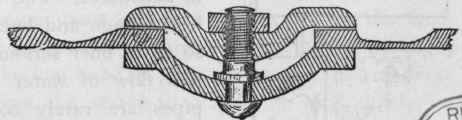
Figure 430.
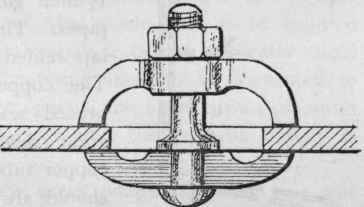
Figure 431.
Continue to:


My Books

