


Chapter VII. Joint Making
Description
This section is from the book "Plumbing Practice", by J. Wright Clarke. Also available from Amazon: Modern plumbing practice.
Chapter VII. Joint Making
A great many young plumbers, by dint of perseverance, succeed in wiping a very fair joint long before they know how to properly prepare the ends of the pipe. This arises from their being allowed to take a short piece of pipe, soiling and shaving a part in the centre, and wiping the joint on that, as if building the solder on was the only thing of importance. To prepare the ends of the pipe properly is of very great importance, and the soundness of the joint depends a great deal on this. In addition, care should be taken not to reduce the waterway, and also not to make the pipe any weaker at the joint. The ends should also be fitted very tightly, or else the solder will run through when the joint is wiped horizontally or underhand and lie in a body inside the pipe; or, if it is wiped upright, the solder that runs through falls down inside the pipe, like a lot of threads or fine ribbons, and lie in the pipe until the water is allowed to flow through. This causes the ribbons to get washed into the valves, causing them to leak by clinging round the working parts. First of all, when opening the ends of pipes, a box or other hard wood "tan-pin" should be used. The common way to open a large pipe is to dummy the end out, and for small pipes the end of the small bolt is often twisted round inside the end of the pipe to open it. Neither of these ways open the pipes true and even, and when the bolt is used the pipe is made rough inside, and also weakened at A, Figure 52. Both ends of the pipes should be opened. The advantage is, that it does not matter which way the current may be running, there are no sharp edges to check the free flow of water. If only one end of the pipe is opened, the entering end will sometimes curl inwards, especially if the joint is made upright, as the weight of the top piece presses upon that part, as at B, Figure 53; whereas, if both ends are opened this is avoided. One end must be opened wider for the other to enter. After the ends have been opened as described, they should be rasped or filed down to a thin edge on the outside, and care should be bestowed on this, especially for the entering end. If this is made as thin as possible it will give a little, and adjust itself to any little inequality on the inside of the other, or socket, end. Very few men take any pains with this, and most are satisfied with just rasping off the outer arris, or they sometimes whittle it off with a pocket-knife. When it is found that the ends do not fit tight, and there is a risk of the solder running through, the top edge of the socket end is closed round the entering end. This is a great mistake, as, if the ends are properly fitted, the socket end can be left open, as at C C, Figure 54; and if it is shaved inside the solder can enter and flow round, so that should none at all be left on the outside the joint would still be water-tight. If this was more often attended to there would be fewer sweaty joints.
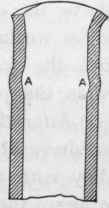
Figure 52.
After the pipe ends have been prepared so far, they are often rubbed with a piece of card-wire to take off the grease. This is a mistake, as a portion of the lead is scratched oft, and, although not much harm is done, still the pipe is unnecessarily weakened. If the ends are well chalked and then wiped with an old rag - which must not be greasy, or a handful of wood shavings, that is all that is required (unless it is old pipe and full of grit on the surface, when the card-wire is necessary). After the grease is " killed," the ends should be soiled and dried. Some plumbers shave the ends and soil them afterwards. This causes the pipe to be weaker at the ends beyond the joint than anywhere else, and the joints cannot be wiped quite so clean at the edges as when the pipe is soiled first and shaved afterwards.
Alter the pipes have been soiled and dried the next thing is to shave them. If this is not properly done the solder cannot alloy with the lead, and the joint will leak. To shave a pipe propeny the shave-hook must be sharp and must be held firmly.
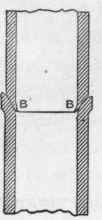
Figure 53.
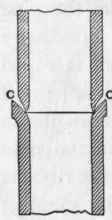
Figure 54.
It is important that the blade be firmly riveted or fastened on the shaft or handle. If these points are not attended to the lead is only scraped, leaving a dull face on it, or else the shaving gets on the edge of the hook and so prevents it taking off a clean shaving. Sometimes a false face is left on the lead, to which the solder adheres, leaving a space beneath through which the water can afterwards find its way. Although it is advisable to use a sharp hook and with a firm hand, it does not follow that unnecessary pressure need be applied to gouge out a deep incision in the pipe, as at D D, Figure 55, or that shaving after shaving should be taken off until the pipe is only half or perhaps a third of its original thickness, as shown at E E. It is not easy with small pipes, but for large pipes it is a much better plan, to shave round the pipe instead of lengthways. The hook for this, Figure 56, should have its cutting edge slightly rounding in its length to prevent the shavings clogging the edge, and it should have a small rounded corner for shaving the part that will form the end of the joint. It is a bad plan to use a sharp-pointed hook for this, as it makes the pipe very weak at this point, and there are very few plumbers who leave a body of solder right up to the end of the joint to fill up what the shave-hook has taken out. Very often a joint leaks because of a narrow strip of space not being shaved. If the shave-hook is passed round the pipe as well as lengthways, and the extreme end of the pipe carefully shaved so that the rasp marks are taken off - especially when they have become filled with soil, there is no liability of the joint leaking from that cause. Sometimes coarse rasps are used for preparing the ends of pipes; but a fine one, as used by cabinet-makers, is much better, as it makes the work smoother, and does not drag and distort the ends so much. During the operation of both rasping and shaving pipes, either for straight or branch joints, something should always be placed in the end or opening, as the case may be, to prevent the raspings or lead shavings falling into the pipe. If this was always done it would very often save the trouble of taking the valves and fittings to pieces to clear them. Where valves have india-rubbers they often get cut and want renewing because of this precaution not being taken.
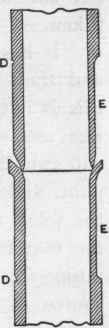
Figure 55.
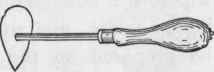
Figure 56.
Continue to:


My Books

