


A Stupid Multiplication Of Traps
Description
This section is from the book "Plumbing Problems", by The Sanitary Engineer. Also available from Amazon: Plumbing Problems, or Questions, Answers and Descriptions Relating to House Drainage and Plumbing.
A Stupid Multiplication Of Traps
A correspondent writes a letter which may properly be inserted in this place. He says:
" I send you a sketch of some plumbing-work which came under my notice recently, as it was being overhauled. Originally the drum-trap (pot-trap) at kitchen-sink connected directly by a 2-inch pipe with the 6-inch earthenware drain below the cellar-floor. The refrigerator-trap also connected to drain by a 1 1/2 -inch pipe. Neither trap was ventilated. This latter was soon disconnected and made to discharge in an open pail, which was emptied every day. Eventually the house-drain becoming clogged with grease, the plumber advised putting in a grease-trap. This sketch shows the result of his labor. Not only did he put a grease-trap (not ventilated) on the sink-waste, but also added a drum-trap to the refrigerator-waste and discharged it into the grease-trap. This job has just been overhauled, a 4-inch vent carried from grease-trap to roof, and an open tray put on the line of refrigerator-waste, so as to entirely disconnect it."
The multiplication of traps with air-bound spaces between them here shown is a flagrant case of stupidity. No such duplication of traps should be allowed. The better way is to terminate the wastes that deliver into the grease-trap above the water-line.

Figure 25.
Plumbing Blunders In A Gentleman's Country House.
It will be noticed that the man who did this work carried the vent-pipe A (Figure 26) into the continuation of the soil-pipe instead of out of doors, thus virtually neutralizing the benefits which the water-closet trap was intended to afford.
The 3/4-inch pipe B also affords direct communication between the soil-pipe at one end and the bath-overflow and inlet at the other, which, under less favorable conditions, might produce serious results. This is only another evidence of how gentlemen, anxious and willing to pay for what is right in their plumbing arrangements, are the victims of ignorance and thoughtlessness. It also shows how much more important it is to have intelligent workmen than expensive appliances.
Figure 27 illustrates the correct manner of arranging the traps and trap-ventilation. A reference to the previous sketch will indicate the points of difference.
It will be noticed, first, that the vent-pipe A from the receiver of the water-closet does not enter the soil-pipe, but leads independently to out of doors; secondly, the several traps are placed directly under the fixtures they are intended to serve.
The bath-trap is a half-s one, with a trap-screw close to the end of the bath and above the lead safe, the vent being close to it. As the least likely to get foul and offensive, we show a standing "overflow and waste; " if this is considered in the way and troublesome, then the overflow from the bath should be run as indicated by the dotted lines. The vent-pipe B, with which the vents from the several traps communicate, can run independently through the roof; but in this climate we should prefer to have it join the soil-pipe above, when any drainage enters the latter, the soil-pipe not being so likely to get closed by ice forming as the smaller pipe would be. The end of the soil-pipe should be without a bend or hood, as in this case there is no danger of articles being thrown down it.

Figure 26.
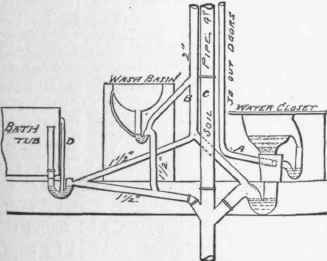
Figure 27.
A Trap Made Useless By Improper Adjustment Of Inlet And Outlet Pipes. The accompanying drawing shows what was found in an up-town louse in this city by a plumber who was called in to mend some leaky pipes. The pipe from the basin is supposed to extend down into the "round" or "bottle" trap, as is indicated by the dotted lines. The overflow-pipe entered the trap above the water-line, at the same level as the outlet, as shown, and the plumber who discovered the case and reported it to us stated there was a draught out of the overflow strong enough to blow out a candle. When our representative went to verify the matter he found the ' overflow closed by paper carefully pasted over it on the inside of the basin. This had been done by the occupants to keep out the smell, which was reported to be very bad.
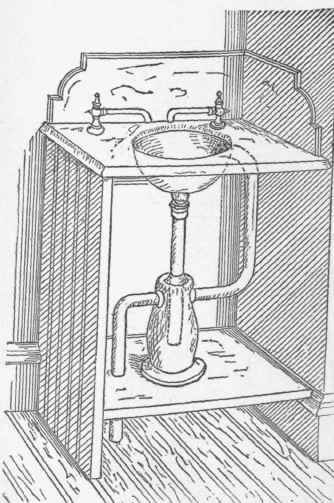
Figure 28.
Continue to:


My Books

