


Unreliability Of Heated Flue As A Substitute For Proper Trapping
Description
This section is from the book "Plumbing Problems", by The Sanitary Engineer. Also available from Amazon: Plumbing Problems, or Questions, Answers and Descriptions Relating to House Drainage and Plumbing.
Unreliability Of Heated Flue As A Substitute For Proper Trapping
Q. The sketch which I send herewith illustrates a job of drainage and ventilation which I did in this city. I would like to have your opinion of the work. The pipe H in the heat-flue is of 4-inch wrought-iron, and is completely coated on the inside with sewer-slime, while the other, E, in the middle of the house, is perfectly clean. The work has been in use about two years and a half, and there is not a particle of smell anywhere about the house. I can refer you to the owner, who lives in the house himself.
A. Judging from your sketch and description, we should say that the absence of any smell during the examination of the premises was due to the fact that such examination was probably made when the chimney was hot and the draught was down the pipe E, and through the pipe H in the chimney. In the absence of a constant heat in the chimney, we think the drain-air would be drawn through the 3/4-inch pipe into your water-closet container, and from thence into your house. This pipe practically neutralizes the protection your water-closet trap is intended to afford, and we should advise dispensing with it; also should prefer an iron pipe inside the house to terra-cotta, and one not larger than six inches; in fact, with proper fall and flushing 4-inch is large enough and less likely to get foul.
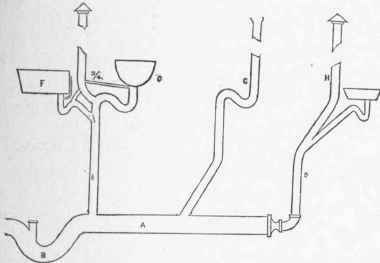
Figure 28.
A - Eight-inch terra-cotta pipe in the cellar.
B - Running trap.
C - Rain-water leader, with trap to prevent gas from corroding the leader-pipe.
D - Four-inch pipe to hot chimney.
E - Four-inch pipe.
F - Bath-tub.
G - A pan water-closet, with 3/4-inch pipe from the container into the soil-pipe.
In view of the foregoing, the propriety of the following, which was an editorial in the Sanitary Engineer of January 8, 1885, will be apparent:
Continue to:


My Books

