


Drainage Of A Saratoga House
Description
This section is from the book "Plumbing Problems", by The Sanitary Engineer. Also available from Amazon: Plumbing Problems, or Questions, Answers and Descriptions Relating to House Drainage and Plumbing.
Drainage Of A Saratoga House
Q. I am building a country house at Saratoga, and inclose herein that part of the ground-plan of each floor which is to contain the proposed plumbing, also an elevation.
I have laid a 6-inch drain-pipe, which extends from the house through a sandy soil, at a good decline, some 700 feet, where it empties into the open air, in a low part of my place, from whence it readily flows into a neighboring marsh.
An ample supply of water is furnished by a ram, through a 1-inch supply-pipe, to a tank in the garret, thus giving an abundance of water at all times. The overflow from the tank runs to another large reservoir in the barn.
I desire to have your suggestions in reference to the best mode of connecting the plumbing with the drain and how best to provide for a thorough flushing of the drain without great expense. Also, whether it would not be better to connect the butler's pantry and kitchen sinks with the main drain by an independent drain flowing through a grease-trap; if so, where would you suggest putting the grease-trap, and how would you construct it, and where would you make the connection with the drain?
By referring to the cellar-floor plan, you will notice that it is my intention to connect the main drain with the sewerage-system of the house near the lower water-closet, which is almost under the slop-sink in the second story, which sink is under the tank, from which it would be possible to create a large flow of water to cleanse the drain. Would the water flowing through an ordinary faucet amount to more than a " driblet" for flushing, or would a larger stream be necessary?
A direct connection between the pantry-sink and the kitchen-sink would be difficult, owing to the chimney which projects into the room, as shown on the plan. Would you advise running a drain separately from each of these sinks straight down to connect with a drain underground on that side of the house? In that case would one large grease-trap be all that would be necessary?
A. There should be a vertical line or "stack" of 4-inch iron soil-pipe leading straight down from the water-closet in the bath-room to the basement story, and also up through the roof. In the basement story there should be in this pipe, directly under the ceiling, a 1/8.bend and a Y-branch with a clearing screw in the other hub of the Y. Thence the pipe can be suspended to the ceiling or attached to the partitions and pass with a good slope to the neighborhood of the water-closet in the basement story. Here three Y-branches should be inserted at suitable places, though two can be combined in one if convenient, to secure the drainage of the water-closet by a 4-inch Y, and the drainage of the slop-sink by a 4 x 2-inch Y, and the waste of the wash-tray by another 4 x 2-inch Y. The pipe can then pass out through the foundation-wall and some two feet beyond it, all of iron. Beyond this the pipe can be of 4-inch stoneware, with a Y-branch, to receive the overflow of the grease-collector, of the same size. The main trap, with its open T-branch, for the air-hole just above it, can be placed close below this junction, and should be surrounded by a manhole, for getting access to it at any time. If possible, let the trap be at least six inches below the drain discharging into it, so the sewage will fall into the trap from above. It is also a good plan to lead a rain-spout into it by an open connection.
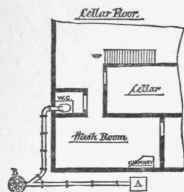
Figure 29.
A - Grease-trap. B - Manhole.
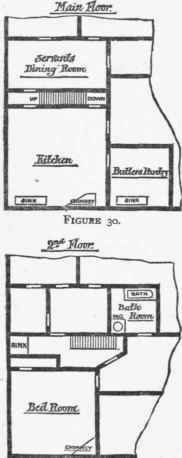
Figure 31.

Figure 32.
The branch-waste from the slop-sink should extend up through the roof, and should not be less than two inches in diameter above the roof and for two feet below it, though it should be larger, as hereafter explained, if the flush-tank is located in attic. The branch from the wash-trays may 1 1/2-inch if of lead or 2-inch if of iron.
The waste-pipes from the kitchen-sink and butler's pantry should pass straight down to the basement story, and be provided with clearing screws, where they turn to discharge into the grease-basin. This should be outside and back of the chimney. It should be built of brick, and the overflow from it can be earthenware pipe, with its intake orifice at least six inches under water and joining the main drain just above its trap, as above described, opposite the corner of the house. But if the outlet be a T instead of a bend, it will be more readily cleaned out from above.
Of course, separate traps must be provided for the slop-sink, the bath-tub, the wash-trays, and the kitchen-sink, and for the butler's sink, and any other fixtures that may be provided.
The air-pipes from the traps at the cellar water-closet and the wash-trays and sinks over them can all join into one and connect with the air-pipe above waste of slop-sink, where a branch should be inserted for the purpose.
The air-pipes from the traps under the butler's pantry-sink and traps, and under the bath-tub and chamber water-closet, can also be combined and branch into the upper part of soil-pipe just above the water-closet trap.
Your proposed method of disposing of your house-drainage will inevitably make a nuisance in the "marsh." It would be better to distribute it on a field of grass, if you have one, where the ground would not become sodden and saturated with the water. But if you allow it to run in one place as it comes from the house it will certainly make a nasty place of it.
If you have a good fall, as we understand, it would be a good plan to make the discharge intermittent by building a small tank, to be discharged when it is full by some automatic arrangement just below the outside trap. Field's syphon will work well if applied with the clean water that overflows from the house-tank, and can thus be made to flush the whole drain below. The barn can be supplied by a part of this, and the rest used for flushing. The flush-tank can be placed in the attic alongside the supply-tank, if convenient, and thus flush the drain inside the house as well as outside.
In this case a 3-inch vertical pipe should be provided for the flushing, and it can receive the drainage of the slop-sink on the chamber-floor, and extend up through the roof. A flushing-tank of this sort should not be less than some fifty gallons capacity and the syphon not less than three inches.
No constant flow of water from a faucet will flush your drains. This can only be done by a sudden discharge of one or two barrels at once by a flush-tank, as we now recommend.
Continue to:


My Books

