


Where To Place Burners To Ventilate Flues By Gas-Jets
Description
This section is from the book "Plumbing Problems", by The Sanitary Engineer. Also available from Amazon: Plumbing Problems, or Questions, Answers and Descriptions Relating to House Drainage and Plumbing.
Where To Place Burners To Ventilate Flues By Gas-Jets
Q. I noticed a peculiar and very effective way of ventilating a hopper water-closet and urinal in a Boston store, and I think it would be of interest to your readers. I inclose a sketch of arrangement, and would like to ask a question.
The fixtures were located in a dark basement. It was necessary to provide a light. This light was utilized in the manner shown to produce the ventilation of closet and urinal. A brick flue was found, and from it was taken a 4-inch spiral sheet-iron pipe, D, and carried across the room, taking out the 2-inch pipe C to the water-closet and 2-inch pipe G to the urinal, connecting them as shown, with openings close to the water in the hopper and outlet and drip from the urinal.
An opening about an inch in diameter was made into the pipe D over the gas-flame, and an inverted funnel attached, with the large end about six inches above the flame. In practice the heat of this flame (an ordinary 4-foot burner) was found to cause a very strong current of air toward all the openings at the fixtures, as shown by the arrows, and, of course, thoroughly ventilate each one.
Should you not suppose a large quantity of air would enter the pipe at the open funnel from the room, as shown by the arrow at F, and would it not be better to close that opening and place the flame close enough to the outside of the pipe to give it the necessary heat, and then would it not produce a stronger current of air at the openings at the fixtures? Please give your valuable opinion on this little thing, if not too much trouble, and settle a dispute between the writer and another.
A, The change you suggest would be open to two objections. First, you would, as in the present instance, waste half the heat produced, if not more; and, second, the products of combustion of the gas would thus be left to defile the air of the house, and the flame of the burner would be likely to melt the solder of the pipe and would deposit soot upon the outside and make a dirty mess of it. The proper way to use a gas-burner to create draught is to inclose the burner in a small fixed glass box or lantern, with a hinged opening for access to the inside, so the burner can be cleaned, as well as the glass, when needed. Then connect the top of the lantern with the chimney-flue, and the bottom of the lantern with the closet-bowl and urinal, by about three inches diameter. By this arrangement all the heat evolved by the burner will be utilized to make the draught, and all the products of combustion will be carried off, while the air will be all drawn from the points desired - viz., the closet, bowl, and urinal.
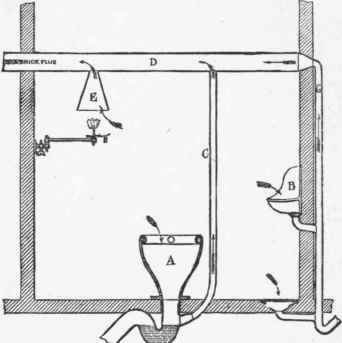
Figure 58.
Q. I wish to produce a draught in a ventilating-flue by using a gas-jet for that purpose. Two arrangements of the jet have been suggested. One is about as follows:
The gas-jet is set under a flat metallic hood, made double, as shown in the sketch, it being intended that the jet shall heat the metal of the lowest hood, which will in its turn heat the air which passes in between the two hoods, or parts of the hood, as indicated by the arrows. The other is to simply inclose the jet in a small chamber or lantern in the flue, as is the very common practice. I am told I will produce a stronger current by the first method, because I heat a large surface, which in its turn heats a large stratum of air, while with the lantern I only heat a small surface of air as it comes in contact with the flame. Nevertheless, I prefer the second, because I think I can heat air better by bringing it directly into contact with the flame than if I used the flame to heat a metal surface first Indeed, the idea first suggested seems to me like inventing fictitious heat to make up for the loss which always occurs in heating the metal surfaces.

First Plan. Figure 59.

Second Plan. Figure 60.
A. We believe the best results will be secured by the latter plan, since less of the heat is lost by radiation into the room.
Continue to:


My Books

