


Soil Pipe Connection To Closets
Description
This section is from the book "Principles And Practice Of Plumbing", by John Joseph Cosgrove. Also available from Amazon: Principles and Practice of Plumbing.
Soil Pipe Connection To Closets
The usual method of fastening water closets to the lead soil pipe is to solder a brass floor flange, Fig. 147, to the lead soil-pipe and then secure the closet to the floor flange by means of brass bolts. A paste made by mixing putty with red or white lead is placed between the two flanges to make a gas and watertight joint. An improved form of closet connection, Fig. 148, that does away with the putty joint is now extensively used. It makes a metal to metal connection between the closet and floor flanges. The construction of this closet connection is simply a brass-flanged nipple, a, securely fastened to the closet flange, b, by means of brass bolts, c, and a lead-caulked joint, d. The joint is made water tight by a hard setting cement placed between the flanges of the nipple and the closet. A brass coupling, e, is soldered into the soil pipe, f, and the closet nipple screwed down tight into the coupling.
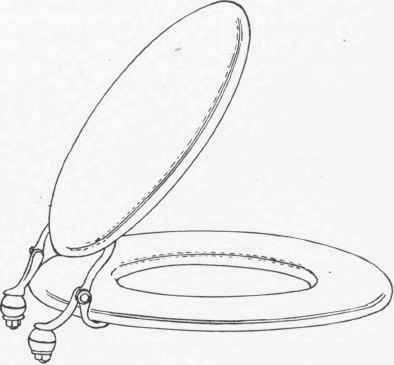
Fig. 146
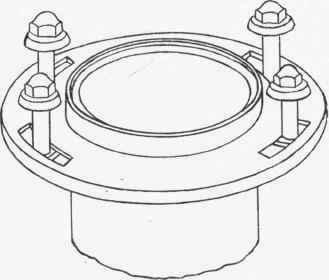
Fig. 147
Flush Pipes are generally made of lead pipe or of brass tubing; if of brass tubing, they may be either plain or nickel-plated. Flush pipes should never be less than 1 1/4 inches inside diameter, and for siphon-jet and wash-down closets they should be at least 1 3/8 inches inside diameter. On the better classes of work flush pipes are connected to the closet bowl by means of brass slip joints. For cheaper work, rubber couplings make a good connection. They are strong, flexible, easily replaced, and often by their elasticity protect the closet horn from being broken when the flush pipe or closet receives a jar.
Continue to:


My Books

