


Chapter XXVI. Rain-Water And Rain-Water-Pipes
Description
This section is from the book "Principles And Practice Of Plumbing", by S. Stevens Hellyer. Also available from Amazon: Principles and practice of plumbing.
Chapter XXVI. Rain-Water And Rain-Water-Pipes
1. WHERE sewage is utilized for irrigation, and also where liquid sewage is discharged into soakage-cesspools, the rain-water and the surface-water should be kept out of the soil-drain; except that in some cases, to save the expense of laying down what would be a costly piece of drain, and also where a rain-pipe has not much duty to perform, the rain-water may be turned into the soil-drain, as shown in fig. 107.
2. The disconnecting trap which should be selected for such a purpose should be one into which some fixture discharges, such as a bath, sink, or lavatory, to prevent the water-seal evaporating, which would at once set up air communication between the soil-drain and the rain-water drain.
3. In country houses there is generally little or no difficulty in separating the rain-water-drain from the soil-drain. When the rain-water is not collected into a storage tank for any purpose, it can be kept quite separate from soil-drains and dirty-water-drains, and conducted to some place where it can gravitate away without inconvenience to anybody or damage to anything.
4. Where the water supplied to a house from a company's main, or spring, or well is hard, the rain-water from the roofs should be Stored in an underground tank, for laundry and lavatory purposes, if for no other. The capacity of the storage tank should be equal to a month's consumption, or more; and where a house would be entirely dependent upon rain-water for all purposes, the storage should be equal to the supply of from between twenty and thirty gallons of water per head per diem for forty or fifty days; and where a house is wisely provided with hot-water circulation and a bath, the maximum quantity should be arranged for.
5. Rain-water should be filtered before it is allowed to enter the storage tank, not for the purpose of purifying it, but for clarifying it.
In fig. 106 a section of a fairly good filter is shown. A bed of well-washed fine gravel, to a depth of 6 in. or 9 in., is laid over the whole of the floor of a cement-lined and brick-built chamber, of a capacity equal to passing the water through it without overflowing. In the receiving compartment a stratum of coarse gravel, about 6 in. deep, is laid upon the bed of fine gravel, and over this is placed a layer of shingle or broken flint, and then over the whole a floor of bricks or tiles is laid, to form a better surface for removing leaves and other foreign matter which may get washed into the filtering chamber. The outlet compartment is filled up with fine gravel, so that when a covering of bricks is placed over the gravel - to prevent a rush of water carrying it away - the upper surface of the floor shall stand an inch or two below the outlet or pipe which is to convey the filtered water to the storage tank.
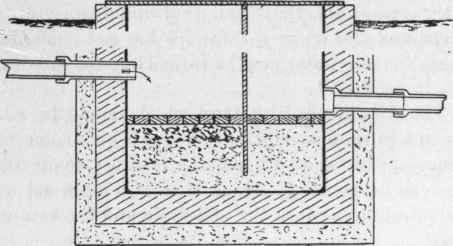
Fig. 106. - Rain-Water Filter.
6. Roberts's Patent Rain-Water Separator is a clever arrangement for preventing the first portion of the rainfall passing into the storing tank, and where we have fixed them we have found them of good benefit.
7. The soft water from the storage tank can be pumped up into cisterns fixed high enough to supply draw-offs to sinks on the bedroom floors for toilet purposes; and a branch pipe from the service main can be carried to a slate cistern on a lower level, for supplying the water for boiling vegetables, and for filling tea-kettles, etc.
8. Rain-water pipes are often fixed of larger size than necessary. An occasional stoppage in rain-water-pipes is caused by a defective grating, or by a grating with too large a mesh, or by a badly-fitted grating over the cesspool socket or entrance to the pipe, rather than by the smallness of the pipe. This is often the case in country houses, where leaves are blown on to the roof and washed down into the cesspool.
There is not only the debris from the roof - the bits of mortar, the broken tiles or slates, the fallen leaves - there is the rust from the interior of the pipe, for this is the age of iron, and rain-water-pipes are generally made of cast iron. In times of little or no rain such things accumulate at the bottom of a stack of pipe and block it up; for it is seldom that any means are provided for the removal of such accumulations. Many years ago I invented and patented an access-shoe (as illustrated in fig. 107), which not only affords a ready access to the foot of a rain-water-pipe for cleaning it out, but gives it ventilation. Where a grating would suggest an improper use of the shoe, a movable cover can be substituted.
Where the mouth of a rain-water-pipe is under or near a window, and it has not much rain-water to carry off, as when fixed to a small verandah or flat, to a porch or bay-window, it may be made to deliver over a surface channel. 9. Whatever kind of pipe may be used outside the walls of a house, all rain-water-pipes fixed inside a house should be of lead, with wiped soldered joints, so that there may be no doubt as to the soundness of the pipes or their joints. And then if any bad air got into such pipes through some bad trapping, or some defective arrangement of the drain connections, there would be no risk of the air entering the house through defective joints, as would be the case were cast-iron rain-water-pipes fixed.

Fig. 107. - Showing Disconnection and Access to Foot of Rain-Water Pipe, etc.
10. I know it is easy to lay down a rule that "all rainwater-pipes shall have their discharging ends opened up to the atmosphere before connection with either a dirty-water or soil-drain." But where there are no areas, where the external walls of a house or building stand upon the boundaries of the property, as is often found in cities, how is this to be done? Well, with care in the planning, even in such cases the pipes can be carried along on the face of basement walls, or suspended from the floor joists; or they can be collected into a drain and carried along under the basement floor, quite independent of the soil-drain, to one place of discharge.
If practicable, in such cases, the rain-water-pipe or rainwater-drain should be carried to the head of the soil-drain for the rain-water to be discharged into it through an automatic flushing tank, twenty, thirty, or forty gallons at a time. In any case only one opening should be made in the soil-drain, and the rain-water-pipe or drain should be carefully trapped off from it to exclude the drain air, and fresh air should be brought into the rain-water-pipe or rain-water-drain, on the house side of the trap, from some convenient place above the pavement, a grating being fixed in the wall over the mouth of such induct pipe.

Fig. 108. - View of a Rain-Water Head.
If no better place can be found for the rain-water disconnecting trap, it may be fixed in the disconnecting chamber of the house-drain to the sewer, and this can be so done that no air shall be able to pass from the chamber into the rain-water-pipe.
11. In the rain-water-heads and rain-water-pipes of an artistic building, the skilful plumber has often a grand opportunity afforded him, not only for displaying what skill he possesses in the art of manipulating lead and working it up into noble, well-proportioned heads, but for showing his ability in ornamental tacking and graceful bending of the pipes.
12. Where two cesspools, or two gutter-shoes, stand near each other, instead of fixing two stacks of rain-water-pipes or carrying one of the socket-pipes along the face of a wall horizontally, to deliver into a small rain-water-head, it is better to extend the head for one gutter or socket-pipe to empty into it at one end, and the other socket-pipe at the other end. The stack-pipe can go down from the middle, or from one end, as shown in fig. 108, which is illustrated from a photograph of a head made at my works about eighteen years ago.
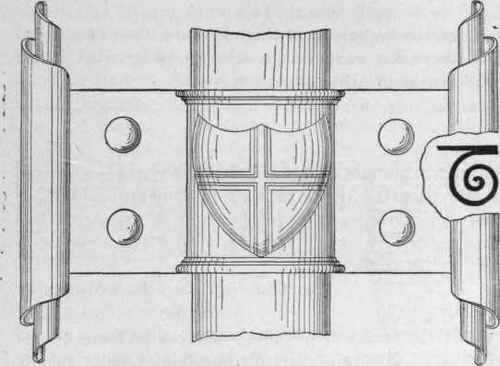
Fig. 109. - View of Socket-Tacks.
13. Instead of reducing the bottom end of a 6 ft. length of pipe, and thereby restricting the water-way, the top end of the lower pipe should be opened out, and a deep socket formed upon it for the end of the upper pipe to enter it freely. Almost any device can be formed on the socket, or planted upon it. Or the socket and astragals can be cast all in one, with or without the tacks. (Chap. XXV., Art 5.) The edges of the tacks can be curled, as shown in fig. 109, or treated in a great variety of ways.
Continue to:


My Books

