


House-Drains (Continued). Disconnection And Ventilation. Part 3
Description
This section is from the book "Principles And Practice Of Plumbing", by S. Stevens Hellyer. Also available from Amazon: Principles and practice of plumbing.
House-Drains (Continued). Disconnection And Ventilation. Part 3

Fig. 176. - Scott-Moncrieff's Cast-Iron Drainage-Trap.
17. In ventilating a drain the inlets and outlets should be so arranged that the air in every part of the drain should be constantly changed. In one of my lectures about ten years ago I showed, by means of glass tubes and smoke, that a single pipe, no matter of what size, or in what part of a drain it was placed, acted only as a vent to a drain, or to a soil-pipe, and did not change the air in it.

Fig. 177. - Section of Smeaton's Cast-Iron Manhole and Trap.
18. A model house-drain, consisting of inch glass tubes and stoneware traps of corresponding size, was placed upon the table, practically as shown on plan, fig. 179. Inch glass tubes were fixed at s p1 and s P2, to represent vertical stacks of soil-pipe, and these were so arranged that either or both could be sealed over and put out of use at pleasure. Model traps, made of stoneware, were connected to the house-drain for disconnecting the bath, sink-wastes, and rain-water-pipe.
A trap for securing the grease from the drain was fixed as shown on plan, and provision made for fixing an automatic flushing-tank at the head of the drain.
The trap to aerially disconnect the drain from the sewer was fixed at d t, with a glass pipe-shaft carried up to the surface, for the admission of air to the drain directly over the head of the trap; but for the purpose of seeing from what distance air could be brought into a drain without materially affecting the ventilation, another air-inlet was attached to the pipe-shaft, as shown in dotted line f a i2, both inlets being under control by the use of stoppers.
19. The glass drain was filled with smoke and the stack-pipe, s P2, opened full bore, all the air-inlets being sealed off, as was also the stack-pipe s pl, but there was no perceptible movement of smoke in the drain, though a little smoke at times issued from the open stack-pipe, but only as the smoke and air in the drain and pipe expanded, from being more rarefied.
But even a partial opening of the air-inlet, either directly over the disconnecting-trap, at f a i1, or of the more distant inlet at f A I2, sufficed to rid the drain of every vestige of smoke. With both stack-pipes open for ventilation it was found that the current was generally greater in one stack-pipe than in the other; and this proved what had been stated in a previous lecture, viz., to insure perfect ventilation of a stack of soil-pipe, every stack-pipe should have its own inlet as well as outlet, or one stack upon a drain, where there were several others, and the admission of air to the drain was from one point only, would get more than its fair share of fresh air, - as one sucking-pig, by vigorous sucking, generally manages to get more milk out of a trough than any other of a litter.
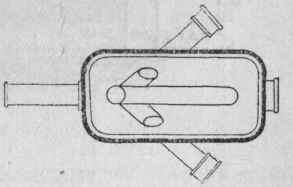
Fig. 178. - Plan of Trap, Fig. 177.

Fig. 179.
20. To set up an air-current in the drain, and to quickly clear it of smoke, it was only necessary to expose both ends of the drain to the air in the room. Nor was it necessary for the complete clearance of smoke to open the ventilation-pipes full bore; i.e., a ventilation-pipe at the head of a drain at s p2, though only equal to one-fourth of that of the latter, with an induct-pipe at f a i1, also of a size much smaller than that of the drain, would create a current right throughout the system, whilst a single pipe at s P2, or at s p1, or in any other part of the drain, though of larger bore, would only allow the air in the drain to come out of the pipe as it expanded in the stack-pipe from the heat of the sun, or became rarefied in the drain from hot water discharges through it, or from displacement, but there would be no ventilation either of the drain or the soil-pipe by one open pipe.
21. If there is to be ventilation in a drain, or soil-pipe, there must be both an inlet and an outlet, for the air to pass in in one place and out at another. From nothing you can take nothing. So, my reader-friend, - to turn for a moment from the house for the body to the house for the mind, - if you want to take any money out of the bank when you are too old to work for it, you must put it in now when you are young and able to make it, and when you do not stand so much in need of the comfort it brings, or there will be but poor currency for you should such an evil day ever come when the circulation ceases, for where no money comes into a pocket no money can go out of it.
22. When the drainage system is perfect, there is not the same necessity for trapping off soil-pipes and disconnecting them from the soil-drain as there is where the drains are foul and faulty. (Chap. XXVII., Art. 15.) In fact in many cases it would be better to make all the soil-pipes upcasts to the drains, and not to trap them off; though where they are so treated it is always advisable to aerate them - to provide each soil-pipe with a fresh-air inlet, i.e., over the junction of the soil-pipe (the branch drain) with the main drain there should be built a manhole, somewhat as shown in fig. 115, Chap. XXVII., and also as shown in dotted lines at f a i3 and f a i4, fig. 179. As explained in Chap. XXVII., Art. 16, where the mouth of such an inlet would stand inconveniently near an entrance to the house, near a window or door, or in a confined nook, etc., it should have a mica-valve fixed over its mouth.
23. Where cast-iron ventilation-pipes are fixed, and their interiors are not protected from rusting, proper pockets for catching rust should be fixed at the bottom of all long vertical lengths, to prevent blockage.
24. Whatever kind of pipe may be fixed, whether cast-iron (Chap. XXVII., Art. 5), or galvanized cast-iron (Chap. XXVII, Art. 6), or lead (Chap. XXVII., Arts. 1, 2, and 3), the pipes should be carried up to the very highest parts of the roof, full bore, where the wind coming from any direction could blow any foul air emitted from them away from the surroundings.
25. To terminate a ventilation-pipe from a drain or soil-pipe, as shown in fig. 118, or in fig. 180, in any of the following positions - which, alas! is often done - is only an ostrich-like way of "protecting " a house; viz., terminating a ventilation-pipe under the eaves of a roof, or close upon the sloping side of a roof, where the foul air would find an easy passage through the tiles or slates into the roof, and thence into the house; under or near a skylight, dormer, or other kind of window; near a void or well-hole; or in the vicinity of the cistern-room, or place of water-storage, where the bad air emitted from such pipes could enter the cisterns to contaminate the water; or at the top of some chimney-stack, where the ventilation-pipe could pour its contents almost undiluted down a chimney, as shown by the illustration, fig. 180, which, together with the explanation which follows, are taken from my " Lectures ":-
"In 1881 I was staying at the Royal Castle Hotel, Lyn-ton, which is built on the crest of a hill overlooking the Bristol Channel, and the valley of the East Lynn. Being anxious to get a good view from my bedroom window, I selected a bedroom at the top of the house, and lived to regret it; for though the morning's sun 'tipped the hills with gold,' I could not see them for the dense smoke which filled my room. I was not long in seeing where the smoke came from, so I jumped out of bed, and provided an exit for it by opening one of the windows, and then returned to bed again to watch the movements of the smoke. Down the chimney it came in clouds, filling the room from floor to ceiling, and went out of the window in a fitful sort of way, and as it gave every sign of continuing this course for some hours, I withdrew from the bedroom, feeling comforted that it was only smoke, for if a ventilation-pipe had been near such a chimney, it might have been drain air instead of smoke, and what a change of air that would have been, even though I had come from Cologne!"
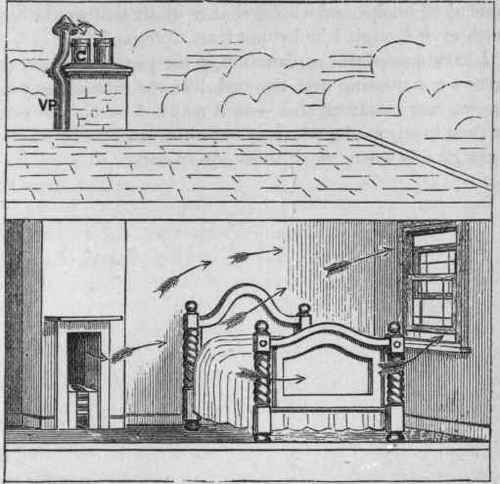
Fig. 180. - Showing Bad Position of the Terminal of a Ventilation-Pipe from a Drain.
I have quoted this explanation of the picture - where the arrows are crossing over the bed, like the rats in the well-known magic-lantern slide - as it may not be without some interest to any reader who may have honoured me by wading through this weary work to its weary end.
Continue to:


My Books

