


Soil-Pipes And Their Disconnection And Ventilation. Part 2
Description
This section is from the book "Principles And Practice Of Plumbing", by S. Stevens Hellyer. Also available from Amazon: Principles and practice of plumbing.
Soil-Pipes And Their Disconnection And Ventilation. Part 2
In my works, when cast-iron soil-pipe is insisted upon, for inside work I require that the pipe shall be that known as underground water-main, the thickness being nowhere less than 3/8 in. For outside soil-pipes I prefer that the pipe shall be not less than 3/16 in. thick in its thinnest parts, and that there shall be a space of at least J in. all round between the external face of the spigot and the internal face of the socket, for filling in a fair thickness of cement, whether Spence's metal, as preferred, or marine glue, or any other kind.
9. Cast-iron pipes much too thin to be durable, and with thin sockets too small to have dependable joints' made to them, are very frequently fixed even in houses of some pretension; but the plumber should have nothing to do with iron pipes for soil-pipes and waste-pipes which will not admit of a fairly reliable joint being made to them. When the spigot end of a pipe occupies the entire space of a socket, how is it possible to work down into the socket, between the faces of the two pipes fitting so closely, a thickness of any kind of cement which shall be durable? The consequence is that such joints are soon made faulty by the sucking actions of the discharges sent through the pipe, even supposing they are not broken by the expansion and contraction of the pipes.
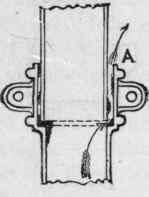
Fig. 111. - Defective Cement Joint.
Where pipes are simply painted, the unprotected faces of the socket and the spigot oxidize rapidly. And this rust or oxide which forms upon the iron goes on increasing in bulk, taking up oxygen from the air, until its force is sufficient to break the socket of thin iron pipes. Also such sockets are at times charged with water, from the condensation which runs down the pipe, and in severe frosts this water becomes frozen and bursts the socket.
10. Then, as I have explained elsewhere, the jointing of iron pipes is never so wholesome as the jointing of lead pipes. With lead pipe, as shown in section, fig. 36, the connection is so close that there is no space or ledge for filth to accumulate in or upon; but in iron pipes, whether cast or wrought, thick or thin, there is always an annular space, or a ledge, or uneven faces where filth more or less can accumulate in or upon. And this evil is aggravated, for in order to keep the molten metal, or fluidal "cement" from running into the interior of the piping, the sockets are first partly filled with a ring or two of "spun yarn, and this absorbent material, when there is a stoppage, or when the pipe is charged, soaks up liquid matters, whether infectious or otherwise. It may not be much in quantity, but if multiplied by every joint in a stack, and by every stack in London, the air of the metropolis would not be so pure as it might be, or as it would be, were lead soil-pipes, with wiped soldered joints, fixed everywhere.
11. As the mouth or top of a rain-water-pipe is generally so situated that any air emitted from it would enter the house through some window, skylight, or lantern light, or between the slates or tiles, or in some other way, no soil-pipe or dirty-water-waste should be fixed in communication with a rain-water-pipe.

Fig. 112. - Showing a Stack of Soil-Pipe, with Main and Minor Branches, and with Lead Traps soldered to same, for receiving a range of valve-closets on each of two Floors, with Anti-Syphoning Pipe complete.
12. I was much criticised when giving my lectures a decade ago for advocating the use of small soil-pipes, but more especially for recommending outside soil-pipes. Since that time thousands of stacks of 3 in., and 3 1/2 in., and 4 in. soil-pipes have been fixed on the external faces of external walls, where they have stood trials from within as well as without with perfect success. But as I said at the time, "I would not pull down a house in order to fix the soil-pipe outside "; nor would I do what is often done, viz., in order to keep the main soil-pipe outside the house, fix long branches from it to the closets, the united length of which would make the total length of soil-pipe inside the house - calculating the parts which pass through the internal wall - reater than would have been the case had the main stack been fixed in a chase inside the house.
(a) Where a lead soil-pipe, if fixed outside, would be exposed to the full power of the sun for many hours in the middle part of the day, to prevent the pipe being contorted, and, perhaps, broken by expansion and contraction, I should prefer it fixed inside.
(b) I should also prefer the pipe fixed inside where a closet on each of many floors branched into it, as shown in fig. 112a, and where the trap-vents would in such case have to be carried through the external wall, to reach the anti-syphoning pipe, as would be the case with round-pipe traps where the main soil-pipe and trap-ventilation pipes were fixed outside.
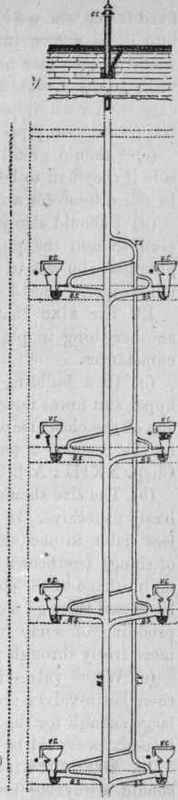
Fig. 112a.
(c) I should greatly prefer the soil-pipes to be fixed outside if they had to be of cast iron, as their joints could not be relied upon for any very great length of time.
(d) I should also prefer the soil-pipes to be fixed outside, even though the pipes were of lead, 3/16 in. thick, if the plumber who was to fix them were not a good and sound joint-wiper. (See Joints, figs. 32 and 34, Chap. XV.)
13. The size that a soil-pipe should be, like many another thing in plumbers' work, depends much upon circumstances.
Continue to:


My Books

