


Mirrors-Frames
Description
This section is from the book "The Art Of Decoration", by H. R. Haweis. Also available from Amazon: The Art Of Decoration.
Mirrors-Frames
A mirror always deserves a good frame, which should be either massive or dispersed in filigree after the manner of the old seams. The frame of so conspicuous an object must be well designed. Avaunt the clumsy, writhing frames in gold, nuggets which we have our suspicions of even when wrapped up in yellow muslin! But a frame properly designed to suit the wall, either in gold and colour, or gold and certain woods, carved or painted, can be made a seemly ornament. If we were ambitious we might take hints from many ancient mirrors, or the frames of old panels. The bronze and ormolu enrichments which came in under Louis XIV., laid on ebony and tortoiseshell and white metal, are well applied to mirror-frames, when they are moderate, and do not wriggle as we look at them. A large mass of gilding always looks better when variegated in colour, as the eighteenth-century French artists felt when they decorated their palace panels and frames with gold, of a yellow or a green hue. The green was largely alloyed with silver, and silver itself was employed for a whitish effect.
Inlaid frames are generally inoffensive, and may be very graceful in design.
I think that much of the contumely cast on large mirrors is traceable to their association with vulgar frames. It is impossible to believe that, had the ancients possessed the art of casting broad sheets of magnificent glass, a discovery reserved for our century, they would have contemned on principle this capital instrument for surprisingly beautiful effects. No; they made beautiful objects with their limited facilities; we make hideous ones in spite of facilities unlimited. Had the artists of the Middle Ages, the Renaissance, or even old Rome, possessed this secret, they would have mounted their great mirrors in panels which would have been the admiration of the world.
Most large looking-glasses of the least objectionable kind nowadays are mounted in narrow bevelled frames, in imitation ebony with gilt revers, etc, or a slight gold rope, tied in knots above sometimes a little colour being introduced in places. But a looking-glass of this weight and importance ought never to have a mean and meagre frame. If we look at the frames of the sixteenth century for either pictures or mirrors, we shall find that they are all broad and massive according to the weight of the enclosure they are devised to protect and set off. Carving of the boldest and most elaborate description, but always founded on a knowledge of the structural needs of the thing decorated, and worked in the hardest wood, and even wrought iron (vide p. 348), surrounds the small plates (the largest they could make), which reflected the faces of Beatrice and Mary Stuart. Silver, modelled with all the genius of a Cellini or a Holbein, sometimes protected the privileged crystal, for silver, being not too good for fire-dogs, was by no means too good for the lady's table.
Some of the magnificent designs of ancient Rome, or of the Renaissance, Italian, or Flemish sixteenth-century, taken from old Roman works unearthed, and some of the best of the very poor versions of archi tectural styles applied to frames which the 'Empire ' period gave us, and which are now run after, ought to teach us what the old meaning of a frame was. It was not merely a tidy metal edge 1 to rough canvas or panels of sharp glass, it was a 'mount;' a protection in case of a fall, and an ornament drawing attention and adding importance to the precious object enclosed.
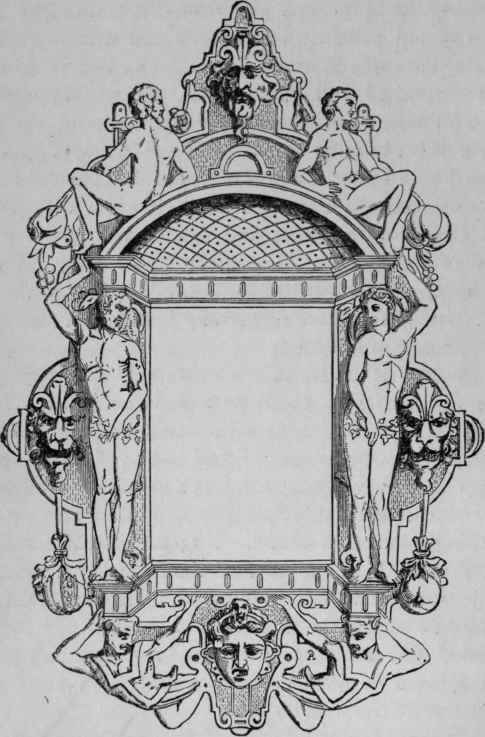
Fig. 43 - Venetian mirror-frame.
A big mirror-frame then should seldom be less than two feet wide; and were the frame sawn out of plain wood, of reasonable depth and value, it would add enormously to the artistic merit of the mirror. If definitely built into the wall, china, pictures, or gems of any kind might be arranged upon the frame, which would thus partake in a reasonable manner of the mural construction, and belong to it, and it ought to be fitly coloured accordingly. Were a more fanciful class of frame preferred, and cost not begrudged, a carved copy of such a design as enshrines many a masterpiece in the Pitti or Uffizj Galleries, or tall columns with elegant bases and capitals supporting a delicately painted lintel, or perhaps an arch, would immensely add to the architectural importance of a fine room. The small mirror (temp. Empire) would of course bear larger proportions. All large frames meant for the wall ought to be of an architectural character; fig. 72, p. 348, and many small table-mirror frames of the French and Flemish Renascence show the proper treatment of a material so costly and beautiful as reflecting glass.
1 Some old pictures, wherein the figures stand in a painted alcove, such as may be seen in most galleries of art, seem to suggest that frames originated in a mere metal protection to the edge of the panel.
Continue to:


My Books

