


Renascene Influence On Dress
Description
This section is from the book "The Art Of Decoration", by H. R. Haweis. Also available from Amazon: The Art Of Decoration.
Renascene Influence On Dress
In a series of papers published in the 'Queen'1 in the autumn of 1879, I traced the origin, rise, and progress of costume, and showed how it was influenced by the spirit of the time. Fashion, in all its varieties, springs from a basis of good sense, rises to extravagant pitch, and then falls into an ugly decadence leading to a violent reaction.
This basis of good sense is generally the 'becoming' (the fitting, the required) forced up from that much discussed primal instinct to emphasize one's own individuality which certainly exists, rooted beneath the instinct of imitation. Furniture and dress follow a like course; which may be represented by a curving line, the line of life, as of beauty, and the ups and downs are determined by the inexorable laws of (1) vitiation of the eye, and (2) the need of due relief.
1 See Queen, Nov. 6, 1879: In and Out of Fashion.
Fig. 10. - Line of beauty.
Naturally, a movement so strong and universal as the Renascence of art could not fail to have a marked influence on costume as it had on domestic decoration, education, and manners; but I never saw its extraordinary result in English dress observed or explained before my paper appeared in the 'Art Journal' of May 1880.
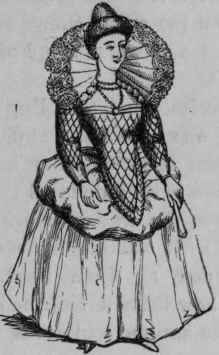
Fig. 11. - Imitation Roman.
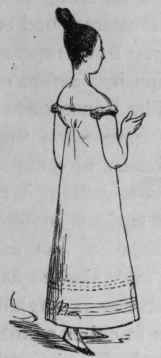
Fig. 12. - Imitation Greek.
It does not seem to be generally understood that the two most grotesque fashions which ever caricatured us were the result of trying to fit the classic dress to England. The figure of Queen Elizabeth, or Imitation Roman (King's Library, British Museum, reproduced in my 'Art of Beauty.' p. 42), a mere clothes-prop wherein every line of the human frame was contradicted, or the far less grotesque form seen in fig. 11, shows us one classic fit in extremis. The Imitation Greek (fig. 12, time of the First Empire), in her puny miserable array, suffering as painfully from too little clothing as her ancestress had suffered from too much, shows us the other. Both represent the last and worst stage of the fashion just before reaction.
The Renascence broke upon Italy first, then England, at a time when the costume was especially stiff and artificial, and occupied very great attention, being held a genuine element in the perfection of the individual;1 and it is curious enough to observe the way in which the Renascence was mirrored in such walking mounds of silk and slashes as figs. 11 and 15 (from Fairholt's 'Costume in England'), and how little it reformed the dress in either country. As the antique sculptures were unearthed, and Greek influence or Roman art projected itself through Roman influence upon Art in England, we perceive an abortive attempt to imitate the ancient Roman habiliments. The dresses were no intelligent translation of the classic into an English form, as was much of the architecture and furniture of the period, but a blind copy, as a child might copy an unknown alphabet in the twilight. It became the 'mode' to be portrayed as a Latin warrior - e.g. the statue of James II. in Whitehall Gardens - as at another epoch it was thought advisable to be portrayed as a Greek athlete - e.g. the statue of the Duke of Wellington opposite Apsley House. The tailor mixed up indiscriminately what was Roman and what was Greek. Anything dug up would do to play at being classic with.
The heavy English brocades or 'broched satins,' such as Henry VIII. loved, were too precious to be sacrificed, so they were 'adapted.' High heels - dear to women the world over ! - were invented, a raised sole of cork similar to the old Greek  (not a perilous block, as in modern shoes, at one end of the sole, but a wedge-shaped sole that supported the foot while raising it; clearly visible in the above-named portrait of Elizabeth); and as the sandal was inadmissible in England, the upper part of the shoe was trimmed something like it! The ruff was a sweet novelty, not exactly classic, but it could be 'worked in ' with a little ingenuity; so they worked it in, and most absurd the medley was. Henry VIII. presents the first signs of the change. The scaly corslet of the Latin warrior, of which Henry's own broad doublet was a careful copy, and the bunched -up skirts of marble goddesses, were grafted stupidly on stomacher and farthingale. We may see the popular version of the classic fold (
 ) clearly in fig. II, The very halo of saints, or the protective plate of statues mistaken for a halo, seems to have been at times aimed at in hat (fig. 13) or pickardil (fig. 11). The double girdle, with robe drawn through it, was apparently not understood, and the raison detre of every portion of classic attire - real utility, was unobserved; but the fulness at the hips adapted itself comfortably to the drumfarthingale in which the fashionable ladies strutted, thinking themselves very classic-looking, no doubt, as they chirped in Greek and Latin and viewed the mythologic pageants that Elizabeth loved. The early tapestry here engraved from a piece in my possession forms a curious link between Gothic and Renascence times, but unfortunately the details, clear in the original, have been destroyed in the engraving. It probably represents the Marriage of the Virgin; and the figures, robed in the fashionable costume, are clearly striving to be mistaken for ancient Romans. The bride's dress proves the misconception of the classic double girdle.
She wears two girdles upon the hips to bear up the weight of her skirt, with a close bodice, having its own (a third) waist, above; a mantle in which the broad collar can only be intended to simulate folds, if it means anything, and held up by the bride's-maid in the mediaeval manner. She wears small tentative ruffs at wrist and neck; her maids are dressed in a kind of Holbein costume, not so ultra-fashionable as their privileged mistress. The plaits of fair hair are rather mediaeval, rising up from the ear. One of the most amusing details is the recognition of the Greek hair-knot over the brow. These royalties are determined to have some such lump, and have carefully fabricated in it some other material: in the bridegroom's case it is affixed to his turban, his crown shining above; in the bride's, it looks somewhat like a small-tooth comb. The mock-sandals are very clear; and observe the buskins! Titianesque sleeves go oddly enough with the clinging tunic of Greece and Rome, and the leaf-shaped 'dagges ' (purely mediaeval) fall over the soldierly corslet which resembles fig. 18, page 102. The bridegroom's mantle classic in front, Gothic behind. The Bishop, neither Pagan, Jew, nor Catholic in garb, gives them the blessing used alike by Pope and Jewish high-priest, with two fingers.
Continue to:


My Books

