


A Discussion Of The British Point Of View On Methods Of Furnishing
Description
This section is from the book "The Practical Book Of Furnishing The Small House And Apartment", by Edward Stratton Holloway. Also available from Amazon: The Practical Book Of Furnishing The Small House & Apartment.
A Discussion Of The British Point Of View On Methods Of Furnishing
The recital of the respective advantages of Modern and Liberal Period furnishing would not be complete without taking into account valuable expressions of opinion upon the subject in notable British journals in their reviews of "The Practical Book of Interior Decoration." This volume was generally received in the most kindly spirit, and has met with an excellent demand on the part of the British public as well as in the Colonies and Japan. A record of the British view upon these manners of furnishing and some further explanation of American circumstances and customs is the more desirable as an aid to the mutual knowledge of conditions and problems and a co-operation in the advancement of household art referred to in the Foreword.
The Studio, which has been such a powerful influence for good in both countries, says: "There is unquestionably a growing sense of the need for a style of domestic equipment which responds more intimately to the needs of the time than either the 'Period' styles or styleless styles of fifty or sixty years ago." Earlier in this review it had noted of the authors of the book: "They do not, it is true, ignore the modern school, and have included a few illustrations of interiors as representing it, but of the really important work of the past twenty or thirty years hardly a hint is given, and we look in vain for a bare mention of the name of Ernest Gimson, recently deceased, who deserves to be remembered as a great furniture-designer".
The Manchester Guardian, writing of the "vast mass of middle-class folk who are interested in the decoration of their homes" says of them: "Indeed such people have a great advantage over their own collecting class and their compeers in England in that they are not to the same extent under the tyranny of the antique and can consequently approach the furnishing of their rooms with a freer mind. The result is that whilst the very wealthy in America are struggling to find a way through the maze of their own purchases the ordinary plain citizen is evolving simple schemes of decoration and furnishings suited to a servantless age which already leave our overloaded English rooms far behind".
The review in The Journal of Decorative Art begins: "To nine well-to-do Americans out of ten, 'Interior Decoration' means 'Period Decoration': therefore, when an American book on decoration appears, one may be quite sure that the periods will be very much to the fore. One may also hazard a guess that the book will deal very thoroughly with the subject, and that it will be quite perfectly printed. Its three authors......quite evidently know their public, their job, and their periods, and their point of view is one that is strictly orthodox in America. But mere copyism is not in their creed. Rather do they regard the Periods as sources from which may be drawn the inspiration and the material for their schemes, and to which they may turn for the standards of excellence at which they aim".
It so happens that on the same page appears the end of a humorous article in which the writer is evidently telling of what had been his ideal of a home. It is much too good to miss: "well-planned affair, somewhat on bungalow lines, with a white gate and green painted exterior woodwork, and it was to be situated in permanent sunshine, a goodish way from London, but near a main line station. The interior would be free from drawing-rooms, and would have an enormous Chesterfield in front of a big fireplace. The garden would contain a tennis court, and something rather special in hen-runs. And there would be a very lively wire-haired terrier." Unhappily, as usual, this writer appears to have been "bilked" in his desires by entirely unsympathetic contractors and dealers.

PLATE 1. A DRAWING-ROOM IS MODERN STYLE. DESIGNED BY SHIRLEY B. WAINWRIGHT, INTERIOR ARCHITECT, LONDON.
From these frankly set down remarks, favourable and otherwise, a rather wide acquaintance with present British tendencies and the strength and great ability of the newer school of designers of interiors and furniture, it is evident to the writer (though it will be a surprise to many Americans) that in England, the home of a long series of very beautiful Period styles, there is a very considerable revolt from Period furnishing in favour of a newer and simpler manner more in accord with present-day characteristics and manner of life. It is worthy of note, too, that new and fresh and crisp as this decoration is, it is built on sound decorative principles, and as a basis to all its wealth of colour, most of it provides a strong and dignified or else structurally simple architectural background. It also strictly avoids overcrowding and "fussiness".
To recur to "The Practical Book of Interior Decoration" the sections on the Modern movement were written during the last year of the war. A number of letters to British designers went unanswered: they doubtless were never received or during those devastating times could be given no attention. Decorative matters in England had for several years remained almost in abeyance, and the authors were fortunate in securing as much material as they did. Furthermore it is to be remembered that this Modern movement in England has greatly developed since the war. The discussion in the "Book of Interior Decoration," then, was, perforce, largely concerned with American conditions.
The present volume abundantly redresses this and presents as thorough-going a representation as possible of both interior work and furniture, the writer having been aided by the kindest co-operation on the part of a number of British designers. He would have been glad to include the work of others who did not so respond.
A short review of American conditions will be of interest to readers on both sides of the Atlantic, for though there is a parallel movement here there are decided differences.
First should it be mentioned especially that certain architects of great ability and having a strong sympathy with the desire for simpler homes have not taken up the Modern method but are working out this ideal, where desired by their clients, through the use of simple period elements. An example of this is given in Plate 4 and the writer calls particular attention to this mode as worthy of careful consideration and as being eminently suited to the tastes of many. He, however, also feels that it would be a decided advantage more often to incorporate with this procedure a considerable but still appropriate colour-development, giving it even greater attractiveness and wider applicability. Such an example is shown in Plate 150, where a house, by no means small, however, has been most capably furnished by its owner. There are also decorators of exceedingly smart interiors employing colour-schemes both exquisite and individual who accomplish simple results by the use of comparatively plain (Plate 6) or handsome (Plate 7) elements when desired.
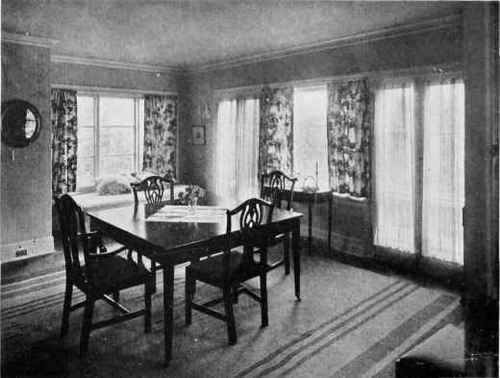
PLATE 6. A CHARMINGLY SIMPLE DINING-ROOM Modern furniture of Hepplewhite type.
The rug is excellent.
Myron Hunt, Architect.
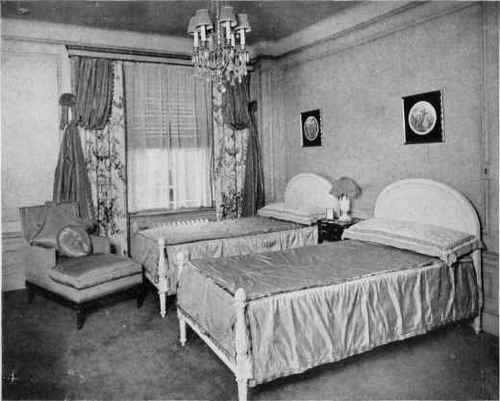
PLATE 7. A FRENCH BEDROOM IN ROSE AND GREEN.
Walls, green; Carpet, rose; Taffeta Hangings and Bedspreads in rose; Undercurtains in rose and green Printed Linen; Furniture, Ivory and Walnut; Chaise Longue in green.
Chamberlin Dodds, Decorator, New York.
In America the modern movement is even yet not at all organised or very greatly to the fore. There are but a few talented men and women working in this direction and they are doing so individually. Furniture manufacturers as yet employ their own designers without a connexion with independent originators making an exhaustive study of conditions and the best furniture to meet them. Decorators have not in great numbers taken up this method, probably because commissions for comparatively simple furnishings are not sufficient to meet the heavy expenses of doing business and of living which have been prevalent here.
Modern decoration has been considerably written up in household journals, but here its exemplifications need steadying. We should remember that, unless due caution is administered with the advice given, it is likely to be mis-understandingly applied and exaggerated at the hands of the inexperienced householder and this valuable method thus be discredited through its wrong use. The spirit of simplicity and level-headedness which is the very basis of the movement must not be lost.
Speaking by and large, decoration in America is Period decoration - but in its best manifestations it is Liberal, International-Inter period, or Catholic decoration, as one may choose to term it. If one has the means he may buy in New York - and to a more restricted degree in other large cities - original furniture, English, French, Italian, Spanish or Portuguese of almost any epoch: he will find faithful reproductions of many such pieces in so-called "decorators' furniture": but he will not find such an assortment in "commercial" period furniture, for in this the supply of styles other than English and some Italian and French phases is more limited.
America is an extremely cosmopolitan nation and many of its people are widely travelled, so that International-Inter period decoration is eminently suited to its needs and desires. The mode is year by year finding its way into many of the more modest homes, especially those of persons of intellectual and artistic attainments, and all that is needed for its fuller development is that manufacturers should supply a greater assortment of the requisite furniture, not "adapted" but faithfully reproduced, and if possible at more moderate prices.
With the world-wide interests of Great Britain the International-Inter period mode would be equally applicable and appropriate. The amount of French furniture in English houses of the better class must be very great, and much sympathetic appreciation has always existed between England and Italy. The employment of the furniture of other nations in connexion with its own will be found to give broader scope and still greater variety to British interiors.
Continue to:


My Books

