


Neo-Classic Furnishing In England. George Hepplewhite
Description
This section is from the book "The Practical Book Of Furnishing The Small House And Apartment", by Edward Stratton Holloway. Also available from Amazon: The Practical Book Of Furnishing The Small House & Apartment.
Neo-Classic Furnishing In England. George Hepplewhite
The next outstanding name among the great designers of this prolific period is that of Hepplewhite. We are ignorant, likewise, of the date of his birth, but he died in 1786; the business being then carried on by his widow Alice. As in the case of Chippendale, his name is given to much furniture made after his designs but not executed by him; the name therefore represents a style rather than a personal product.

PLATE 132. HEPPLEWHITE INTERLACED-HEART BACK ARM CHAIR, MAHOGANY.
Manufactured by Century Furniture Co., Grand Rapids. Mich.
Covered with Small Figured Tapestry.
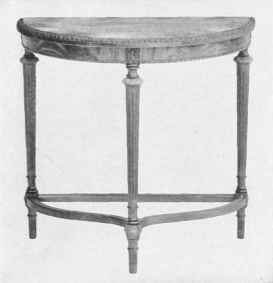
PLATE 132. MAHOGANY CONSOLE-TABLE OF NEO-CLASS1C DESIGN Top 26 x 14 inches.
Manufactured by Imperial Furniture Co., Grand Rapids. Mich.
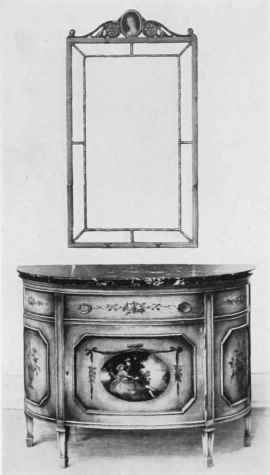
PLATE 133. NEO-CLASS1C MAHOGANY CONSOLE AND MIRROR.
Manufactured by The Elgin A. Simonds Co., Syracuse, N. Y.
Console. Height 32 in., Top 42 x 17 in.
Mirror. 42 x 24 in.
This style (or preferably, these styles) shows a combination of the Classic influence of Adam, the more restrained forms of Louis XV and those of Louis XVI, and, withal, he evidences an abundant originality of his own. Those who ignore tradition and precedent and would invent a new thing under the sun, are invited to study the whole field of furniture design - for by no means are Chippendale and Hepplewhite isolated examples of a wide use of "sources".
Most valuable contributions to mobiliary beauty were the shield-shaped and interlaced-heart designs of chair backs. A close reproduction of the latter form is shown in Plate 132. The disposal of the arms in these chairs (see also Plate 97) renders them very convenient in drawing close to a table. They illustrate some of his prominent characteristics - a genuine English roominess and comfort, combined with grace and sufficient but not excessive lightness of design; his very free use of curves, while still contriving, through the use of straight legs and general chastity of form, to preserve a fundamentally Classic appearance and a refinement that especially appeals to persons of cultivated taste. There exists, it is true, one structural weakness in these chairs - the backs do not join the seat-rail, and they thus depend for their support entirely upon the uprights: with pieces of the weight of those illustrated they prove themselves, however, sufficiently strong. He also designed oval, hoop, and honeysuckle backed chairs, all of which are charming.
Between some few of his chairs and settees and those of Sheraton the general reader will find difficulty in distinguishing; the truth being that both helped themselves liberally to the inspiration if not the actual forms of contemporary Louis XVI furniture. The main difference between the two is that Hepplewhite pieces are noticeably curvilinear, while Sheraton's tendency was rigidly in the direction of the straight line. How carefully Hepplewhite could upon occasion follow the mode of Louis XV, also, is seen in Plate 131, lower right.
The sideboards of these times are very interesting. Though modern furniture-makers have needlessly attempted to help out Thomas Chippendale, he never made a sideboard. He made side-tables, and these should be used with his dining-room furniture, storage-facilities for linen and table-ware being provided elsewhere. If anyone is unable to live without a sideboard, let it be one of the other designs of this time or a good specimen of American Empire style, rather than a mongrel production. Shearer was successful with this article of furniture and was duly followed both by Hepplewhite and Sheraton. The distinction here is that Hepplewhite's fronts were serpentine or concave, while' Sheraton's were flat or convex (Plate 135). Both used square legs and round legs, but Hepplewhite's favourite form was the first mentioned, tapered and with spade feet as in the chairs mentioned. His sofas, tables, and cabinet-pieces are very attractive. He availed himself of most of the decorative processes, including inlay, but preferred painting to this mode, and his more ornamental cabinet-work was frequently adorned with charming panels by Angelica Kauffmann and others of this school. Light mahogany and satinwood were much used for the graceful pieces by Adam, Hepplewhite and Sheraton, and are particularly appropriate. It may as well be said that the fine forms of furniture of all three designers were provided for gentlefolk and were not intended for yokel-like lounging.

PLATE 135. A CLEVERLY-FURNISHED DINING-ROOM IN A SMALL APARTMENT.
Sideboard and table Sheraton.
Continue to:


My Books

