


Neo-Classic Furnishing In England. Thomas Chippendale
Description
This section is from the book "The Practical Book Of Furnishing The Small House And Apartment", by Edward Stratton Holloway. Also available from Amazon: The Practical Book Of Furnishing The Small House & Apartment.
Neo-Classic Furnishing In England. Thomas Chippendale
Those who wonder at the slight knowledge we possess of the personality of William Shakespeare may well consider the case of Thomas Chippendale, busily engaged in his shop in St. Martin's Lane, London, but a hundred and fifty years ago.
The name of Chippendale is a household word - the only name known to many who have but slight knowledge of furniture. He was, indeed, the first man whose name was popularly connected with what he designed - previously the product was known only by the name of the sovereign under whose reign it was made. From thenceforth due credit was given its creator.
Chippendale published editions of "The Gentleman and Cabinet-Maker's Director" in 1754, 1759, and 1762, and was the most noted furniture designer of his age. It is probable that the entry, in the burial register of the church of St. Martin's-in-the-Fields, of the death of a Thomas Chippendale in 1779 refers to him: we are not certain when he was born - probably about 1717: of his personality we know nothing, and of his intellectuality only what is evident through his book and his work. Most of the data usually given regarding him is uncertain.
Platitudes are in order for those who care to utter them regarding the amount of personal knowledge remaining of England's greatest poet and its most various and perhaps also greatest designer of furniture. Yet the work of both endures - and is frequently ascribed to others.
Mr. Herbert Cescinsky in an article published in the London Connoisseur of May, 1921, is inclined to term all furniture commonly called by the name of this designer but made previous to the first edition of "The Director" (1754) or at least before 1750, as pre-Chippendale. The knowledge of this able writer in all connected with eighteenth century English furniture is unsurpassed and must be regarded with the greatest respect. It is to be hoped that further data may eventually be forth-coming, for though in a sense the matter is "academic", it nevertheless is of great interest.
Mr. Cescinsky does not there expressly mention Thomas Chippendale the elder and the tradition that he was in the business either before or with his famous son. There does not seem previously to have been any question regarding the establishment of the business much earlier than 1750; and the issue of "The Director" itself would rather bear out the common report. The designing of such a body of furniture as is there exhibited and in so many veins, even if he were somewhat aided by others, and the slow processes of engraving then current, must have required a very considerable length of time; while the extensive list of cabinet-making and other subscribers could hardly have been secured except by a widely-known and successful firm.
If designers of such marked ability as the Chippendales were at work during these earlier years, two questions then naturally present themselves; What were they doing? and who made the furniture of that time commonly credited to Chippendale? Mr. Cescinsky is careful to state that "The Director" designs (alone) are no reliable criteria of Chippendale's work, because in that book he desired to show new styles rather than old, he mentions that we know Chippendale used the ball-and-claw foot, and describes and illustrates the interlaced back-splats and the contours of the backs themselves (Plate 129). These developments from the previous style have always been ascribed to "Chippendale" - whether father or son. They were made by someone, and that one of undoubted talent. No other name than that of Chippendale has yet definitely been put forward, but, if we remember the precedent in the case of Shakespeare, we shall doubtless be treated, from other sources, to a dozen, mostly absurd, suggestions. For the present, then, we may still speak of this furniture - more popularly known as Chippendale than perhaps any other - by that term, and the present writer hopes that if the claim be just it may be established, rather than that this name be deprived of a portion of its wonted glory.
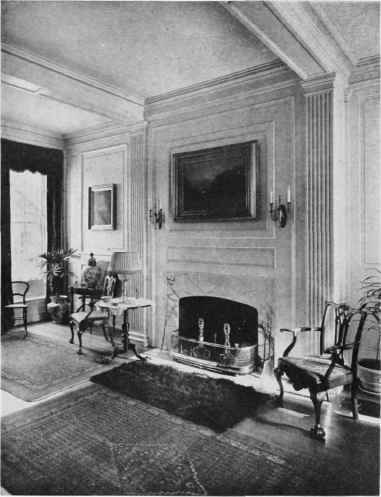
PLATE 129. PANELLED WALLS WITH CHIPPENDALE CHAIRS AND TABLE AND SHERATON CONSOLE TABLE.
Thomas, Churchill & Mollitor, Architects.
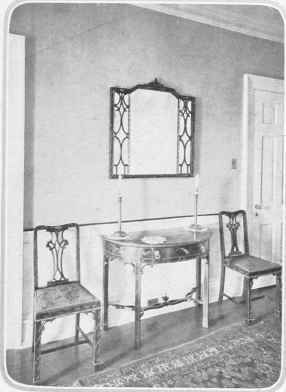
PLATE 130. A HALL WITH CHINESE CHIPPENDALE LACQUERED FURNITURE.
C. E. Schermerhorn, Architect.
Though Chippendale was not in general a Neo-Classicist, to him must be ascribed the introduction of the straight leg, and of the contour employed by Adam thirteen to fifteen years later. These appear in the first issue of "The Director" in the same year (1754) that Robert Adam, then twenty-six years of age, was leaving Edinburgh, where he had worked with his father, for his long tour of the Continent. Chippendale's large book-cases possess great dignity of a Classic nature and some of his plain pieces have the same quality (Plates 97 and 128, right) but for the most part his forte lay elsewhere. His Rococo work has already been mentioned, and reproductions of chairs in this vein will well accompany and relieve the French pieces of Louis Quinze. A chair of French style appears in Plate 126.
The best designs in his Chinese taste bid fair to remain among his most permanent productions - modern examples of these occur in Plate 130. Some of his pagoda-like constructions are undoubtedly of the greatest exuberance but are interesting, and where this tendency is curbed these designs would be most desirable if reproductions could readily be secured. With the chairs containing backs of strips disposed diagonally the present writer has no patience because these are totally at variance with the lines of the piece: these and some of the so-called Gothic chairs seem the worst of Chippendale's immensely varied work. The clustered legs sometimes used by him are charming and are much stronger than they appear.
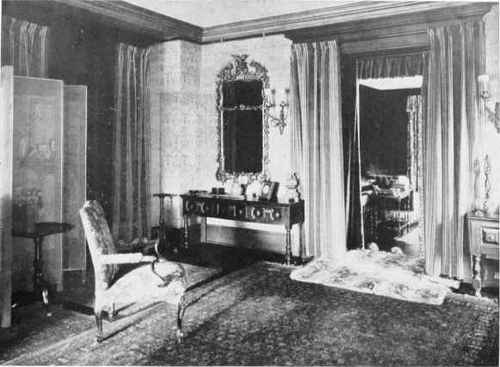
PLATE 126. A LIVING-ROOM IN LIBERAL PERIOD STYLE IN A PARK AVENUE, NEW YORK, APARTMENT.
Fabric-covered walls. Stuart and Chippendale furniture.
William Lawrence Bottomley, Architect.
His Queen Anne developments best accompany the pieces of that period, but are frequently seen with Neo-Classic furniture (Plate 129). Notwithstanding their Eastern influence, the more dignified straight-and-fretted-legged tables and chairs in Chinese taste may suitably be used in the like environment.
Chippendale's styles were widely copied by other cabinetmakers in Great Britain and, as we shall later see, enjoyed a similar vogue in America.
In London the business was continued by his son, likewise named Thomas through the habit of bestowing an identical Christian name upon those of successive generations - a custom accursed of all who have attempted genealogical or other research. Thomas Chippendale, 3d, died in 1822.
Continue to:


My Books

