


Neo-Classic Furnishing In England. The Brothers Adam
Description
This section is from the book "The Practical Book Of Furnishing The Small House And Apartment", by Edward Stratton Holloway. Also available from Amazon: The Practical Book Of Furnishing The Small House & Apartment.
Neo-Classic Furnishing In England. The Brothers Adam
Those eminent men Robert and James Adam, after extensive travel in Southern Europe and personal study of the monuments of antiquity there to be found, established themselves with their two brothers as architects in London, calling themselves by the Greek word for brothers, the "Adelphi". They were of high social position; Robert was a member of Parliament, and he and Sir Robert Chambers were, in 1761, appointed the King's architects. Robert was the genius of the family but James also was an able man.
They were never constructors of furniture, but the artistic conscience of Robert would not rest satisfied with the designing and erection of beautiful buildings without also desiring to carry out their effect through all their appurtenances - hence he became one of the foremost designers of furniture.
His wall-surfaces were to England a new thing under the sun. The panelling which had there held sway since the beginnings of domestic architecture were by him discarded in favour of other modes. That most closely associated with his name was of plaster or stucco with panels of arabesque ornament often in colour, or ornamental panels containing frescoes, these frequently being executed by Italian artists. The ceilings, often coved or domed, were elaborately ornamented, even if the walls remained plain. Wedgwood plaques and panels of Classic design inserted in the walls, or niches with statues were likewise characteristic. He also employed walls hung with handsome damasks. Mantels and mirrors were among his most beautiful achievements. Doors were often of panelled mahogany.
Such interiors were elaborate, but Mr. Wilson Eyre, the eminent Philadelphia architect, has been very successful in his renderings of the style in houses of moderate dimensions. A fine plain-walled interior with ornamental cornice and ceiling and overdoor decorations is shown in Plate 128. This is by Messrs. Mellor and Meigs, also of Philadelphia.
Though the influence of the Adelphi upon the architects was far-reaching some panelled walls (Plate 129) doubtless persisted, and this background may be used for Neo-Classic furnishing, especially where other cognate forms are employed in conjunction with Adam furniture or alone.
Later there occurred in the treatment of walls a gradual drying up of the fresh inspiration given by the Adams, till plain plaster walls, relieved only by occasional niches, heavy plaster cornices and ceilings, and rather pompous woodwork, prepared the way for the so familiar dreary interiors of Victorian times.
Probably the most wonderful furniture ever made in England is that at Harewood House and Nostel Priory, designed by Robert Adam and executed by Thomas Chippendale, together with the handsomest pieces designed by Chippendale himself. The invoices of the former are still preserved.

PLATE 128. AN ADAM ROOM WITH PLASTER WALLS, OVERDOOR DECORATIONS, AND CLASSICALLY DESIGNED CORNICE AND CEILING.
The ceiling was carefully copied from one at "Solitude ", the Seat of the Honourable John Penn, Philadelphia.
By Courtesy of Mellor, Meigs and Howe, Architects.
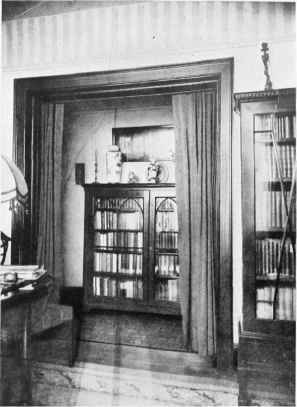
PLATE 128. THE FURNISHING OF A NARROW APARTMENT HALL SEEN FROM THE RECEPTION-ROOM.
Book-cases Chippendale (fine old pieces), Hepplewhite chair, and American Empire table.
Note use of accessories.
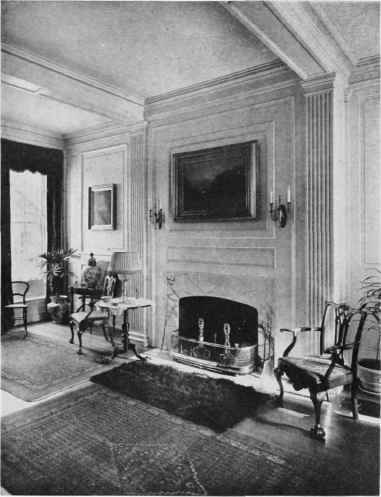
PLATE 129. PANELLED WALLS WITH CHIPPENDALE CHAIRS AND TABLE AND SHERATON CONSOLE TABLE.
Thomas, Churchill & Mollitor, Architects.
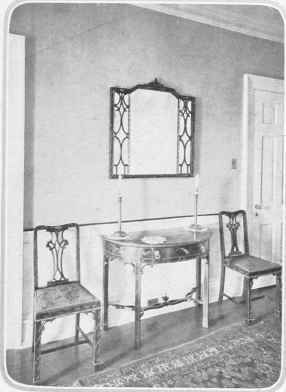
PLATE 130. A HALL WITH CHINESE CHIPPENDALE LACQUERED FURNITURE.
C. E. Schermerhorn, Architect.

PLATE 131. CHIPPENDALE ARM CHAIR. Width 27 in., Height 36 in.
CHIPPENDALE LADDER-BACK ARM CHAIR. Height 40 in., Width 24 in.
This Side chair is Reproduced from an Original at Plymouth, Mass.
SHERATON ARM CHAIR. Height 33 1/2 in., Width 25 in.
Reproduced from the Collection of A. T. Pope, Hillstead, Farmington. Conn.
HEPPLEWHITE ARM CHAIR "IS THE FRENCH TASTE"
Height 34 in., Width 27 in.
Manufactured by Century Furniture Co., Grand Rapids, Michigan.
The furniture devised by Adam for great manor-houses was naturally more elaborate than that for simpler premises, but nearly all of it was marked by chastity of design. The style is fully illustrated in "The Practical Book of Period Furniture." His seating-furniture often closely resembled the forms of Louis XVI. The Adam vogue included not only mahogany and satinwood but also beautifully designed painted pieces. Pale green was a favourite ground, with vari-coloured ornament. A considerable quantity of Adam furniture is supplied by commercial manufacturers and other pieces may be purchased from decorators.
Continue to:


My Books

