


Applied Ornament
Description
This section is from the book "English Furniture", by Frederick S. Robinson. Also available from Amazon: English Furniture.
Applied Ornament
After all, it does not greatly matter whether the term livery cupboard was or was not at one time applied both to an object with open shelves like a dresser and to a cupboard with a front composed of pilasters. The present facts are that we have oak dressers remaining with open shelves, and also what are undoubtedly livery cupboards with pilaster fronts, used either in bedrooms to hold food for the night, or in churches for weekly doles. That which is illustrated (Plate xliv.) is one of several at St. Albans. It is in the south transept, and was instituted by one Robert Skelton, in 1628. Its actual date may be somewhat earlier. Mr. W. Bliss Sanders draws a distinction between bedroom livery cupboards and those used in sitting-rooms. The Stationers' specimens may afford an idea of the latter, but the writer knows of no other existing examples. For him the livery cupboard, as it remains to us, is the pilaster-fronted receptacle for food, either used in a bedroom or a church, though the quotation from the Hengrave contract may be taken as an evidence that the original livery cupboard was an object with open shelves.
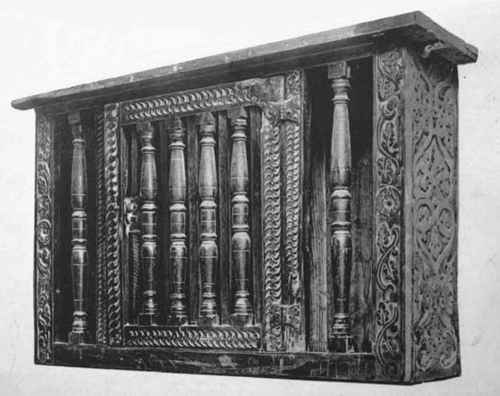
Plate XLIV. Livery Cupboard, Oak Early 17'ih Century
XLIV. Livery Cupboard, oak. Early seventeenth century. Filled with loaves for public distribution every Sunday, in accordance with a charity founded by Robert Skelton in 1628. St. Albans Abbey.
By kind permission of the Dean.
Mr. Sanders has many quotations which contain neither the word 'livery' nor 'court cupboard.' One of few which are to the point is from the will of Mary Chapman of Bury, 1649: - 11 give unto my daughter Mary Chapman my posted setteworke bedstead and liv'ry cupbord to it,' which is pretty conclusive evidence of what a livery cupboard meant in the first half of the seventeenth century.
There is a noticeable contrast between the foregoing examples in this chapter and those which follow. These last depend much more for their effect upon either applied mouldings, or applied turned halfpendants, or large and small oval bosses or prisms. The last two figure largely upon the cabinet upon a stand (No. 67) in the Victoria and Albert Museum (Plate XLV.2), and also upon that belonging to Sir Charles Robinson of Newton Manor, Dorset (Plate xlv.i). This also, in all probability, had a stand similar to the other. It is the custom to ascribe to Flemish influences examples in which a too liberal use of this applied work has been made. Certainly there are two particular motives which may be legitimately set down to that influence. The first is where turned half-pendants are used broader at the top, tapering towards the bottom, and with a horizontal strap across them carved in the wood as if to represent a fastening by which they are made to adhere to the main body. The effect, enhanced by circular bosses representing broad nail-heads at each end of the strap, is somewhat like that of a bradawl which a carpenter thrusts into a leather loop to keep it in its place on the wall of his workshop.

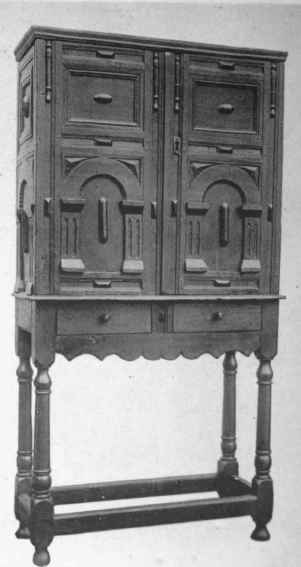
Plate XLV.
I - Oak Cabinet I 7th Century
2 - Cabinet, Oak, With Bosses Of Black Wood 17th Century
xlv. (1) Cabinet, oak. Seventeenth century. Sir Charles Robinson, C.B.
Dimensions: Height 27, Width 30½, Depth from front to back 24¼ inches.
(2) Cabinet, oak, with bosses of black wood. Seventeenth century. V. & A. M.
The second practice is that of covering panels with applied fretwork from an eighth to a quarter of an inch in thickness, much besprinkled with 'nail-head' bosses. These are certainly two Flemish tendencies. As to the applied mouldings set at many different angles, shown by some of the chests of drawers illustrated, and diamond and prism shapes, Flanders was not their only home: they are widespread over Renaissance furniture generally.

Plate XCIX. Mahogany Fret-Worked Settee, Chippendale (The Cover Is Modern)
XCIX. Settee, mahogany fret-worked. Chippendale. The cover is modern. Lieutenant-Colonel G. B. C. Lyons.
A more precise discussion than any turning upon this or that foreign influence can be mooted as to the relative merits of applied work and solid carving. Those with whom it remains a cardinal principle that ornament shall proceed naturally out of, or be kept subservient to, the constructive nature of the object, will prefer the merely carved cupboard to that depending for ornament upon pendants or pilasters, which are more detachable with age than is to be desired. If, however, we insist upon being too logical, we are liable to turn our principle into a fetish whose behests, if we obeyed them, would entail our discarding the familiar planted arch from our oaken furniture, and reducing it to a state of solid but rather primitive simplicity. The uncompromising purist can triumph in theory when, for instance, he points out that the mouldings on the framework of a panel were meant merely to diversify the step or slant or bevel from the plane of the framing to that of the panel. Therefore they should be worked upon the solid wood, and not be mere headings bought at so much a foot ready made, to be glued or tacked on to the structure. In practice, however, the applied moulding, in various shapes and ornaments, crept in very early, as many of our illustrations will show.
It is better, therefore, to accept this style of ornamentation, if it is well calculated and not too Flemishly florid and heavy. The ovals in Sir Charles Robinson's cabinet (Plate xlv.i), which has four 'nail-head' bosses on each door panel, are certainly open to this imputation, and in so far make it inferior to its companion. Both may be called 'Cromwellian' in period, a time at which we shall see that the leather-covered chair, much studded with nails, was introduced from over the water, and vied in comparative plainness with these unassuming cabinets.
Plate XLV.
I - Oak Cabinet I 7th Century
2 - Cabinet, Oak, With Bosses Of Black Wood 17th Century
xlv. (1) Cabinet, oak. Seventeenth century. Sir Charles Robinson, C.B.
Dimensions: Height 27, Width 30½, Depth from front to back 24¼ inches.
(2) Cabinet, oak, with bosses of black wood. Seventeenth century. V. & A. M.
Continue to:


My Books

