


The Planted Arch
Description
This section is from the book "English Furniture", by Frederick S. Robinson. Also available from Amazon: English Furniture.
The Planted Arch
So much for the resemblances widely observable between the exterior styles of stonework and the interior styles of wood. The connection between the room and its furniture is in many cases more obvious still. It will be germane to our subject to mention some few of the well-known houses in which the motives on the panelling are practically identical with those on furniture. Haddon Hall is perhaps as familiar as any house in the country. We have to do with the Long Gallery, whose earliest possible date is between 1567-1584; and it must certainly have been built before 1611, when the Sir John Manners, who conceived its erection, died. The frieze, with its huge badges, overpowers the lower woodwork. Below it are coats of arms upon cartouche shapes.1 Below these again come imbricated pilasters, between which is the familiar planted arch as it appears upon the outside of 'The Feathers' at Ludlow. The dado underneath these consists of large panels with mouldings dividing them into geometrical shapes.
These latter panels, and the plain panels with the arch planted on them, are exactly what might be found on the lower and upper part of cabinets of the period.
At Bolsover Castle, in the 'Star Chamber,'date about 1620, the same kind of panelling may be seen as far as regards the planted arch. This epithet, it may be as well to explain, is applied to those arches which are not cut in the solid panel, but are so affixed to it as to make it appear as if the panel was slightly recessed. The frequent tooth edging on the lower side or ' soffit' of the arch projects so that the fingers can often pass between the teeth and the panels. In the later seventeenth century style of oak, the arch is still to be seen, but usually it is a shape only incised upon the panel - a mere reminiscence of the architectural shape.
1 A very good cartouche panel in the writer's possession is reproduced here (Plate xiI). There should be a lion's head in the centre, the mane only of which is left. At Carpenters' Hall are three panels in the same style, one of which has exactly the same light riband work upon it. They are of the date of 1579, and bear the names of the Master and Wardens. Mr. Litchfield reproduces them in his History of Furniture, and gives the cost of one of them - materials, 3s.; workmanship, £1, 3s. 4d.
The Bolsover panels have the guilloche upon the front of the arches, as again it may be found on many a bed and cupboard and chest. One of the most magnificent examples of arched panelling still exists in a house built for an unknown Bristol merchant. The 'Red Lodge,' Bristol, has a room with an elaborate corner door such as has been before described. The chimneypiece is supported by Corinthian pillars, and has carved on it large terminal figures and a coat of arms in a large cartouche. The panelling of the room consists of arches planted in, those of the dado being very large. A tall, narrow arch appears in the centre of the door, which is bordered by a heavy gadroon moulding, that shape which is inveterate upon the centre drawers of cabinets and their thick legs. There is also much use of applied round bosses and ovals.
The visitor to Merton College library, which dates from 1376, may see how the decorative scheme of the early seventeenth century suits a Gothic building. There is a large round arch, beneath which one passes, with smaller arches above. The upright pattern, which, as we have seen, runs along the lintels of Apethorpe, here adorns the friezes of bookcases; whilst the gadroon is on cornices and on borders of panels. This room, with its chained books and early architecture, is one of the most interesting in Oxford.
Not so very far from the University is the beautiful old house of Chastleton, Oxfordshire. The casual visitor may be repelled by the plain severity of its exterior, but the interior is of great interest. Not to mention the long gallery running round the top of the building, there is a drawing-room panelled in the manner I have been describing, and filled with the furniture originally made for the house. Again, on the dado is seen the planted arch, diversified by pilasters at the main windows, with fine scroll-work running up them. Certain additions have been made in the way of portraits fitted into the panelling, which, though not modern, do not help the scheme. Under the ceiling runs the upright ornament of the Apethorpe lintels. The date of this fine old place is 1602, and there exists an inventory of the furniture as it was in the year 1632 (circa). .
Godinton, in Kent, is an extraordinary storehouse of carved oak, part of which was originally made for the house, while a good deal of early work in the Tudor style has been collected and put up from elsewhere. There is a great staircase, with figures on the newels, and a vine trail just below the handrail, dating from 1628. In the drawing-room a frieze below the cornice has a representation of the old exercises of the militia, showing them with their matchlocks and rests engaged in drill. This is a very exceptional piece of work, to be compared with those figures in full relief, representing various types of General Ireton's army, which adorned the newels of the staircase in the house built for Cromwell's daughter Bridget, whom he married. We are, however, concerned chiefly with the usual and the characteristic, examples of which may be found in this and many another house which there is not space to mention.
After the dissolution of the monasteries, the wealth obtained from which no doubt gave a great impetus to that wave of house-building which ran all over England at the period we are reviewing, the rage for church building died away. There was, however, no stinting of new church furniture and decoration, so that we find many pulpits dating from the Jacobean period, and screens are also common. As is to be expected, the woodwork of the church is identical with that of the house and its furniture. At Netherbury Church, Dorset, there is a fine octagonal pulpit with two tiers of planted arches and panels with imbricated inlay. At Uppingham Church, Rutland, is a good specimen of a simpler kind.
The very best examples of complete early seventeenth century church woodwork are to be found at Croscombe Church, Somerset, and St. John's Church, Leeds. At Croscombe the planted arch and the S-curve are found upon the pews. The S-curve, the semi-circle pattern, and an interlaced semi-circle pattern also are carved upon the insides of the pew fronts. The reading-desk and pulpit also have the planted arch, with much strapwork and applied diamond shapes. On the screen and in the pulpit canopy appear the pierced steeples and C-curves, just as they are to be seen on the top of the Renaissance house. The upper arches of the screen are double and toothed, and have a pendant between them. The lower arches are plain. The pulpit bears the date of 1616.

Plate XI. Interior Of Croscombe Church, Somersetshire
XI. Interior of Croscombe Church, Somersetshire. The nearer pews, fifteenth century. Pulpit, 1616.
By kind permission of the Rector.
St. John's Church, Leeds, is even more interesting from the fact that it was new built in 1631-1633, so that the woodwork may be supposed to have been constructed in a style considered suitable to that of the stone, which is late Gothic. The whole of the pewing has fine panels, carved rails, and turned finials. The splendid original screen has been restored from its old fragments, which were bought up from cottages and other places, to the lasting renown of those who engaged in so appropriate a work. This screen stretches right across the church, and has slender terminalshaped pillars, with applique baluster-work or 'turned half-pendants' upon them. The acanthus is carved on the thick central part of these balusters, which have an acorn-shape at the lower end. The panels of the pews have elaborated S-curves. The turned finials of the pew-ends have thin scores round them, similar in treatment to the pendants of the Yorkshire cabinets (Plates xl., xli.). These pew-ends might serve as the backs of so many oak chairs, so identical are they in shape to domestic furniture of that kind and period. It is necessary indeed to remind ourselves that old church pews are a very fertile source of made-up furniture.

Plate XLI. Yorkshire Oak Cabinet
XLI. Yorkshire Cabinet, oak. About 1630. Miss Stirke.
Slightly smaller than its companion of Plate XL.
They have been torn out of churches by the hundred, and put by unscrupulous furniture-vampers to uses for which they were never intended.
There are many other churches in the woodwork of which close resemblances may be found to the style of domestic furniture. From those examples which I have mentioned, however, it is possible to get a good notion of the similarity of exterior stone and interior woodwork and furniture motives.
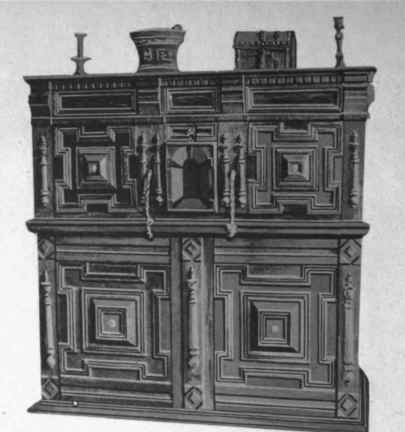
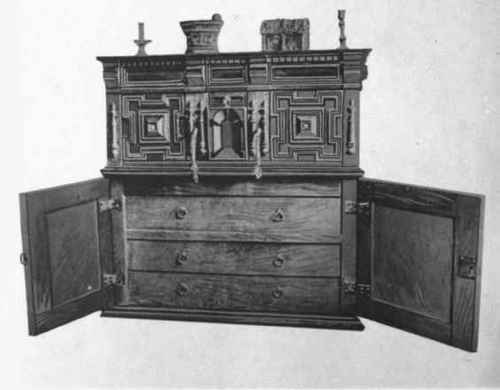
Plate XLVLLI. Oak Cabinet
xlviii. Cabinet, oak, showing 'turned half pendants' applied. Rev. F. Meyrick-Jones.
Continue to:


My Books

