


Livery Cupboards
Description
This section is from the book "English Furniture", by Frederick S. Robinson. Also available from Amazon: English Furniture.
Livery Cupboards
This speciality of use for food-stuffs brings us to the other moot point of 'livery cupboards.' We have seen that Singer says that the term was used indiscriminately with 'court cupboard' and 'cupboard of plate'; and he describes the object so named as a piece of furniture with stages or shelves. Mr. Litchfield (p. 73) quotes from records in the British Museum of contracts made for joiners' work at Hengrave about 1518, in which livery' cupboards are specified. 'Ye cobards they be made ye facyon of livery y is wthout doors.' He says that 'they consisted of three stages or shelves standing on four turned legs, with a drawer for table linen.' This answers to the familiar shape of our present kitchen dresser, whose more ornamental exemplar abounds in Wales. A fine eighteenth-century example in the possession of the writer is illustrated here. The specimen without shelves is the property of the Rev. F. Meyrick-Jones.1 Mr. Litchfield makes a quotation from Harrison's Description of England at the end of the sixteenth century, to the effect that after a person has been supplied with drink (at the lower retainers' tables in a rich man's hall) 'he delivereth the cup again to some one of the standers by, who . . . restoreth it to the cupboard from whence he fetched the same.'2 His conclusion is that livery or 'service' cupboards were dressers upon which mugs were hung by hooks, as they are now.
Very few, at any rate, of this early period can remain.
The more acceptable application of the word livery (livree) belongs to a cupboard enclosed, not by panelled, but by railed doors, allowing free ingress to the air. From supper to breakfast, 7 p.m. to 10 a.m., was a very long time, and as people were liable to be hungry in between, food and drink were kept in cupboards of this description and 'delivered' in portions for those who required them, to take to their bedrooms. This is how Mr. J. H. Pollen understands the matter in his introduction to the catalogue of the Bethnal Green Exhibition. Mr. Baring-Gould in An Old English Home illustrates a specimen and gives a very apt quotation from Spenser's account of the state of Ireland: 'What livery is, we by common use in England know well enough, namely, that it is an allowance of horse-meat, as they commonly use the word stabling, as to keep horses at "livery"; the which word, I guess, is derived of liver-ing or delivering forth their nightly food; so in great houses the livery is said to be served up for all night - that is their evening allowance for drink.'
1 Plate xliii. 1 and 2.
2 The paragraph, slightly obscure, seems to refer to halls of middle degree. The custom 'cut off much idle tippling.'

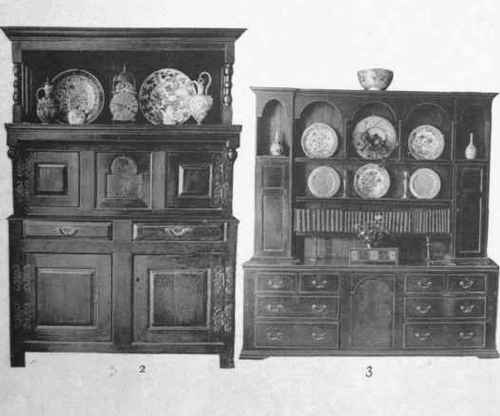
Plate XLIII.
1 - Dresser, Oak 17th Century
2 - Welsh Court Cupboard, Oak Late 17th Century
3 - Welsh Dresser, Oak, Inlaid With Mahogany 18th Century
XLIII. (1) Dresser, oak. Seventeenth century. Rev. F. Meyrick-Jones.
Length 60, Height 29, Depth from front to back 18½ inches.
(2) Welsh Court Cupboard, oak. Late seventeenth century. Shows the ' raised and splayed' panel, and three tiers or stages. The property of the author.
Dimensions: Height 77¼, Breadth 54⅝, Depth from front to back 21⅛ inches.
(3) Welsh Dresser, oak, inlaid with mahogany. Eighteenth century. The property of the author.
Dimensions: Height 89¼, Length 83⅜, Depth from front to back 19¼ inches.
Mr. W. Bliss Sanders in his Half-timbered Houses and Carved Oak-lVork, refers to this question whether court and livery cupboards were the same thing, which he says antiquaries have long debated. His view appears to be that originally they were not the same, but that their uses later were combined. Mr. Litchfield reproduces in his History of Furniture (p. 116) one of the two so-called livery cupboards belonging to the Stationers' Company. It is an open dresser, with shelves and a covered receptacle below. 'They formerly stood on the dais,' he says, 'and are good examples of the cupboards for display of plate of this period (seventeenth century). The lower part (enclosed) was formerly the receptacle for unused viands, which were distributed to the poor after the feast.' If that is the case, we have here examples of the combined uses of a buffet or dresser and a livery cupboard. Unfortunately the date of the object illustrated appears to be no earlier than 1674, and it has also been fitted with an ornate broken pediment, with heavy voluted ends, and an eagle on a pedestal between them, the whole apparently added in the year 1788. The date of 1674 is altogether too late for this much-altered specimen to assist us to a conclusion.
Continue to:


My Books

