


Later Designs
Description
This section is from the book "English Furniture", by Frederick S. Robinson. Also available from Amazon: English Furniture.
Later Designs
A particularly bad feature is to be noticed in the legs of the chairs. These are no longer straight, either tapered or turned, but coarsely curved, the concave on the outside. By comparison with the old cabriole leg they are extremely ugly, the contrast and look of strength afforded by the convex upper part of the cabriole leg changing to the slender concave below, being entirely absent. The design is not much helped by the drawing, which appears to me inferior to that of Sheraton's earlier work. As a rule, upright splats are avoided, their place being taken by curved shapes, either open or solid, placed horizontally. One chair has the top of its back straight above and curved below. There is a leaf moulding running round the curve and terminating in eagles' heads at both ends. These project above the straight top, and face each so as to be seen from the front in profile. Another similar arrangement shows a pair of dolphins facing each other, and with an Egyptian head between. Their tails cross and form a circle on the lower cross-rail of the back.
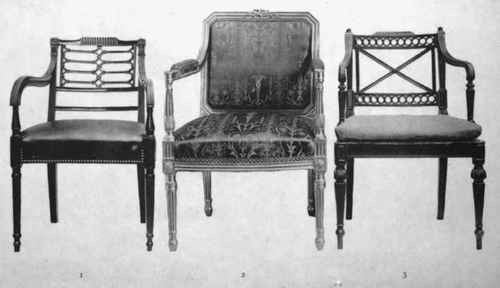
Plate CXXII. I - Armchair, Mahogany Adam About 1780 2 - Armchair, Adam 1780 Circa.
CXXII. (1) Armchair, mahogany. Adam, about 1780. Henry Willett, Esq. (the late).
(2) Armchair, gilt. Adam, 1780 circa. The
Earl of Ancaster.
(3) Armchair, mahogany. Adam, about
1780. Miss Evans. Forde Abbey.
Occasionally the ordinary front legs of the chair are replaced by one curved 8-shaped support. More uncomfortable than any must have been the camel-backed chair. This is really ridiculous. The back is formed of two realistic camels looking away from each other. Where their bodies and hind legs should have met, a drapery hangs, though the space allowed would have been insufficient to accommodate both animals. The front legs of this wonderful invention are lion-headed cabrioles with odd-shaped caps or crowns upon them. There is much mane running down the leg, and the same drapery arrangement as on the back. Another version shows eagles at the back, and jackals, perhaps, on the front legs. Most of these out-of-the-way designs have hollow or dipping seats. All of them are described as parlour and drawing-room chairs.
Then we come to 'Herculaneums,' which are of very much the same class, but not so naturalistic, their ornament being based upon Roman details. Amongst plainer things there is a tub or easy-chair, with projecting ear-pieces, as in what are known as 'Grandfather chairs.' Sheraton's tub-chair seems, however, to be made of wood, whilst the other with Heppelwhite is upholstered. 'A Fauteuil chair' is much more graceful and worthy of his early period. Unfortunately this and a Bergere chair are only exceptions, for as we turn over the page we come to Nelson's chairs, which are all anchors and dolphins - a worse version of the conversation chair than that of his earlier period, and then Grecian sofas and couches. These are the original of that couch with ends rolling over outwards and upholstered in horse-hair with a cylindrical horse-hair bolster, with which we were familiar, many of us, in our youth, and which are still to be found in many a lodging-house. Sheraton's are, of course, more ornamental, but the type is unmistakable.
There are welcome echoes of his best time to be found amongst the designs for cabinets and ladies' writing- and dressing-tables, but too much formal inlay is to be found upon them, in place of the fine scrolls of the earlier period. The glazed doors are frequently covered with brass lattice, or else merely two lines crossing each other diagonally, in place of the more varied glazing patterns with curves and other geometrical shapes. Every now and then a thoroughly common-looking head, either Egyptian, or, presumably, Gothic, with a crown, is found as a finish to a cabinet or bookcase leg or the top of a fire-screen. Perhaps the reductio ad absurdum is reached in a Gothic Light. This has a heavy tripod base with the. inevitable grotesque lions' heads and paws. On this rests a slender open pointed arch. Between the pillars is a niche with a round top. This contains a female figure with an astonishing head-dress, a necklace, and a shawl crossed over her bosom exactly as our great-grandmothers are represented in miniatures of the period. The 'Chinese Light' is a suitable companion.
She wears the conical hat dedicated to all Chinese-English figures, and stands with hands on two pilasters terminating in spear-heads, and entwined with serpents eating the flowers which grow below the spear-heads.
Continue to:


My Books

