


Quartetto And Round Tables
Description
This section is from the book "English Furniture", by Frederick S. Robinson. Also available from Amazon: English Furniture.
Quartetto And Round Tables
I prefer to believe that these inventions must have been amongst the last which the disappointed and struggling artist racked his brain to evolve. That his ingenuity had not flown with his taste is proved by the Cylinder writing-tables, based on trestle feet, and the various narrow and long 'Sofa-tables' shaped so as to be convenient for placing alongside of a sofa, and also supported upon trestle or 'horse' feet. To Sheraton perhaps we may ascribe the invention also of those useful little occasional-tables made in 'nests' or series, and dwindling in size so as to fit one inside the other. These he calls Quartetto tables, and they are as light and almost as graceful as if they belonged to his best period. I have seen a set in imitation of Japanese lacquer.
A 'New design for a dining-table' has a huge dumb waiter in the centre. The circular shape of this table, and the use in other designs of a thick central pillar on four concave-curved or lion's-paw feet, gives colour to the idea that Sheraton may have introduced the fashion of these circular tables, so much in vogue during the early nineteenth century. Jane Austen refers to them in Emma, which was written between 1811 and 1816, and appeared in the latter year. In chapter xli. she writes: 'Mr. Knightley must take his seat with the rest round the large modern circular table which Emma had introduced at Hartfield, and which none but Emma. could have had power to place there and persuade her father to use, instead of the small-sized Pembroke, on which two of his daily meals had for forty years been crowded.' They are certainly not so adaptable as the 'set of dining-tables' consisting of a centre and two ends, which held their own against the circular shape until the modern heavy telescope-table with extra leaves was invented.
This, as we learn from Mr. Litchfield's Illustrated History of Furniture, was patented by Richard Gillow in 1800. The auctioneers' description of this as a 'set of dining-tables,' Mr. Litchfield observes, is 'probably a survival of the older method of providing for a dinner-party.' The'pillar and claw' tables could be set together or separated as the case required. The end pieces were made semi-circular, and could be used as side-tables set against the wall.
It is hardly necessary to follow Sheraton through the decadence of his French, Grecian, alcove, and canopy beds, or of his 'New French' and other window draperies. Serpents may be found coiling about window tops, and curtains looped up with half moons. One of the worst windows has huge lions' heads to take the curtain loops, while down each side of the window from above hangs a series of globular shapes formed by bows tied at intervals on a long loosely stuffed cylinder of drapery. The effect is that of so many pudding-bags. There is consolation to be found in the probability that not a tithe of these worst designs ever advanced beyond the paper stage. If they did, they have disappeared into that limbo which is devoted to things not deserving to survive.
We must remember that the publishing of a book of designs is apt to give a furniture-maker a prominence in a history of furniture, which, if the work of forgotten makers, or of those who did not publish books, could be all identified, would be found excessive. If the long-standing firm of Gillow were to publish their records, much might be learned of interest. These date from 1724, but the firm is said to have existed even before that date. It is at the present time producing, amongst other things, beautiful replicas of works originally made a hundred years ago. To Gil-low's may be attributed much of that rosewood or mahogany furniture inlaid with brass which was popular at the beginning of the nineteenth century, and which it is the custom to call 'late Sheraton.' The list of subscribers to the books of the latter tells us the names of a great number of cabinetmakers, many of whom shared court patronage with those better remembered. They executed work fully as elaborate as anything designed by Sheraton or Heppelwhite or Chippendale. Illustrations are here given (Plate clvii.) of perhaps the most monumental existing piece of English furniture.
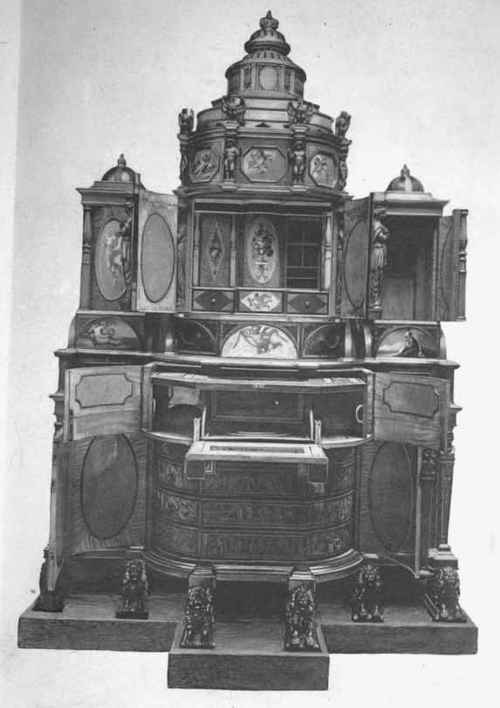
Plate CLVII. Cabinet, Satinwood, Veneered, With Paintings
CLVII. Cabinet, satin-wood veneered, with paintings. Messrs. Partridge.
Dimensions : Height 108, Breadth 72, Depth from front to back 36 inches.

Plate LXXXVIII. Cabinet, Mahogany 1730 Circa
LXXXVIII. Cabinet, mahogany. 1730 circa. One of a pair. Messrs. Partridge.
It is an interesting example in many ways, but chiefly as showing how in the fulness of time England paid back to the Continent the artistic coin she had borrowed. Side by side with it we may set the so-called 'Tudor Cabinet' of pearwood, No. 27 in the Victoria and Albert Museum (Plate clvi.). When that was commissioned we had no one in England who was equal to the task of producing a sumptuous piece of furniture. Close upon two hundred years later, when a Spanish king requires a grandiose piece, he has recourse to England for the fulfilment of his needs. The makers of this were Seddon Sons and Shackleton, cabinetmakers to George IV., and rivals of Gillow's. It is a bureau, jewel-case, dressing-table, and organ all in one. The design is by Sir W. Chambers, and the painted decorations are by W. Hamilton, R.A. The former died in 1796, and the date of this cabinet is well within the eighteenth century. It was made to the order of Charles IV. of Spain, and was actually completed on June 28, 1793. The principal cabinetmaker belonging to the firm was in all probability R. Newham, whose name with the date quoted is also written inside. The height is nine feet, extreme breadth six feet, and depth three feet.

Plate CLVI. Cabinet, Principally Pear-Tree Inlaid Late 15th Century
CLVI. Cabinet, principally pear-tree inlaid. Late sixteenth century or early seventeenth century. The upper part is perhaps South German, the lower possibly English. V. & A. M.
Upon it are painted representations of the order of the Golden Fleece, and the Immaculate Conception in a riband carried by cupids. The other panels represent the Four Seasons, Fire and Water, Night and Morning, Juno in a car drawn by peacocks, Ceres in a car drawn by lions, and five cupids in separate small panels. In the domed top is an organ with outside case of ormolu and a Wedgwood plaque. Below this are pigeon-holes concealed by cupboards. The mouldings and edgings are of fine ormolu. The side pedestals and cupboards below have plain interiors. The bureau and dressing-table has a large mirror and all kinds of fittings, either sliding or swinging on pivots. The chest of drawers below has cupboard doors. The carving of the figure-work is extremely skilful, the main surface of the cabinet being satin-wood. It is in the possession of Mr. R. W. Partridge, St. James's Street.
Continue to:


My Books

