


Secret Drawers
Description
This section is from the book "English Furniture", by Frederick S. Robinson. Also available from Amazon: English Furniture.
Secret Drawers
At the present time, when banks are at hand and innumerable forms of investment are continually being offered to every one who has saved a little money, it is difficult to realise the trouble there was in earlier days to dispose of cash. At one time men turned their bullion into gold plate, until the inconvenience of the practice, from a financial point of view, caused government to make enactments against it. Strong-boxes such as that supposed to be 'King John's Money-Box' at Rockingham Castle were for many generations a much-used article, upon which the locksmith exercised his ponderous ingenuity. 'So late as the time of the Restoration every trader,' says Macaulay (vol. i. p. 479, ed. 1873), 'had his own strong-box in his own house,' and 'in the earlier part of the reign of William III., all the greatest writers on currency were of opinion that a very considerable mass of gold and silver was hidden in secret drawers and behind wainscots' (vol. i. p. 395). In 1696 the evil due to the hoarding of money was most acute, and we should be prepared to find the furniture of all this period as cunningly provided with hiding-places as an old clock was with mechanical conceits. I imagine that the one made its possessor about as sure of his time as the other would make him of his money.
Both must have been the source of constant anxiety.
A chest of drawers (Plate lxii.) in the possession of Mr. V. B. Crowther-Beynon, of Edith Weston, introduces us not only to the new style of decoration by mouldings, but also to a new characteristic, which is not uncommonly found upon examples apparently of an early period in the seventeenth century. It will be noticed that beneath the cornice of the top slab there are moulded brackets. The largest member in each of these is fashioned into a round tube which serves as an admirable handle when the forefinger is inserted. The hollow arrangement can be seen end on at the sides. In the same village there is a simpler example similarly fitted. This one is a very elaborately moulded specimen, with small arches in the four main panels. The variety shown in the disposition of the mouldings, and the architectural quality suggested by the brackets and the jutting plinth, make this an example quite beyond the ordinary chest of drawers of this type. The large use of dental courses, both horizontal and perpendicular, is a point to be noticed along with the two long and narrow arches, and the two 'double' ones on the second drawer from the bottom.
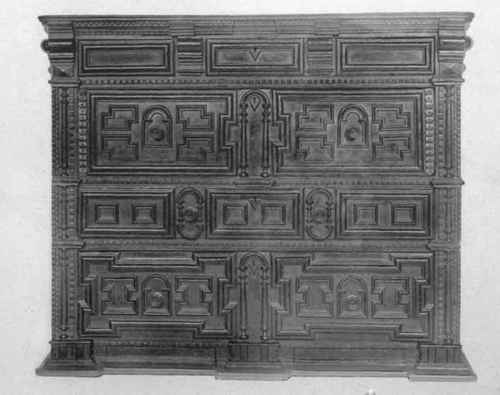
Plate LXII. Chest Of Drawers, Oak
LXII. Chest of Drawers, oak. With tube handles on upper drawer. V. B. Crowther-Beynon, Esq.
It should be mentioned that in the cornice, under the top slab, are various small unobtrusive drawers of secret intent.
This example compares well in general lines with No. 70 in the Victoria and Albert Museum, of four long drawers (Plate lxiii.). In this the brackets and jutting plinth are entirely absent, and the various tiers are rather unnecessarily emphasised by the mouldings which run straight across the front. None the less this is an effective piece, its boldly raised and splayed panels catching the light in a very striking way. It may be set down as late seventeenth century. Given a plain plinth instead of its raised frame with drawers, it will afford a good idea of the usual early chest of drawers, if the somewhat elaborate mouldings of the deepest drawer were as simple as the rest. The large panel with heavy moulding on the side need cause us no surprise by its presence at this date. We may regard this example, standing as it does on a 'frame' with spiral-turned legs, as the immediate precursor of those plain-fronted, tall chests of drawers upon six legs with which the early eighteenth century will familiarise us.
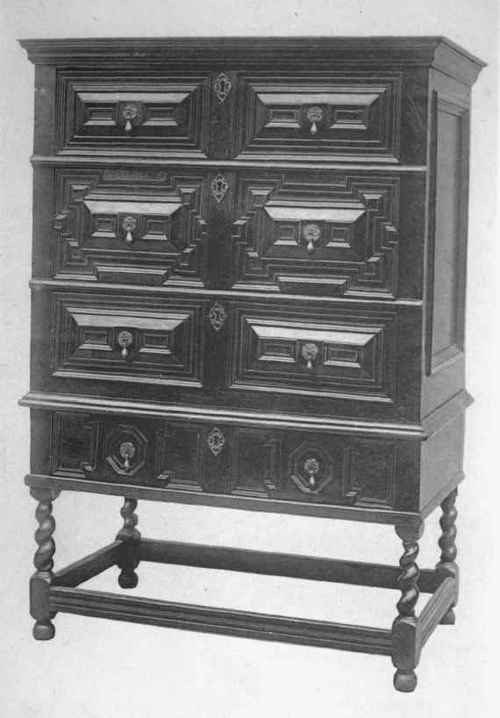
Plate LXIII. Chest Of Drawers, Oak Late 17th Century
LXIII. Chest of Drawers, oak. Late seventeenth century. V. & A. M.
Dimensions: Height 52½, Length 38, Depth from front to back 22 inches.
These in their turn will serve as the last link between the early single chest of drawers and the final and monumental development of the double chest of drawers, or 'tall-boy,' of the mahogany period.
If proof were needed of the difficulty of dating furniture of the kind described, it might be found in two examples, drawn to scale by Mr. J. W. Hurrell, in his useful book of Measured Drawings of Old Oak English Furniture. The first is a chest with one tier of two drawers beneath it, in the possession of Mr. James Broster, of Leek. It has geometrically disposed applied mouldings on its panels, and turned half-pendants ' applied to its stiles. Upon it is the name of Ann Lightfoot, and the date of 1702. The second, belonging to Mr. Hurrell himself, is also a chest with one tier of two drawers beneath. This has no applied half-pendants on its stiles, but is fitted with heavily raised and splayed drawer fronts. The chest part proper has a rail carved with a pattern which might belong to the early seventeenth century. Its three panels are carved also, and bordered by that familiar rhomboidal pattern of light and dark woods inlaid, which is found on many chests of much earlier date than that which is inlaid on the stiles of this one, namely, 1700. An ogee in the panel mouldings also indicates a period later than the carving would suggest.
These two instances, if we may rely on them, would show that chests with one tier of drawers had by no means been ousted from use in favour of fully developed chests of drawers, even at a time when tall specimens of the latter upon raised frames were being made without a vestige of incised work or 'turned half-pendants 'upon them.
In the second half of the seventeenth century must be placed the oaken specimen (Plate lxiv.) communicated by Messrs. Waring, a chest with one drawer. The upper part has a central panel with very similarly disposed mouldings to those on the bottom of Mr. Crowther-Beynon's chest, or on the deep drawer of No. 70 in the Victoria and Albert Museum. It has a heavy raised and splayed panel on its ends - an infallible sign that it is not to be classed with early seventeenth century oak - and it rests on a frame with X-cross stretchers curved, and legs turned, in a manner to suggest a still later period. We are reminded of certain architecturally designed chests of the sixteenth century, such as an unique one of 1556 in the church of St. Mary Overie, Southwark, by the pediments with finials at the end, which appear upon the two smaller panels of the front. But this chest is far less elaborate, and, moreover, henceforth we shall find a broken pediment constantly recurring upon the tops of bureaus, cabinets, and clocks.

Plate LXIV. Oak Chest, 17th Century, On Stand Of Late 17th Century
LXIV. Chest, oak. Seventeenth century, on stand of late seventeenth century. Messrs. Waring.
The frame is perhaps of later date than the upper part, but no great difference exists between them.
Continue to:


My Books

